Melanie Georgacopoulos reinvents pearl layering with sculptural onyx links
Pearls go architectural in Melanie Georgacopoulos’s Eclipse, where onyx links and a movable clasp turn a classic strand into a precise layering tool.
The pearl, rebuilt as a chain
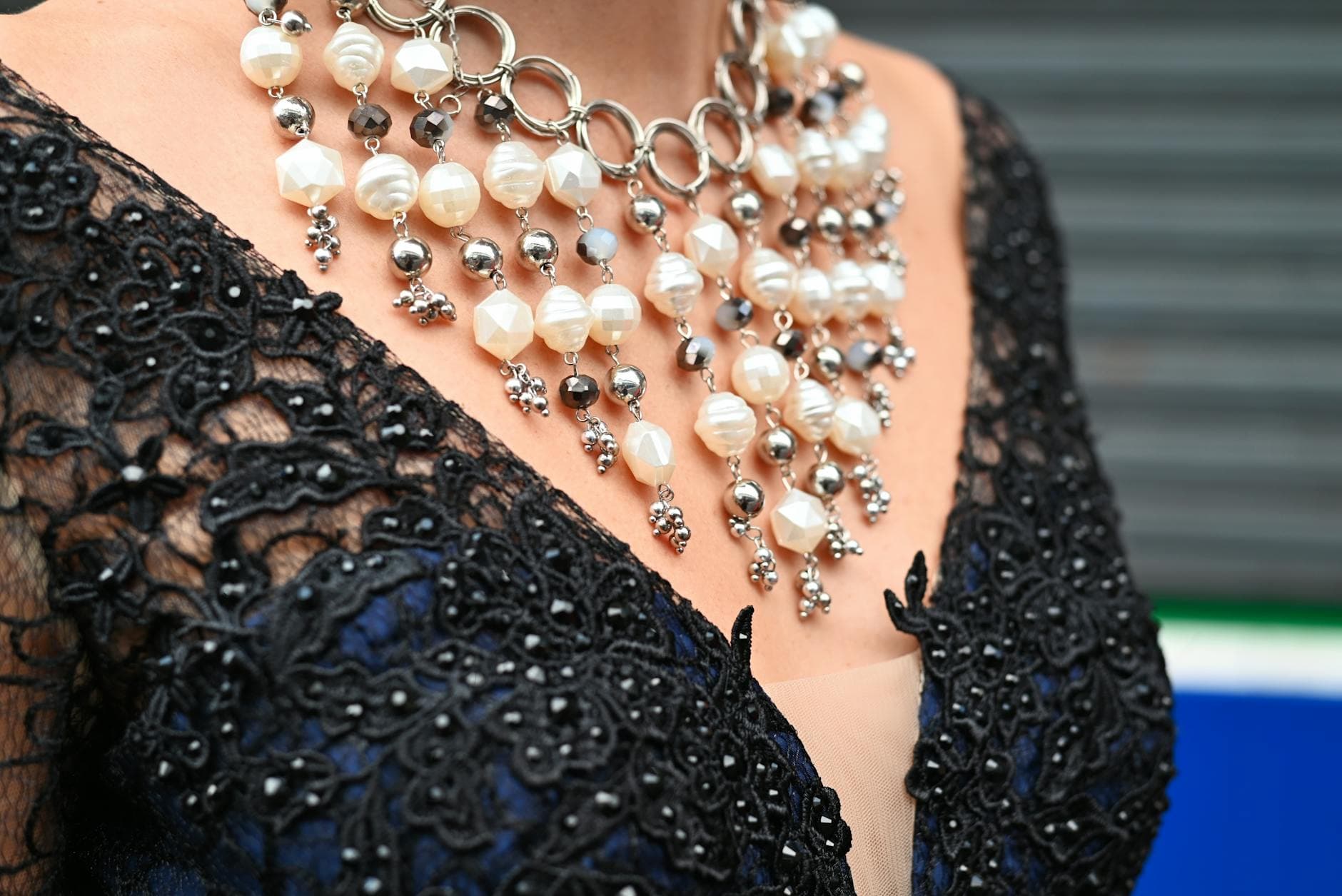
The Eclipse necklace makes the oldest pearl idea feel newly drawn in pencil. Melanie Georgacopoulos threads white 3.5 to 4 mm freshwater pearls through custom-cut onyx links, then finishes the piece with a bespoke 18 ct yellow-gold clasp set with 2.89 carats of diamonds. The result is not a sentimental strand but a graphic necklace with structure, contrast, and enough engineering to shift the way you think about layering.
That engineering matters. The necklace can be fastened in multiple ways, which means it can sit close to the neck as a statement collar or relax into a longer, more fluid line. In practical terms, that kind of adjustability is what separates a decorative pearl piece from a real styling tool. It lets the necklace move between day and night, between a single bold focus and a layered composition, without losing its shape.
Why the black-and-white contrast works
Georgacopoulos has built her Eclipse collection around black and white, and the tension between the two materials is what gives the necklace its power. The pearls bring softness and glow; the onyx cuts that softness into a harder silhouette. She has said that black and white are "very strong together and work so well as opposites," and that is exactly what the necklace demonstrates on the body: light against dark, curve against edge, lustre against line.
This is also why the piece feels so current. The contrast is not decorative for its own sake. It reads as a clean visual language, one that mirrors a broader appetite for jewelry that looks intentional from across a room and still rewards close inspection. The black-and-white pairing gives the necklace a boundary-setting clarity, which is part of what makes it feel less like classic pearl jewelry and more like wearable sculpture.
How to layer a sculptural pearl necklace
The double-row structure already gives Eclipse a built-in sense of depth, so the smartest layering is disciplined, not crowded. Think of it as the anchor piece in a small composition rather than one strand among many. If you add another necklace, it should either extend the line or calm it, never fight it.
A few rules make the mix work:
- Keep the second necklace visually simpler than Eclipse.
- Choose a cleaner chain profile if you want contrast, or a flatter silhouette if you want the pearl row to remain dominant.
- Leave room around the neckline so the onyx links read as architecture, not texture overload.
- Let the clasp show when possible, because the gold-and-diamond closure is part of the design language, not just a functional detail.
The best pairings are pieces that understand restraint. A slim gold chain will underscore the warmth of the yellow gold clasp. A minimal collar can frame the necklace without competing with the double row. What does not work as well is a busy cluster of textured chains, which can flatten the contrast and make the pearls feel ornamental rather than structural.
When to let it stand alone
There are moments when Eclipse should carry the whole look by itself. If the neckline is already busy, if the outfit has strong seaming, or if the clothes are made in a fabric with a lot of visual weight, the necklace has enough presence to stand on its own. Over a clean shirt, a sharply cut jacket, or a simple dress with space at the collar, it can become the only jewelry you need.
That is where the detachable clasp becomes especially useful. A necklace that can shift length does not just adapt to the body, it adapts to the outfit. Wear it shorter when you want the onyx links and pearls to sit like a compact jewel collar. Wear it longer when you want the rows to breathe and the diamonds in the clasp to become part of the visual line. The same piece can solve two very different styling problems.
The designer behind the form
Georgacopoulos’s approach makes sense once you know her background. She began exploring pearls during her master’s degree at the Royal College of Art in 2007 and established her eponymous label in 2010. Her work is described as sculpture-informed, and that description is not marketing fluff here. Eclipse treats pearls and mother-of-pearl as materials with volume, line, and surface tension, not as nostalgic tokens.
That is why the necklace feels more architectural than decorative. The pearls are small, at 3.5 to 4 mm, but the design gives them scale. The onyx links sharpen them. The yellow gold and diamonds elevate them. Even the collection’s wider use of chain language and contrast-driven forms suggests a larger point: this is jewelry meant to be worn as structure, not just sparkle.
At $26,640, Eclipse sits firmly in the realm of collectible design jewelry. The price reflects not only precious materials, but also the labor of rethinking a pearl necklace as a chain with multiple wearing positions. In a market crowded with safe pearl strands, that matters. Georgacopoulos has made a case for pearls that can hold their own against sharp tailoring, mixed materials, and the modern desire for jewelry that looks as considered as the clothes around it.
Eclipse proves that the most persuasive pearl jewelry now behaves like architecture: precise, adaptable, and sharp enough to stand against the noise.
This article was produced by Prism’s automated news system from verified source data, official records, and press releases, then run through automated quality and moderation checks before publishing. The system is built and supervised by the people who set the standards it runs under. Read our full AI policy.
Did this article answer your question?