Tennis Necklaces Anchor Layered Looks With Timeless Diamond Brilliance
A tennis necklace can do more than sparkle alone. It gives layered jewelry a polished center, balancing chains, chokers, and pendants with clean diamond light.
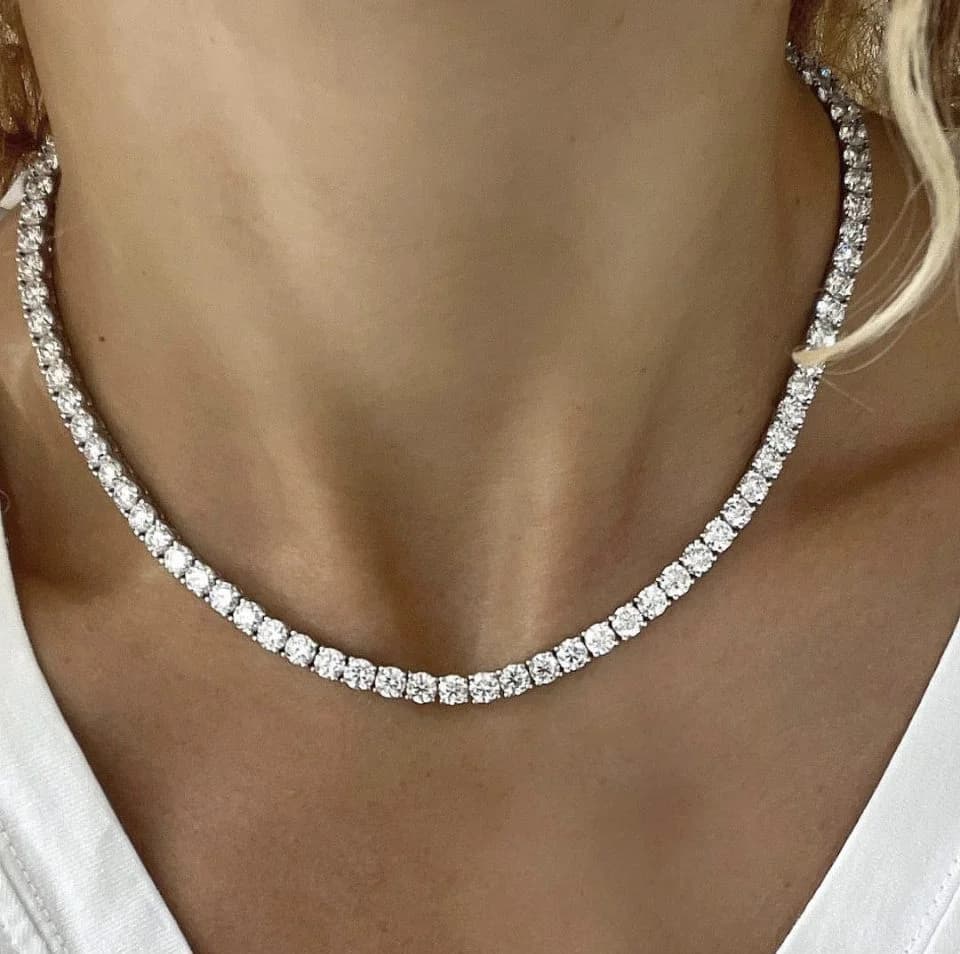
The tennis necklace as the center of a stack
A tennis necklace is one of the few fine-jewelry pieces that can feel fully self-contained and still play beautifully with others. Its uninterrupted line of diamonds gives it a graphic clarity, so when it becomes the base of a layered look, the entire stack reads cleaner, sharper, and more intentional. That is why the silhouette has moved from classic solo wear into the center of a modern layering formula.
The smartest way to think about it is as the hero piece. A tennis or rivière necklace delivers the brightest, most continuous line of brilliance, while the supporting layers around it add texture, contrast, and movement. That balance keeps a stack from looking busy. Instead of competing for attention, the surrounding chains frame the diamonds and let the necklace do the visual heavy lifting.
Why the silhouette still feels current
Part of the tennis necklace’s appeal is that it carries both history and ease. The style traces back to early diamond-line designs made possible by 14th-century cutting advances, which helped turn diamonds into a more fluid, luminous surface when set in a continuous line. That technical lineage still shows in the piece today: the look is refined, precise, and surprisingly versatile.
The name itself adds to the charm. “Tennis” comes from the sports-origin story that made the tennis bracelet famous, when Chris Evert’s diamond bracelet famously broke during a U.S. Open match and briefly stopped play. Sources differ on whether that moment happened in 1978 or 1987, but the cultural effect is the same: the word tennis became shorthand for a style that feels athletic and luxurious at once. The necklace inherits that same energy, which is why it can move easily from eveningwear into everyday layering.
How to build around it
When a tennis necklace is the foundation, the best supporting pieces should feel like careful edits rather than decoration for decoration’s sake. Natural Diamonds describes layered necklaces as a matter of balance, proportion, and a touch of creativity, and that is the right lens here. The diamonds already provide structure, so the pieces around them should introduce contrast without overwhelming the line.
A delicate chain is the most natural companion if you want the look to stay refined. It softens the diamond intensity and creates negative space, which helps the tennis necklace remain the focal point. A chunkier link chain can also work, but only if it adds a deliberate counterpoint in texture and weight. That kind of pairing works best when the rest of the outfit is simple, because the jewelry itself becomes the styling statement.
Where chokers fit in
Chokers can be particularly effective with a tennis necklace because they create a second visual horizon above the diamonds. A close-fitting choker, especially one with a clean silhouette, can make the tennis necklace feel longer and more sculptural. The result is less about piling on pieces and more about creating a layered frame around the neck.
The key is to keep the choker distinct enough from the tennis necklace that the two do not blur into one another. If both pieces are highly reflective and similarly scaled, the stack can lose definition. A simpler choker, or one with a different finish or texture, keeps the eye moving and preserves the crispness that makes the tennis necklace so effective in the first place.
When a pendant belongs, and when it does not
A pendant can work with a tennis necklace, but only when it serves the composition rather than interrupting it. Because the tennis necklace already carries a strong, continuous visual line, a pendant should introduce a point of emphasis without breaking the rhythm of the diamonds below it. Small or medium pendants tend to be the safest choice, especially when they are suspended from a slender chain that does not compete with the diamond line.
The best pendant-and-tennis pairings feel editorial, not crowded. If the pendant is too large, too ornate, or too low-slung, it can pull attention away from the necklace’s clean brilliance. The stronger approach is to let the pendant behave like punctuation, not a second headline.
Two layers or three
This is where restraint matters most. Two layers are usually enough when the tennis necklace is substantial, because its continuous diamond surface already gives the stack presence. Add a delicate chain or a simple choker, and the result feels polished without turning the neckline into a display case.
Three layers make sense when each piece has a clearly different job. The tennis necklace can anchor the center, a fine chain can create air, and a choker or pendant can add a distinct note above or below. If any one piece starts to look like an afterthought, stop at two. A strong stack always looks edited, and the tennis necklace is at its best when it sets the hierarchy.
Why the look feels bigger than one trend
The rise of tennis jewelry as a mainstay has given this necklace a wider cultural footing. Coverage around tenniscore points to a broader appetite for layered, high-low diamond styling, especially as celebrities and current women’s tennis stars make jewelry feel more visible and more wearable in active, public settings. That shift matters because it moves the tennis necklace out of a purely formal context and into a wardrobe language built on repetition, ease, and polish.
In that sense, the tennis necklace is more than a beautiful object. It is a styling tool that turns a formal jewel into the most adaptable piece in the jewelry box. It anchors a stack with enough brilliance to stand alone, yet enough restraint to make every surrounding layer look more considered. That is the quiet power of the silhouette: it makes layered fine jewelry feel less like accumulation and more like composition.
This article was produced by Prism’s automated news system from verified source data, official records, and press releases, then run through automated quality and moderation checks before publishing. The system is built and supervised by the people who set the standards it runs under. Read our full AI policy.
Did this article answer your question?