Ancient and Archaeological Jewelry Captivates Collectors Seeking Provenance, Rarity, and Storytelling
Ancient intaglios and Roman and Greek artifacts are drawing record collector interest, with buyers drawn to verified provenance and the stories carved, literally, into stone.
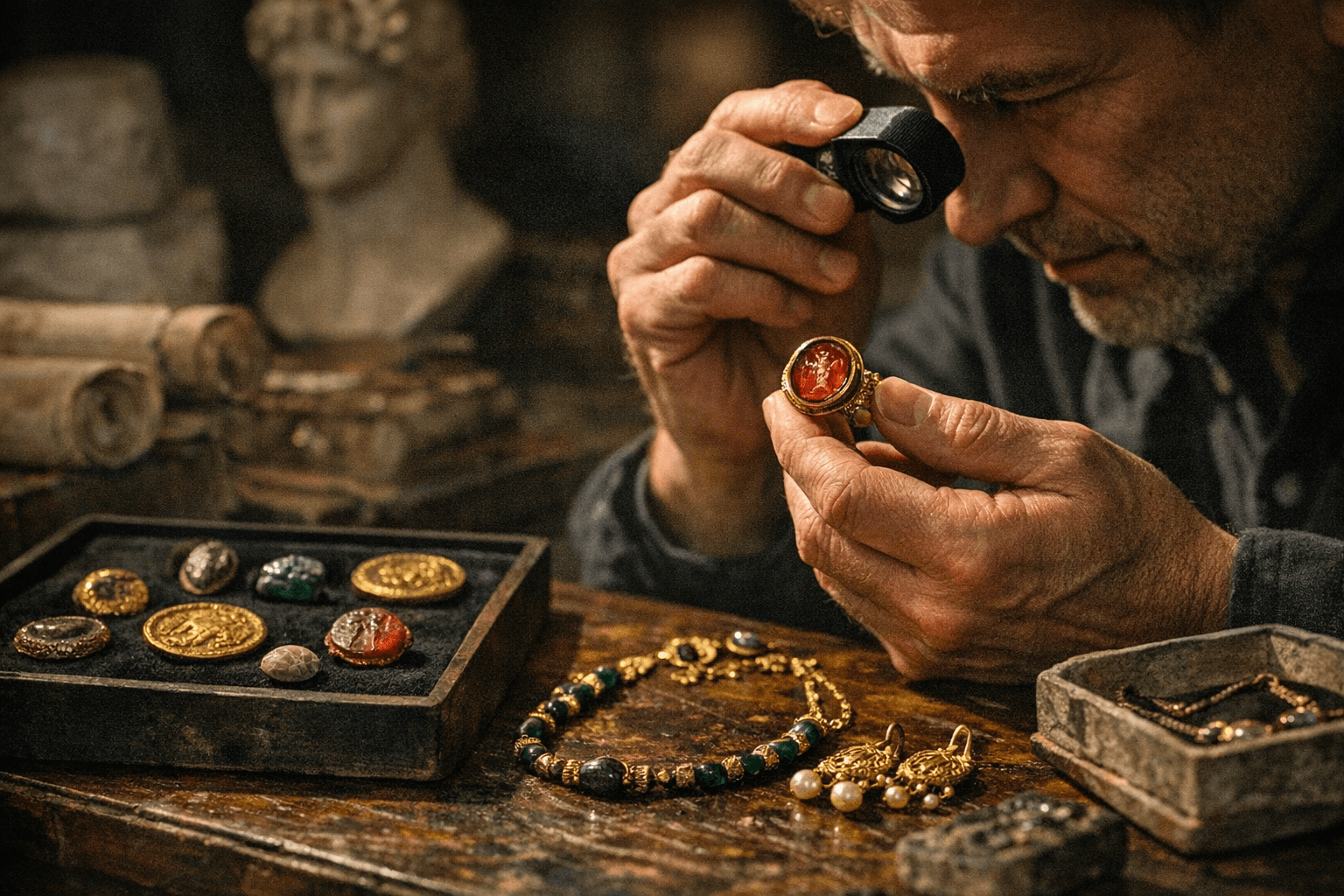
There is something deeply disorienting, in the best possible way, about slipping a 2,000-year-old Roman carnelian ring onto your finger. The stone is warm. The image cut into its face, perhaps a charging bull or a portrait of Mercury, was made by hands that held a stylus before Rome fell. That sensation, part museum encounter and part intimate inheritance, is exactly what is driving one of the most compelling shifts in fine jewelry collecting right now: a surging demand for ancient and archaeological pieces that can be worn, not only displayed.
What Is an Intaglio, and Why Does It Matter Now
An intaglio is among the oldest forms of gemstone artistry on earth. The technique involves incising or engraving an image into a hard material, whether carnelian, agate, amethyst, garnet, jasper, or even glass, so that the design sits below the surface rather than projecting above it, as a cameo does. The practice likely originated in Mesopotamia and Assyria before spreading to Ancient Greece and Egypt by the 8th to 7th century BC. By the height of the Roman Empire, prominent individuals had their own unique intaglios carved in amethyst, agate, garnet, jasper, and other stones, and these served not only as personal seals pressed into wax but as portable declarations of identity, power, and protection.
Worn with the carved face against the skin, the stone presents a smooth, unmarked surface to the world. Turned outward, it reveals a miniature world: a god, an animal, a mythological scene. That duality, public and private, aesthetic and symbolic, is part of what makes intaglios so resonant for contemporary collectors.
The Market Moment
Roman intaglio carnelian rings and gemstone intaglio necklaces are surging in popularity in 2026, prized for their ability to tell timeless stories through stone. Auction houses are meeting that demand with increasingly focused offerings. A Christie's Antiquities auction in New York featured a collection of nearly 60 engraved gems mounted in gold rings, with estimates ranging from approximately $700 to $30,000, with the majority falling in the $4,000 to $6,000 range. The selection included intaglios and cameos rediscovered from some of the most important collectors of such gems, who had amassed them from the 16th to the early 20th centuries, giving many pieces well-documented provenance chains.
Individual lots tell their own layered stories. A Roman green calcite intaglio of a Gryllus, an abstract combination creature considered to have apotropaic properties, mounted in a modern ring of over 20 karat gold, recently appeared at auction with a traceable provenance running through a private London collection and an Oxfordshire collection dating to the 1980s. Antiques Trade Gazette identifies provenance as one of the most important considerations in this sector, noting a long history of looting from archaeological sites that makes documented ownership histories not merely desirable but ethically essential.
Animal Talismans and the Language of Ancient Motifs
The animals carved into ancient gems were never decorative choices. They were arguments about the world. Soldiers wore rings depicting Mars, believing his presence would grant them strength in battle, while merchants and traders wore rings engraved with Hermes or Mercury to ensure safe journeys and successful trade. Snakes were symbols of eternal life and protection, associated in Rome with healing and rebirth. One particularly noted piece at Fellows Auctioneers features a Roman ring with an agate intaglio depicting a charging bull attacking a rearing lion, with a Capricorn between them: a compact cosmology of power, aggression, and celestial authority carved into a surface smaller than a thumbnail.
For modern wearers, these motifs carry layered appeal. They function simultaneously as art objects, as talismans in the original sense, and as conversation pieces with genuine archaeological weight. Modern consumers are drawn to pieces that carry meaning, mythology, or spiritual symbolism, and in the digital age, where many experiences feel intangible, objects that are physical, meaningful, and emotionally resonant occupy an increasingly coveted space.
Designers Bridging Ancient and Contemporary
Some of the most compelling work in this space is happening at the intersection of archaeological artifact and contemporary jeweler's bench. Rebecca Rau, a New York City-based jewelry designer, was reviewing an auction catalog when a bronze amulet from the ancient Central Asian region of Bactria stopped her. Shaped like a four-spoke wheel and covered in a soft green patina, the piece dated to between 1,200 and 800 B.C. "It was like an orphaned artifact whispering to me, 'Don't leave me behind,'" Rau said. Such items are often overlooked by collectors because they are too small to stand alone as decorative objects.
Rau envisioned a different future for it. She set the amulet with pink spinels, sapphires, a red rubellite, and a baroque South Sea pearl, then hung it from a Victorian-era 14-karat gold lariat chain. The resulting Criss-Cross Necklace anchors her Then & Now collection, which features one-of-a-kind pieces incorporating objects spanning from 1,200 B.C. to 1880. "I'm compiling layers of different periods and stories, hoping that they add up to something that feels both approachable and interesting for someone today," she said. That layering, across millennia rather than seasons, is precisely what separates this category from any other corner of the jewelry market.
Provenance as Both Ethics and Desire
The appetite for ancient jewelry is genuinely exciting. It is also genuinely complicated. An artifact was withdrawn from a Christie's auction after an archaeologist raised concerns about its provenance, highlighting the importance of robust research processes. Christie's stated that it dedicates "considerable resources" to investigating provenance before any sale. For collectors, this means that the paper trail behind a piece is not bureaucratic tedium but part of its meaning. A documented chain of ownership, ideally running back decades through reputable collections or museums, is the difference between a piece that enriches culture and one that, however inadvertently, harms it.
When evaluating any ancient piece, the documentation to request includes:
- Prior collection history, ideally pre-1970 (the UNESCO Convention benchmark for cultural property)
- Export and import records where applicable
- Any published references in scholarly catalogs or auction records
- Authentication by a specialist with documented expertise in the relevant period and region
An increasing number of jewelry designers have been incorporating ancient artifacts into contemporary designs, producing the kind of distinctive creations that resonate with buyers who want their jewelry to carry genuine history rather than a manufactured patina of it. The difference is always in the documentation.
What Makes a Piece Worth Pursuing
Provenance is one of the most important considerations when trading in antiquities, given the long history of looting from archaeological sites. But beyond ethics, rarity is real. No two ancient intaglios are identical. The hand that carved a second-century carnelian could not have imagined it circling an auction room in 2026, yet here we are. Sotheby's notes that intaglios can be worn with the concave carving facing the wearer or turned over to reveal an engraved image floating below a smooth surface, making each stone a private experience as much as a public one.
The Christie's sale of Hellenistic gold jewelry, including a pair of Attic gold earrings dated to 750 to 725 B.C. estimated between $10,000 and $15,000, demonstrates that museum-quality pieces do circulate into private hands, and that serious collecting in this category requires both connoisseurship and patience. The J. Paul Getty Museum's recent acquisition of a Hellenistic gold box-bezel ring, described as "one of the finest and best-preserved surviving examples of this ancient jewellery type," is a reminder of how high the ceiling goes when condition, rarity, and provenance align.
What unites every serious ancient jewelry collector is the same instinct Rebecca Rau felt standing over that bronze amulet: the recognition that some objects have already survived more than we can imagine, and that caring for them, wearing them, and tracing their full story forward is its own form of cultural stewardship.
This article was produced by Prism’s automated news system from verified source data, official records, and press releases, then run through automated quality and moderation checks before publishing. The system is built and supervised by the people who set the standards it runs under. Read our full AI policy.
Did this article answer your question?