Auction for rare Tom Thumb wedding locket tied to pop-culture history
A brass Tom Thumb wedding locket sold for £100, but its real value lies in how it turned celebrity, photography and matrimony into portable souvenir jewelry.
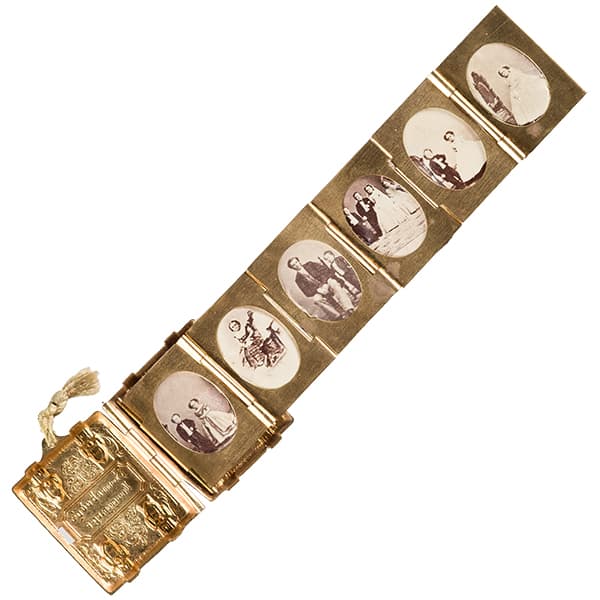
A brass locket shaped like a suitcase, engraved “Somebody’s Luggage,” carried 12 miniature albumen photographs inside six accordion-hinged frames, and sold for £100. The price was modest; the cultural payload was not.
The piece commemorated the 1863 marriage of General Tom Thumb and Lavinia Warren, two of the most famous performers in America’s Barnum-made spectacle economy. Charles Sherwood Stratton, born in Bridgeport, Connecticut, in 1838, became General Tom Thumb after P.T. Barnum discovered him at age four and built him into an international celebrity. Mercy Lavinia Warren Bump, born in 1841, was another Barnum attraction, and their wedding on February 10, 1863, at Grace Episcopal Church in New York City was followed by a reception at the Metropolitan Hotel.
That ceremony became more than a society event. It was an early model for celebrity merchandising, with Barnum selling souvenirs of the occasion, including this locket, individual daguerreotypes and a pamphlet about the couple’s lives, courtship and wedding. The locket was produced in the United States as a commercial souvenir, and the Metropolitan Museum of Art classifies a related example as both an album and jewelry, a useful reminder that sentimental jewelry has long lived at the edge of object and image. The Victoria and Albert Museum dates its version to the same marriage and describes it as a photographic locket, making the format feel less like a novelty than a Victorian prototype for fan culture.

The photographs inside the locket sharpen that argument. They include Lavinia Warren’s sister, Minnie Warren, who served as bridesmaid, and George Washington Morrison Nutt, known as Commodore Nutt, who appears as best man. One museum record notes that because the couple had no children, a baby was borrowed for the photographs. That detail is exactly what gives the object its charge: it is not simply commemorative, but staged, a tiny manufactured world in brass and silvered paper meant to preserve a public fantasy.
The wedding itself was front-page news for days, later said to have eclipsed Civil War coverage, and Harper’s Weekly ran a full-page engraving of the marriage. The newlyweds were later received at the White House by President Abraham Lincoln, sealing their place in the era’s celebrity hierarchy. Against that backdrop, the locket feels less like ephemera than a compressed chapter of American fame culture, when jewelry, photography and publicity were already learning how to feed one another.
This article was produced by Prism’s automated news system from verified source data, official records, and press releases, then run through automated quality and moderation checks before publishing. The system is built and supervised by the people who set the standards it runs under. Read our full AI policy.
Did this article answer your question?