Boucheron’s Human Being collection celebrates individuality through one shape
Boucheron’s Human Being turns one cluster silhouette into five distinct gemstone moods. The collection shows how material alone can shift emotion, from dewy Rain to the carved intimacy of Tattoo.
Boucheron’s Human Being is built on a simple, rigorous idea: keep the shape, change the stone, and let individuality emerge from the difference. The maison dedicates its 2026 Carte Blanche high-jewelry collection to “what is most precious of all: the human being,” then proves the point by repeating one and the same form across five jewelry sets. It is a lesson in symbolic design, where meaning comes not from a new outline every time, but from how diamonds, quartz, morganite, and smoky quartz alter the emotional temperature of the same cluster.
One silhouette, five readings
Carte Blanche gives Boucheron’s design studio complete creative freedom, and Human Being uses that freedom with unusual discipline. Claire Choisne and her team did not scatter the collection across unrelated motifs; they returned to a single cluster silhouette and tested what happened when it was translated through different savoir-faire. Boucheron describes the result as a way to celebrate “being rather than seeming,” and the phrase fits the construction: each piece looks related at a glance, but the closer you look, the more its volume, its light, and its gemstone identity begin to separate.
That is what makes the collection feel precise rather than abstract. In high jewelry, repetition can sometimes read as branding. Here it reads as an argument, with each material version insisting that sameness on the outside can still hold a distinct inner life.
Rain and Flower: softness built by hand
Rain is the most labor-intensive kind of delicacy. Boucheron set more than 4,800 diamonds by hand inside hollow rock-crystal droplets, then layered them with plant-based resin, a construction that turns the surface into something between moisture and light. The set took 1,550 hours of work, and those hours show in the effect: Rain does not feel heavy despite the diamond count, because the crystal and resin keep the form visually suspended, like a droplet caught before it falls.
Flower shifts the same silhouette into something more tactile and painterly. Instead of hard sparkle or sheer transparency, Boucheron used individually painted rose quartz stones, which gives the set a warmer, more artisanal pulse. The 3,290 hours behind Flower matter because the emotional read depends on precision at the surface level: the painting softens the gemstone’s natural blush, and the repeated cluster shape starts to feel botanical rather than abstract. Where Rain suggests condensation, Flower suggests petal density, a different kind of fragility held together by exacting handwork.
Light and Tattoo: luminosity versus imprint
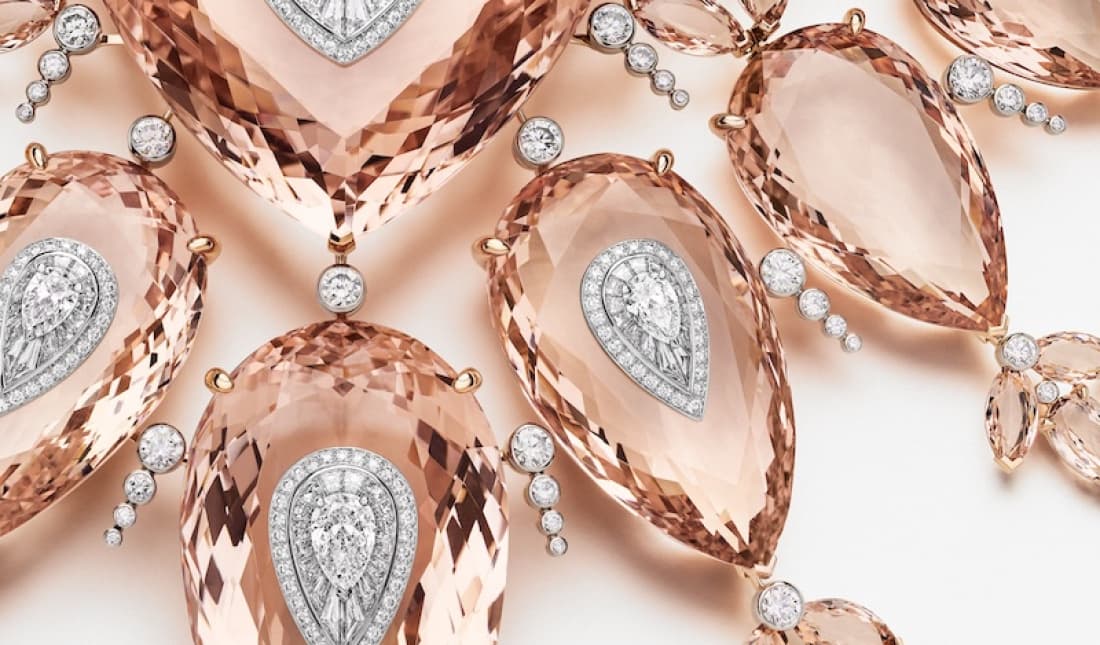
Light is the brightest assertion in the suite, and its scale is part of the message. Boucheron set more than 1,500 carats of morganite into the design, then spent 3,750 hours bringing the set to completion. Morganite, with its pale pink glow, changes the silhouette into something more atmospheric than structural, so the same cluster form reads less like a solid mass and more like a field of radiance. It is the closest the collection comes to turning the body into light itself, but without losing the architecture of high jewelry.
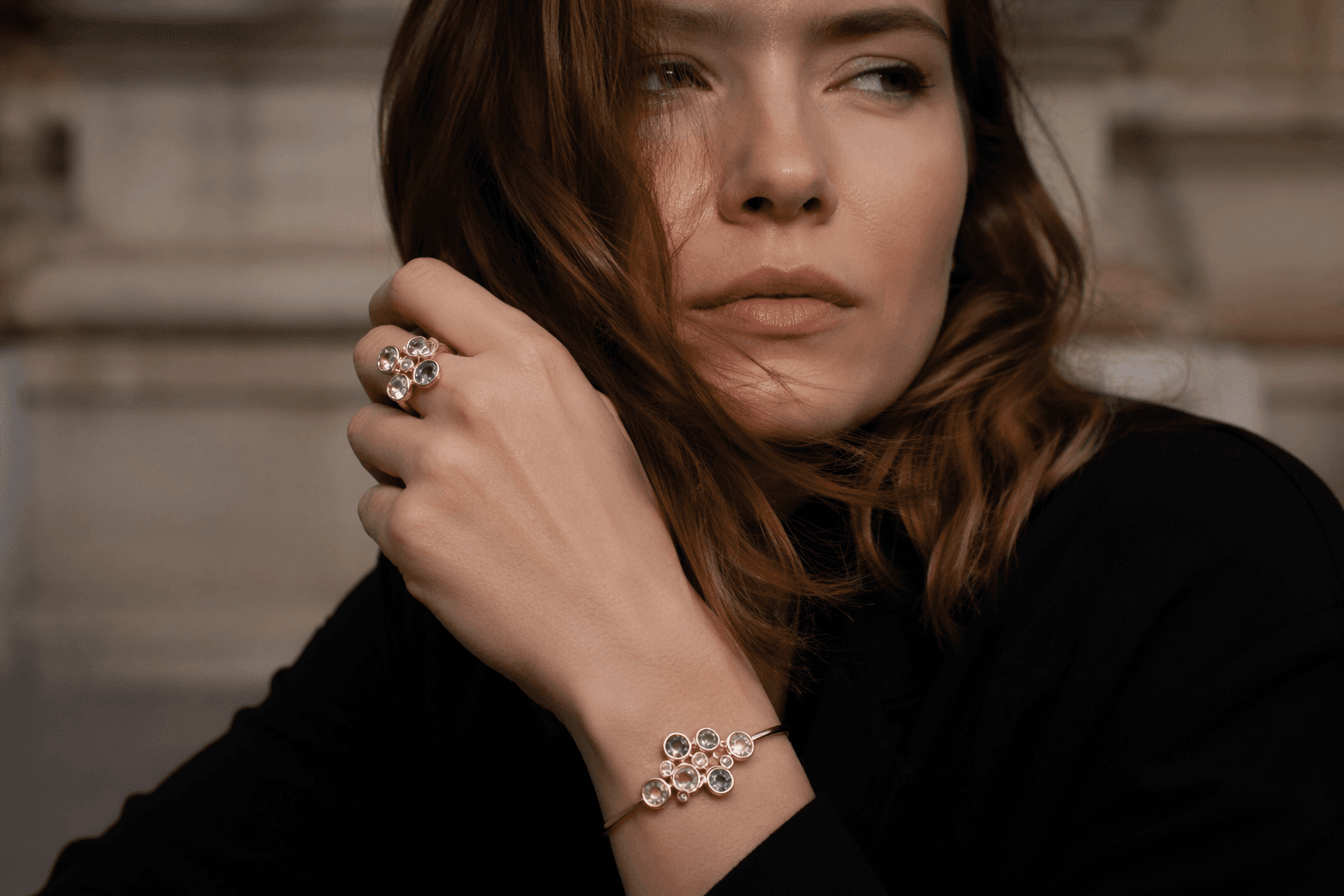
Tattoo pushes in the opposite direction. Instead of placing decoration on top of the stone, Boucheron carved glyptics on the reverse side of smoky quartz, a method that makes the image feel embedded, private, and slightly shadowed. One artisan reportedly invented more than 200 tools to achieve the symmetry required for the set, which gives the result an almost obsessive exactness. Tattoo is the most intimate of the five because the design lives behind the surface; the viewer sees the work through the stone, as though memory and mark-making have been trapped inside the same object.
Checkers and the grammar of contrast
Checkers completes the five-set structure and keeps the collection from collapsing into a single gemstone story. Even without the same craft details Boucheron provides for Rain, Flower, Light, and Tattoo, the name itself extends the collection’s logic: pattern, repetition, and contrast become part of the emotional system. If the other sets test how water, bloom, glow, and engraving change a shared silhouette, Checkers underscores the graphic side of the experiment, where order and variation can coexist in one object.
That matters because Human Being is not really about five different shapes. It is about one shape learning to carry five different forms of attention. The house is not asking whether individuality can be styled into jewelry. It is showing that individuality can be built into the very method of making.
Carte Blanche as Boucheron’s annual laboratory
Human Being also sits inside a now-familiar annual rhythm for Boucheron. The 2025 Carte Blanche collection was Impermanence, inspired by ikebana and wabi-sabi, and it included 28 high-jewelry creations. The 2024 chapter, Or Bleu, focused on water and the waters of Iceland, with 26 creations. In 2023, More is More made a high-jewelry case for joy, including Tie the Knot in diamonds and white gold, a piece that weighed only 94 grams and helped frame pleasure as something the conservative high-jewelry world could still take seriously.
Seen together, these chapters show a maison using Carte Blanche as more than a seasonal showcase. Each year Boucheron picks a concept, then tests how far high jewelry can stretch without losing its discipline. Human Being is the sharpest version of that habit yet, because it uses the most classical luxury language of all, precious stones, painstaking setting, and exacting craft, to make a point about identity that feels immediate rather than abstract.
This article was produced by Prism’s automated news system from verified source data, official records, and press releases, then run through automated quality and moderation checks before publishing. The system is built and supervised by the people who set the standards it runs under. Read our full AI policy.
Did this article answer your question?