Claddagh ring, Ireland’s enduring symbol of love and loyalty
The Claddagh ring turns love, loyalty and friendship into a visible code, from its heart-crown-hand motif to the way it is worn.
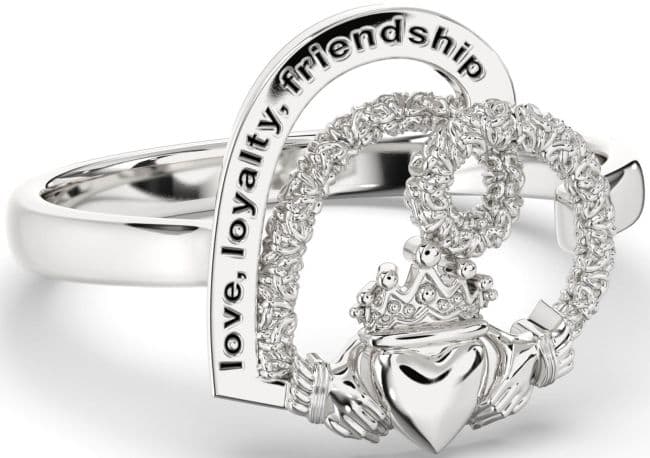
The Claddagh ring works because it can be read in a second. Two hands frame a heart, a crown sits above it, and the whole design turns jewelry into a message about love, loyalty and friendship rather than just decoration. In the modern tradition, the same ring can also signal relationship status, which is why it remains one of the clearest examples of meaning you can wear.
How to read the Claddagh
The Claddagh’s language is built into its shape. Encyclopaedia Britannica identifies it as a traditional Irish ring with three motifs, a heart, a crown and two hands, each carrying a fixed meaning: love, loyalty and friendship. That symbolic triangle is what gives the ring its force, because the design does not rely on trend, scale or embellishment to make its point.
The arrangement matters as much as the symbols themselves. The hands appear to hold the heart in place, while the crown crowns it, a compact visual grammar that makes the ring legible even from a distance. For gift-givers, that clarity is part of the appeal: the ring does not merely suggest affection, it states it.
Galway, Richard Joyce and the ring’s early life
The strongest historical anchor for the Claddagh sits in Galway. Galway City Museum says the oldest known Claddagh ring dates to around c. 1700, and that the ring was made by Richard Joyce, a Galway goldsmith from one of the fourteen merchant tribes of Galway. The museum credits Joyce with the modern design of the ring, tying the object to a named maker rather than a vague folk origin.
The museum also places the Claddagh in a longer design history, describing it as a Galway variation of a ring type once popular in medieval Europe. That detail matters because it shows the Claddagh did not appear in isolation. It evolved from older European ring forms and then settled into a distinctly Galway identity, which helped make it both local and portable.
Wake Forest University’s Fashioning Faith project pushes the story into religious and material-culture territory. It dates a Claddagh ring object to the 1700s and tags it with Catholicism, Ireland, Richard Joyce and Thomas Dillon, which places the ring inside lived faith, daily dress and heritage, not just romantic folklore. That range of tags is part of the Claddagh’s durability: it carries emotion, but it also carries place and belief.
How to wear it so the message is legible
The Claddagh’s second language is orientation. A widely used modern code reads the ring and the direction of the heart to communicate relationship status, giving the wearer a way to say something without speaking. The system is simple enough to remember and specific enough to be useful.
- Right hand, heart facing outward: single
- Right hand, heart facing inward: in a relationship
- Left hand, heart facing outward: engaged
- Left hand, heart facing inward: married
That code turns the ring into a social signal as much as a decorative object. If you are choosing one as a gift, the placement tradition gives the ring a built-in message, but it also asks for care, because the same motif can mean different things depending on the hand and the direction of the heart. For anyone wearing it, the point of the crown, the frame of the hands and the angle of the heart should all read clearly, because the symbolism depends on that visibility.
Where the tradition is kept alive
A visit to Galway still puts the Claddagh in a physical setting, not just a museum label. In early 2020, Galway City Museum acquired what it thought was the oldest Claddagh ring known in existence, and the institution’s collection now gives the design a documented home. That acquisition matters because it grounds a ring often repeated in jewelry boxes and gift shops in an actual historic object with a date, a maker and a place.
The ring’s retail and museum life overlap in Thomas Dillon’s Claddagh Ring store in Galway, which Visit Galway describes as “the smallest museum in Europe with the biggest gift shop.” The shop is said to house some of the very first Claddagh rings made by goldsmiths Nicholas Burge, Richard Joyce and George Robinson from 1700 to 1800. That makes the place useful for more than souvenir buying: it is one of the few settings where the Claddagh can be seen as both commerce and archive.
For meaningful jewelry, that combination is rare. The Claddagh does not need reinterpretation to stay relevant, because its emblem is direct, its wearing code is readable, and its Galway history is tied to named makers and surviving objects. A good symbolic jewel does more than decorate the hand, and this one still tells the truth at a glance.
This article was produced by Prism’s automated news system from verified source data, official records, and press releases, then run through automated quality and moderation checks before publishing. The system is built and supervised by the people who set the standards it runs under. Read our full AI policy.
Did this article answer your question?