Detectorist finds rare 17th-century memorial ring for Westminster headmaster Richard Busby
A skull-motif Busby memorial ring found near Preston sold for £3,200, linking a Lancashire detectorist’s hobby find to Westminster’s most famous headmaster.

Noonans sold a late-17th-century gold memorial ring for Dr Richard Busby for £3,200, placing a Lancashire detectorist’s find among about 20 known Busby rings with the skull motif. The piece, with traces of black enamel and floral engraving on the outside, is the kind of memento mori jewel that turns grief into a wearable object.
Amanda Parker found the ring in a field at Catforth, near Preston, Lancashire, in August 2024 after her daughter and partner, both experienced detectorists, introduced her to the pastime. The inside inscription, recorded by the Portable Antiquities Scheme as “Ri Busby STP ob 5 Ap 95 aet 89,” identifies the memorial and points to 1695 as the year it was made, shortly after Busby died on 5 April 1695 at the age of 88 or 89.
Busby, who was born in 1606 and died in 1695, served as headmaster of Westminster School for 55 years. Westminster Abbey says he is buried beneath the pavement of the Choir, where he also presented the black-and-white marble pavement in 1677. Westminster School calls him its greatest headmaster, and its history traces back to a charity school established by Benedictine monks of Westminster Abbey. His pupils included John Dryden, Christopher Wren and Robert Hooke, a roster that explains why even a small gold ring still reads as a document of English cultural history.
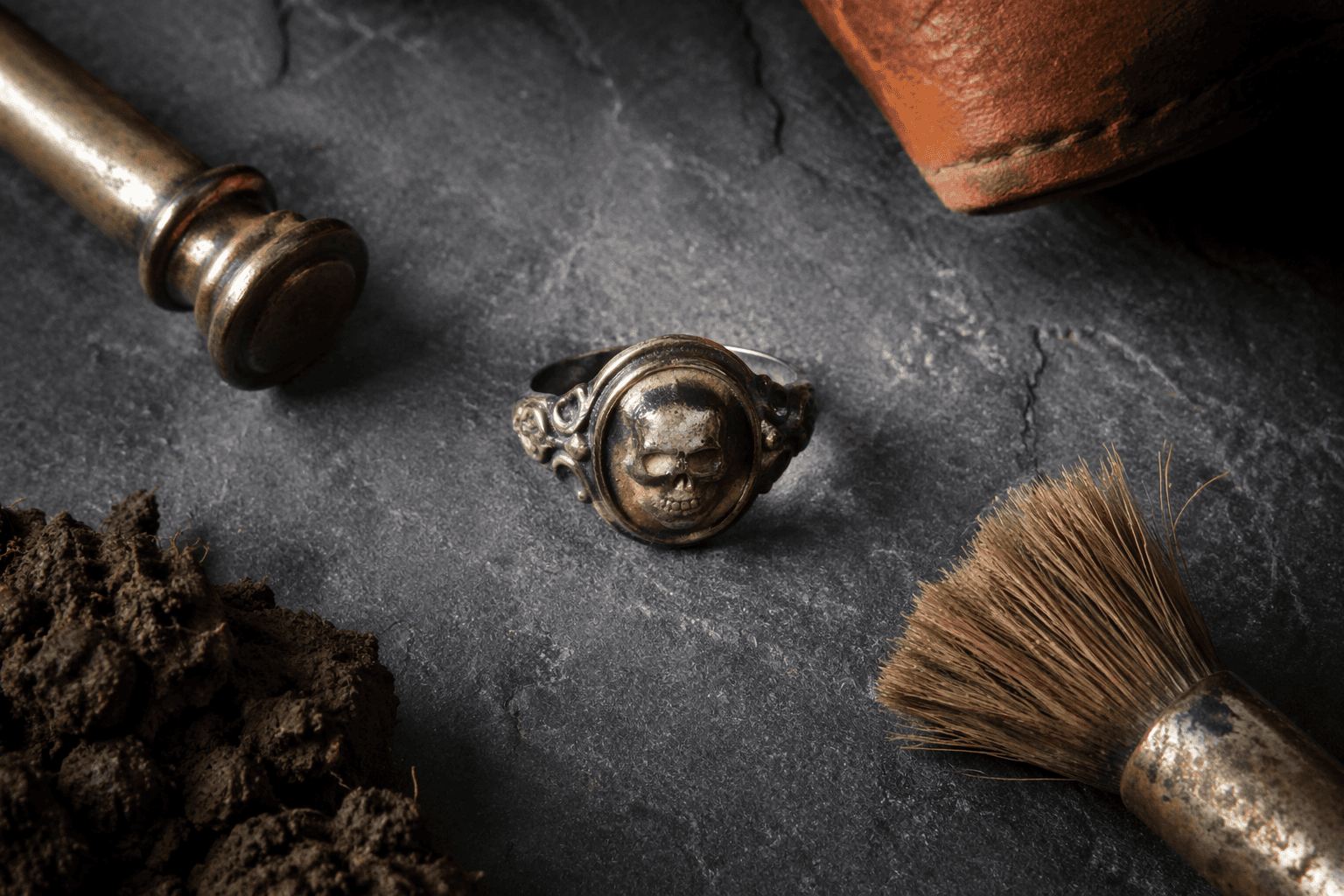
The ring was previewed by Noonans Mayfair in its 23 June 2026 Jewellery, Silver & Objects of Vertu sale with an estimate of £2,000 to £3,000. The lot sat among 14 metal-detectorist finds in the same auction, underscoring how British detecting regularly feeds the market for historically specific jewels that are first declared, then catalogued, and eventually offered to collectors.
What makes the Busby ring compelling is not just rarity, but legibility. The skull motif, black enamel and memorial inscription speak the visual language of remembrance without needing a label, which is why memento mori pieces still feel so current alongside today’s signet rings, engraved talismans and heirloom jewels meant to carry a life story.
This article was produced by Prism’s automated news system from verified source data, official records, and press releases, then run through automated quality and moderation checks before publishing. The system is built and supervised by the people who set the standards it runs under. Read our full AI policy.
Did this article answer your question?