Europe’s crown jewels reveal monarchy, identity and history
Europe’s crown jewels are more than spectacle. Their crowns, colored stones and ceremonial settings still shape how meaning looks in modern jewelry.
The crown jewel as a design language
Europe’s crown jewels endure because they do more than glitter. They translate monarchy, national identity and political history into a visual code built from crowns, crosses, colored stones, enamel and formal settings, a language that still shows up in meaningful jewelry today. What makes these objects compelling is not only their rarity, but the fact that they were made to be seen in public, understood instantly and remembered long after the ceremony ended.
That is why crown jewels continue to matter to jewelry lovers. They are not simply old treasures in vitrines. They are the original template for symbolic adornment, where a jewel can signal office, continuity, inheritance and state power in a single glance.
Britain’s regalia set the benchmark for ceremonial jewelry
The British Crown Jewels remain the most complete collection of royal regalia in the world, held in trust by the monarch for the nation and part of the Royal Collection. Historic Royal Palaces describes the set as more than 100 objects with over 23,000 gemstones, a scale that makes the collection feel less like a handful of trophies and more like an entire visual system for monarchy. Royal Collection Trust places the history of the set at almost a thousand years, with most of the major pieces made for Charles II’s coronation in 1661.
Two crowns define the collection’s ceremonial logic. St Edward’s Crown is used only to crown a new monarch during the coronation ceremony, while the Imperial State Crown is worn at state occasions. The distinction matters: one is reserved for the moment of transformation, the other for the ongoing performance of rule. After the coronation of King Charles III and Queen Camilla on 6 May 2023, the regalia returned to public display in the Treasury of the Jewel House at the Tower of London, restoring one of Britain’s most closely watched symbols of state to daily view.
For modern jewelry, Britain’s crown jewels explain why certain forms keep returning. The high, architectural silhouette of a crown, the hierarchy of a central stone, the insistence on symmetry and the use of rich materials all speak to permanence. These are not decorative accidents. They are design choices made to hold authority.
France turns survival into meaning
The French Crown Jewels take a different path through history. The Louvre now houses them in the Galerie d’Apollon, alongside the museum’s royal collection of hardstone vessels, giving the jewels a setting that reads as both art history and state memory. The most resonant object in that set is the Côte de Bretagne spinel, which the Louvre describes as the oldest surviving gem in the collection and links to Anne of Brittany.
That single stone tells the French story in miniature. It is not just valuable because it is old. It matters because it survived political change, royal upheaval and the long reshaping of France’s public collections. In a field that often treats size as the only measure of prestige, the French case proves something more subtle: provenance can be as powerful as carat weight.
For contemporary meaningful jewelry, this is where the appeal of a named gem becomes clear. A jewel with a documented past carries emotional depth that cannot be fabricated by scale alone. The Côte de Bretagne spinel shows how one surviving stone can stand in for a vanished court, a lost dynasty and a nation’s changing sense of itself.
Vienna’s imperial crown is a study in authority and materials
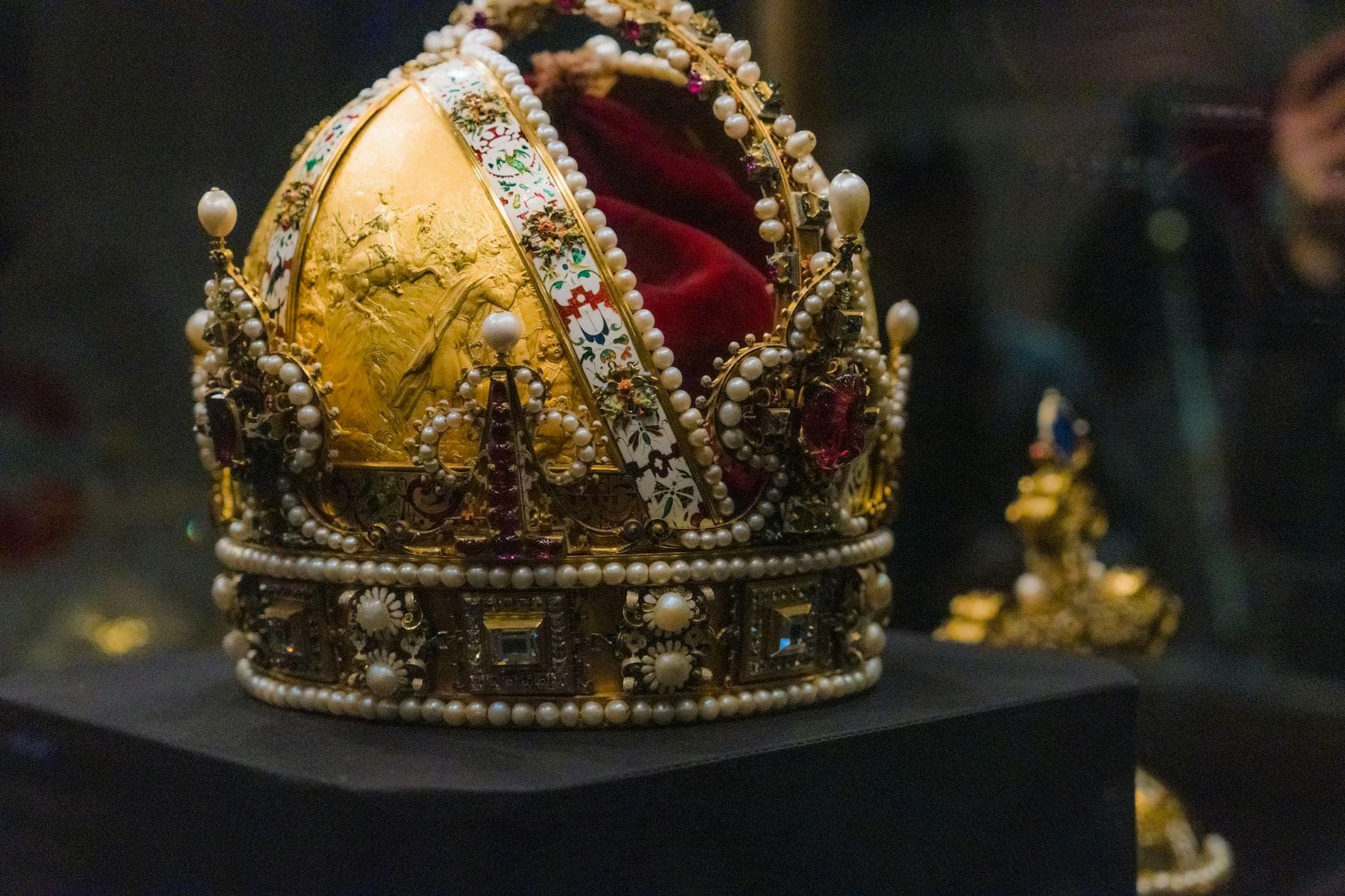
In Vienna, the Austrian Imperial Crown offers a more overt lesson in political symbolism. The Imperial Treasury says the crown was made in 1602 for Rudolf II and constructed from gold, enamel, pearls and precious stones. It served for centuries as the coronation insignia of the kings and emperors of the Holy Roman Empire.
The Treasury also emphasizes that these regalia gained special symbolic power when imperial legitimacy was questioned. That detail is crucial. The crown was never only about ornament. It was a legal and visual claim, a way of making authority visible through material form. Gold gave weight, enamel gave color, pearls softened the severity, and precious stones amplified the sense of dynastic continuity.

This is one reason crown-inspired jewelry still feels potent when it is done well. The best pieces borrow the structure, not just the sparkle. They rely on balanced proportions, a disciplined palette and a sense that every material has a purpose. In the Viennese example, meaning is embedded in construction.
Sweden and Denmark keep regalia alive as state symbols
Sweden’s regalia are described by the Royal Court as the principal symbols of Sweden’s form of government, preserved as royal cultural heritage. They are kept in the Treasury beneath the Royal Palace in Stockholm, where the jewels remain both ceremonial objects and public symbols of constitutional identity. Their value lies in that dual role. They belong to history, but they also help define the present.
Denmark’s system is equally revealing. The Royal Danish Collection says the crown jewels have been placed at the disposal of the sitting queen since the 1700s, a reminder that royal jewelry can function as a living tool of state, not just a museum property. Frederik VIII and Queen Lovisa established the Danish Royal Property Trust in 1910, adding another layer of stewardship to a collection that extends beyond a single tiara or necklace. Rosenborg Castle, where part of the broader royal jewelry collection is associated, reinforces that public-private balance.
Together, Sweden and Denmark show how crown jewels can remain active in modern constitutional life. They are not frozen relics. They are carried forward by institutions that frame them as heritage, authority and memory at once.
What crown jewels teach modern meaningful jewelry
The design lessons are surprisingly specific:
- A crown silhouette still signals authority, even in a pendant or brooch.
- A named stone, like the Côte de Bretagne spinel, gives a jewel narrative weight.
- Gold, enamel, pearls and precious stones create contrast that feels ceremonial rather than casual.
- A piece with a clear institutional or family provenance often carries more emotional value than one with vague storytelling.
- Symbols matter when they are disciplined, not overdone. The strongest regalia balance grandeur with clarity.
That is the real continuity across Europe’s crown jewels. They keep proving that jewelry can be more than adornment: it can be a public language, a political object and a personal emblem all at once. In contemporary collections, the most meaningful pieces still borrow that grammar, turning crowns, colored stones and ceremonial forms into a form of identity that outlasts fashion.
This article was produced by Prism’s automated news system from verified source data, official records, and press releases, then run through automated quality and moderation checks before publishing. The system is built and supervised by the people who set the standards it runs under. Read our full AI policy.
Did this article answer your question?