Five diamond trends defined Las Vegas Jewelry Week 2026
Las Vegas Jewelry Week 2026 pointed to bigger natural diamonds, slimmer settings, and revived shapes that feel more personal and easier to wear.
Las Vegas Jewelry Week 2026 felt less like a spectacle of one-off trophies and more like a working preview of what will actually land in cases next. Across JCK, Luxury, and Couture at The Venetian Expo in Las Vegas, the strongest signal was a market leaning toward sculptural diamonds with clearer silhouettes, while still leaving room for approachable entry points. JCK ran from Friday, May 29, to Monday, June 1, with Luxury opening on Wednesday, May 27, and select areas starting Thursday, May 28. The week’s theme, “In Your Element,” fit a show floor where form, flexibility, and merchandising breadth mattered as much as carat weight.
Minimalist settings made large stones feel even cleaner
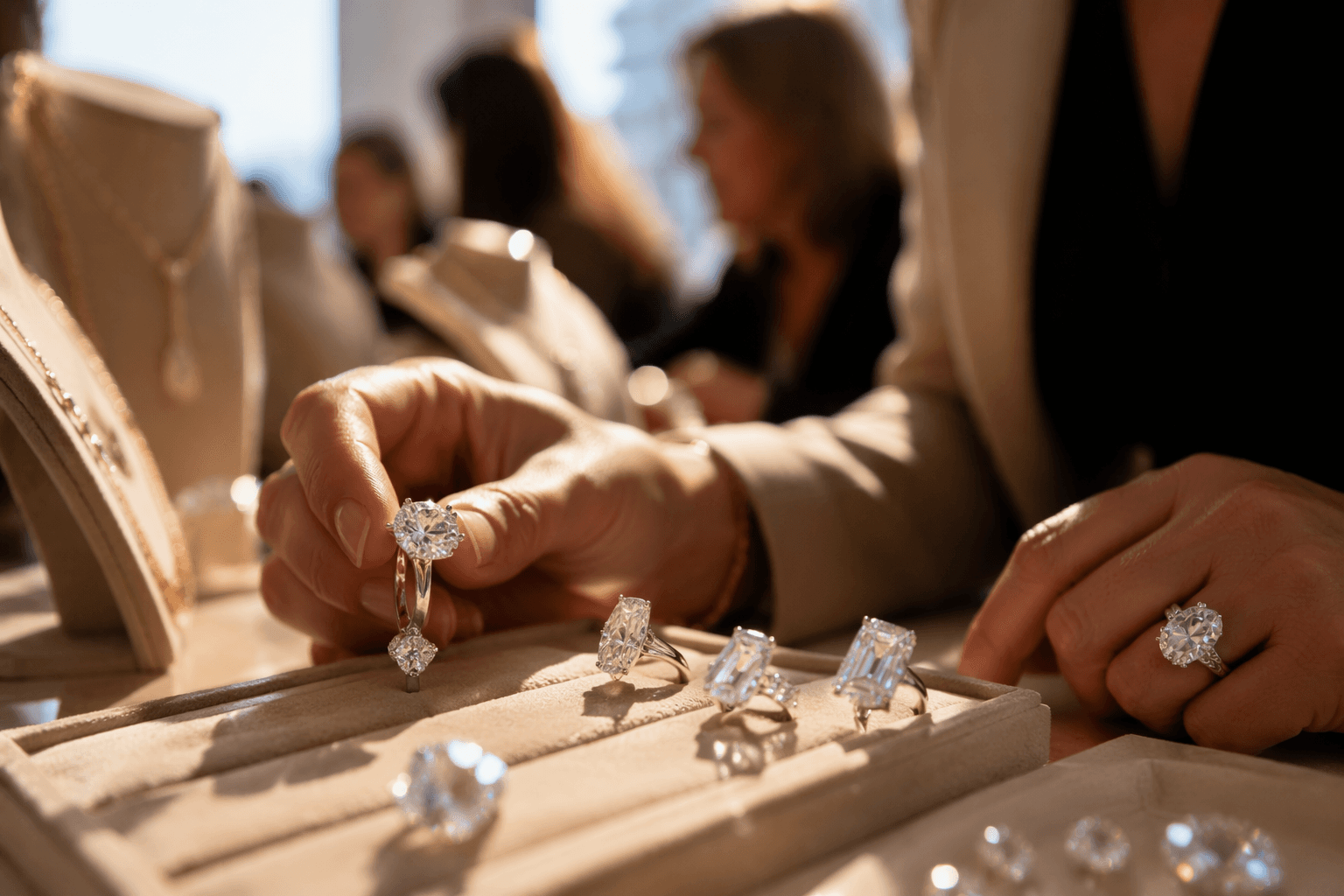
The most immediate shift was the rise of pared-back settings that let a single stone do the visual work. JCK’s roundup pointed to solitaire-style designs with minimal metal, a look that makes larger diamonds appear sharper, brighter, and less crowded by ornament. That is not just an aesthetic choice; it lowers the barrier for shoppers who want a strong diamond look without committing to an elaborate mount, especially when the setting itself stays visually quiet.
What made this trend persuasive on the floor was its commercial logic. A cleaner setting can create a more dramatic presence even at more accessible price points, which is exactly why it matters for buyers watching the market closely. It also dovetails with the industry’s broader appetite for wearable pieces that still read as special, rather than formal or overbuilt.
Gold-and-diamond charms turned into easy entry pieces
Charms emerged as one of the most retail-friendly ways to add diamonds without pushing a full statement jewel. The gold-and-diamond versions JCK highlighted work because they can be layered, collected, and bought incrementally, which makes them a natural add-on for customers who want precious materials without the commitment of a major center stone. In a market that is still sensitive to price, that flexibility is part of the appeal.
The charm story also reflects how jewelry is being merchandised now: smaller, giftable pieces that still carry enough polish to feel elevated. Gold provides the warmth and weight; diamonds supply the sparkle and status cue. Together, they give retailers an easy way to move a customer from an impulse purchase to a more personalized collection over time.
Marquise cuts came back with a familiar, flattering shape
The marquise cut was one of the clearest silhouettes to reassert itself, and it helps that the shape brings instant personality. JCK noted that marquise was a staple of 1980s and 1990s engagement rings, which places the revival squarely inside the larger fashion cycle now bringing back older proportions and sharper profiles. The cut’s elongated outline also flatters the finger, stretching the look of the stone without necessarily demanding the same price leap as a larger round.
That history matters because the marquise is not merely nostalgic; it is recognizable, directional, and easy to spot in a case. Buyers who want something distinct without veering into novelty can read it quickly, and that clarity is valuable in engagement and right-hand jewelry alike. Its return suggests shoppers are looking for shapes with identity, not just size.
Mixed-cut designs gave diamonds a more custom feel
Mixed-cut jewelry was another sign that shoppers want individuality without sacrificing cohesion. JCK’s roundup described pieces combining fancy shapes in a single design, a move that gives jewelry more visual motion than a single-cut arrangement while still feeling intentional. The effect is less formal than a matched suite and more editorial, as if the piece was built around personality rather than symmetry alone.
This is where the trend feels especially relevant to real buying behavior. Mixed cuts can make a diamond look more bespoke, and that sense of customization is increasingly important in a market where buyers want their jewelry to read as theirs, not just as a catalog piece. The style also works well across categories, from earrings to rings, which should help it move beyond the show floor into everyday assortment planning.
Bigger natural diamonds signaled a market split, not just a style shift
The boldest message from the week was that natural diamonds were, in JCK’s words, “bigger and bolder than ever.” That showed up across earrings, rigid gold collars, and mixed fancy shapes, all of which pushed presence over delicacy. It also lined up with Rapaport’s account of brisk trading in 2-carat-and-larger stones, while diamonds under 2 carats saw slower or mixed results, a split that suggests the upper end of the market is behaving very differently from the middle.
That divide matters because it changes how retailers should read demand. Shreyans Dholakia of Shree Ramkrishna Exports called the scarcity in 2-carat-and-up goods “real scarcity,” while Nilesh Chhabria of Finestar Jewellery & Diamonds said the buyers who came were serious and intended to do business. Around the show, the Natural Diamond Council reinforced the category’s narrative at Natural Diamond Club gatherings at Yardbird in The Venetian, where programming centered on natural diamonds, responsibility, provenance, and engagement-ring history. Put together, the week made one thing plain: shoppers are still responding to natural diamonds, but they want them in forms that feel sharper, more specific, and easier to defend at the counter.
This article was produced by Prism’s automated news system from verified source data, official records, and press releases, then run through automated quality and moderation checks before publishing. The system is built and supervised by the people who set the standards it runs under. Read our full AI policy.
Know something we missed? Have a correction or additional information?
Submit a Tip