Hancocks spotlights 1970 Illario bracelet with turquoise, lapis lazuli and gold
A 1970 Illario bracelet in turquoise, lapis and yellow gold distills Hancocks’ Bulgari-era pedigree into a collector piece with unmistakable 1970s swagger.
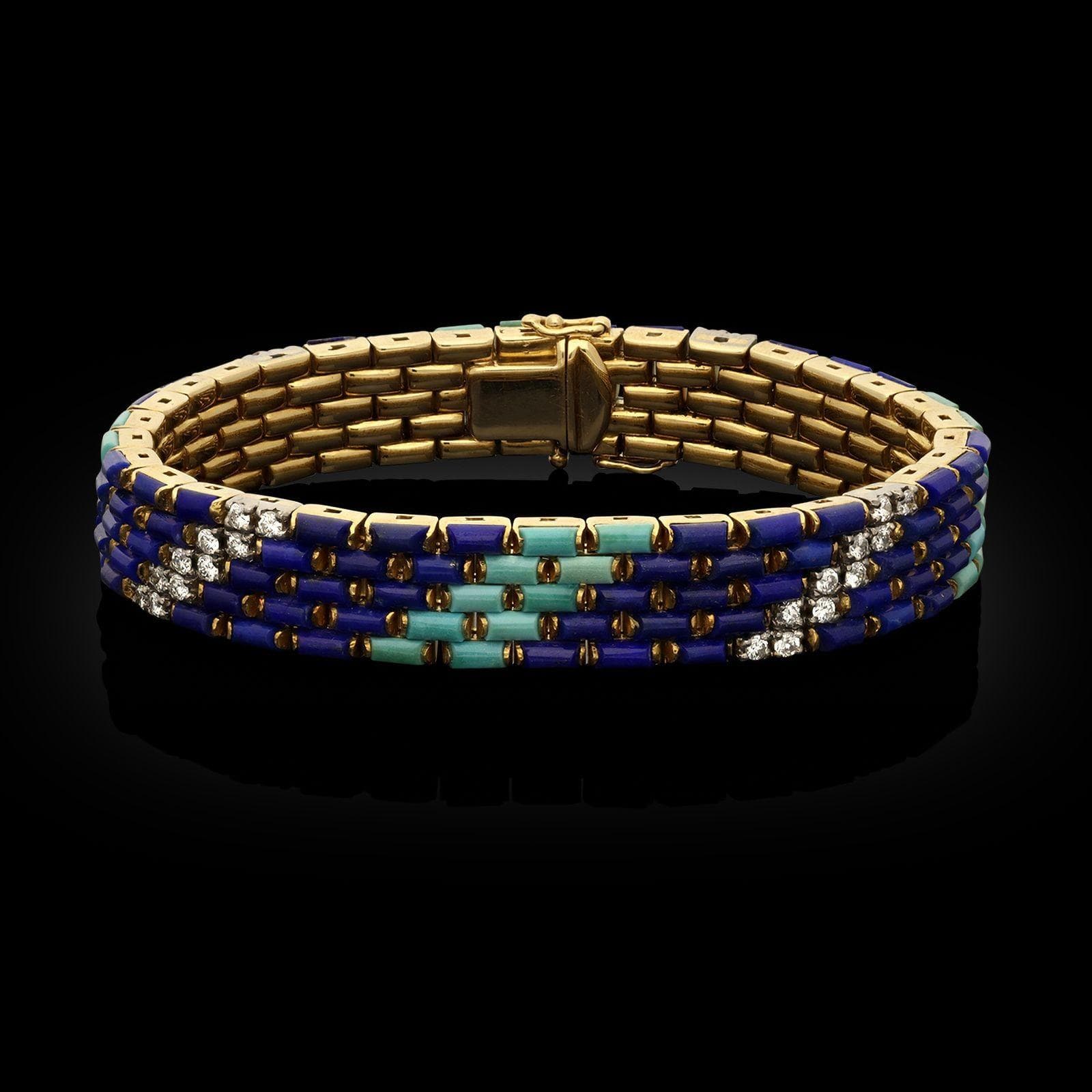
Hancocks has put the spotlight on a bracelet that looks like a fragment of Roman glamour cut into wearable form: a circa 1970 Illario link design in 18ct yellow gold, turquoise, lapis lazuli and diamonds. Priced at £27,500, it is not merely an attractive vintage jewel but a compact lesson in how Italian workshop skill and luxury-house identity converged in the late 20th century.
The bracelet’s architecture does much of the talking. Its articulated brick-link construction runs 18cm in length and 1cm in width, giving the piece a tight, graphic rhythm rather than the airy feel of a more delicate chain. Hancocks lists 40 round brilliant-cut diamonds, estimated at 1.60 carats, alongside 40 carved turquoise stones and 110 carved lapis lazuli stones, all set against the warm sheen of yellow gold. At 58.9 grams, it has the substantial wrist presence collectors expect from serious mid-century Italian work, while the concealed box clasp with safety keeps the design clean from the front.
The provenance is what lifts the bracelet from handsome vintage to collector-grade object. Illario, formally Carlo Illario e F.lli, was founded in 1920 in Valenza by Carlo, Vincenzo and Luigi Illario, in one of Italy’s great goldsmithing centers southwest of Milan. Hancocks says the firm’s partnership with Bulgari ran from the 1950s through the 1970s, a period when the two names were intertwined in the making of some of the era’s most desirable jewels, including Serpenti watch bracelets. Illario also sold under its own name, which makes this bracelet a particularly telling survivor of a moment when workshop authorship and brand identity often overlapped.
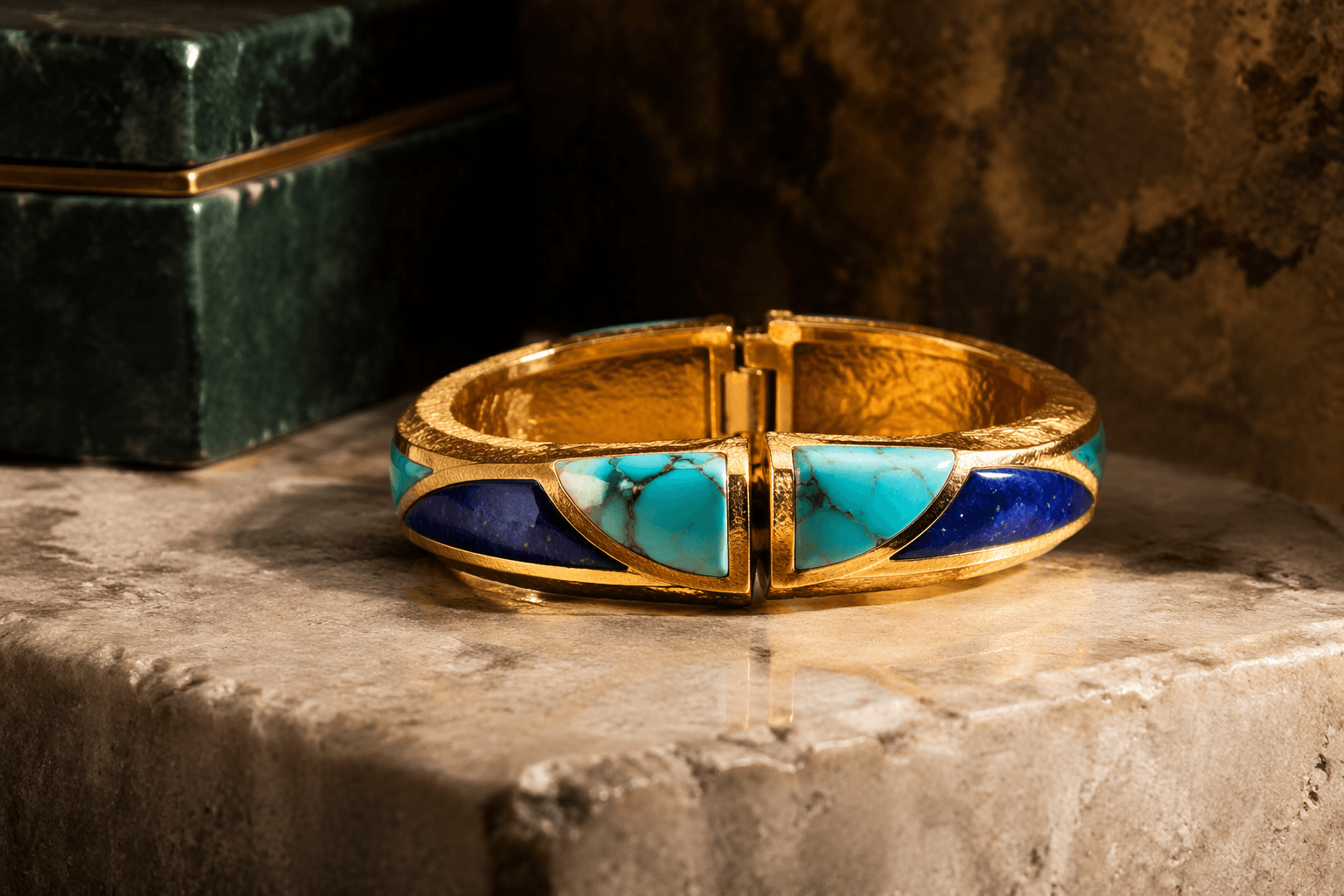
That relationship matters because the bracelet reads like Bulgari’s visual language translated through Illario’s hands. Bulgari’s history traces its foundation to Rome in 1884 by Sotirio Bulgari and identifies the house’s modern style as emerging from the 1940s with yellow gold and vivid color combinations. The first Serpenti bracelet-watch debuted in 1948 with a Tubogas construction, setting a precedent for sculptural gold and bold geometry that still defines the maison. In that context, the turquoise-and-lapis palette on this bracelet feels quintessentially of the period: saturated, architectural and unabashedly opulent.
For Hancocks, founded in London in 1849, the piece also functions as a curatorial statement. Its asking price sits in line with the upper end of vintage Bulgari territory, where comparable gold bracelets can hover around the same level or climb far higher depending on rarity, attribution and condition. What makes this Illario bracelet compelling is not only its materials, but its lineage: a wrist sculpture that carries the design codes of Bulgari’s golden age without needing the Bulgari stamp to prove its importance.
This article was produced by Prism’s automated news system from verified source data, official records, and press releases, then run through automated quality and moderation checks before publishing. The system is built and supervised by the people who set the standards it runs under. Read our full AI policy.
Know something we missed? Have a correction or additional information?
Submit a Tip