Hiker finds rare sixth-century gold sword fitting in southern Norway
A hiker near Riaren found a 6-centimeter gold scabbard fitting that once shimmered on a ceremonial sword, its animal-head motif still legible after 1,500 years.
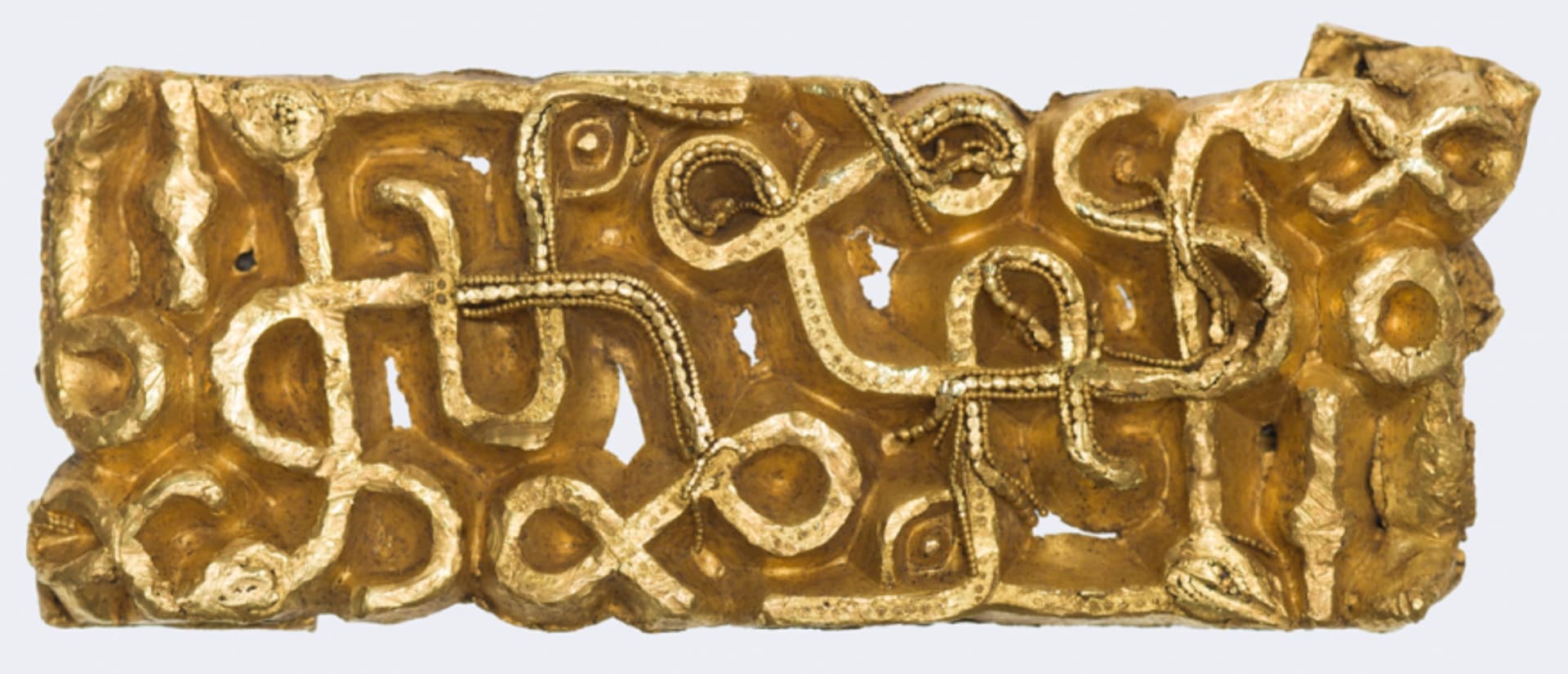
A morning walk in the Austrått district of Sandnes ended with a flash of gold under a storm-felled tree, and what emerged was not a stray trinket but one of the rarest surviving ornaments from Norway’s Migration Period. Near the hill Riaren in southwestern Norway, a local hiker noticed a mound beneath exposed roots and then saw something glittering. The object was a sixth-century gold scabbard fitting, a small but commanding piece of martial jewelry that once hung from a belt with a sword suspended below it.
Researchers at the University of Stavanger date the ornament to the 500s CE and say it measures about 6 centimeters wide and a couple of centimeters high. It was likely attached to a ceremonial sword scabbard belonging to a regional ruler, making it as much a badge of authority as a piece of equipment. The university says it is the first find of its type in Rogaland, and only 17 other comparable examples are known from Northern Europe.

The beauty of the piece lies in its workmanship. Archaeologists describe twisted gold thread and traces of triple-stranded beaded gold wire that would have caught the light and made the fitting shimmer as the sword moved. Siv Kristoffersen said that surviving traces of those gold threads place the ornament among the finest works from the period. The decoration appears to show two animal heads in profile facing each other, though it may also represent a human head with an animal body, a hybrid motif common in this kind of ornamentation. That visual language matters: this was not merely decoration, but storytelling in metal, a compact emblem of power, identity, and belief.
Håkon Reiersen of the University of Stavanger called the discovery “magnificent” and said the odds of finding something like it were minimal. He also said the object strengthens the case that Hove in Sandnes was an important power center in the Migration Period. The area has already yielded a rare gold arm ring with serpent heads, a silver necklace found in the 19th century, and a Roman bronze cauldron discovered in 1907. Excavations at Hove in 2011 and 2012 exposed a large farm complex with two longhouses, one 47 meters long and the other more than 60 meters, evidence of an elite seat that could commission and wear objects of this caliber.
Researchers believe the fitting was probably placed in a rock crevice as a sacrifice to the gods during a time of crisis and poor harvests. That reading fits the broader sixth century in Norway, when volcanic eruptions, climate stress, crop failures, famine, and plague reshaped lives and likely thinned the population. In that context, the ornament feels less like buried treasure than a surviving fragment of a world that used gold, texture, and animal form to turn status into symbol.
This article was produced by Prism’s automated news system from verified source data, official records, and press releases, then run through automated quality and moderation checks before publishing. The system is built and supervised by the people who set the standards it runs under. Read our full AI policy.
Did this article answer your question?