Isabel Delgado’s Sofia ring blends lapis and gold in Córdoba-inspired design
Isabel Delgado’s Sofia ring turns Córdoba’s arches and the Côte d’Azur’s blue-white palette into a heavy, hand-cut study in lapis and 14k gold.
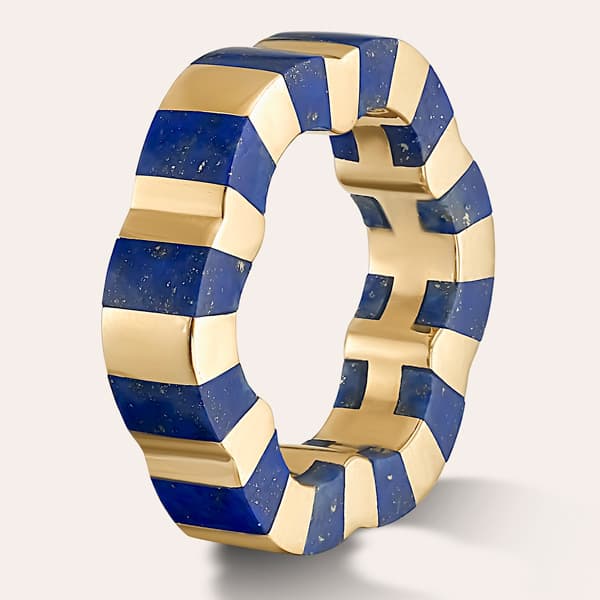
The Sofia ring does something rare in fine jewelry: it turns a place into a silhouette you can wear. In 14k yellow gold and hand-cut lapis lazuli, the $17,500 statement piece translates the arches of Córdoba and the blue-and-white umbrellas of the Côte d’Azur into an object that feels both architectural and intimate. Its force is not just in the color, but in the way Isabel Delgado uses weight, cut, and proportion to make the references read as form.
A ring built from memory and monument
Delgado says the Sofia ring was the first design she developed for the Sofia collection, and that origin matters. Rather than starting with a gemstone and building around it, she began with a mood and a set of pressures: gold prices had been rising, diamonds were fluctuating in demand, and she wanted to explore new materials without leaving gold behind. That mix of necessity and instinct gave the ring its distinctive character, because the piece feels considered from every angle, not merely decorated.
The Córdoba reference gives the design its structural gravity. The Mezquita-Catedral de Córdoba began as a mosque built in 784 to 786 and was later converted into a Christian cathedral in the 13th century, which makes it one of the most layered monuments in European architecture. Delgado’s ring does not copy that history literally; instead, it distills the idea of repetition, rhythm, and arches into a jewel that seems to hold space rather than simply occupy it. The effect is less souvenir than translation.
How lapis changes the language of gold
The lapis is the decisive material choice. Delgado explored lapis, carnelian, and other materials as a practical way to adapt to market conditions while still working in gold, but lapis gave her the clearest emotional register. Its saturated blue naturally recalls the Côte d’Azur’s umbrellas, yet the stone also carries its own deep art history: humans have valued lapis lazuli for more than 6,500 years, and it is the source of ultramarine pigment.

That long lineage gives the ring a surprising seriousness. Blue in jewelry can easily tilt decorative, but lapis has an authority that comes from centuries of use in ornament and painting. Set against warm gold, it reads as a color with depth rather than surface sheen, which is exactly why the ring feels transporting. The palette suggests sea, sky, and shade, but the material itself keeps the piece grounded in craft.
The labor hidden in the surface
What makes the Sofia ring feel substantial is the degree of handwork behind it. Every lapis segment was individually hand-carved and required weeks of cutting and polishing before assembly, and Delgado and her team spent months refining the silhouette, the cutting, and the connections between materials. That kind of attention shows in the final object: the ring’s impact comes not from excess, but from precision.
This is where the piece separates itself from more literal destination-inspired jewelry. Instead of leaning on obvious motifs, Delgado treats the references as design problems to solve. How do you make a stone feel architectural? How do you let blue carry the emotional temperature of a coast without slipping into prettiness? The answer lies in the discipline of the making, especially in the seams between gold and lapis, where the eye can sense the labor even when it cannot name it.
Why the heft matters
Delgado has said she prefers jewelry with weight and heft, and that luxury should be felt on the skin. That conviction is written all over the Sofia ring. The piece is not trying to disappear into minimalism; it is meant to register physically, the way good gold jewelry should. In that sense, the ring aligns with Delgado’s broader commitment to gold, even as prices and tariffs have made the metal more difficult to work at scale.
Her brand, based in Dallas, uses New York City manufacturers, a setup that underscores the hybrid nature of the work: entrepreneurial, geographically dispersed, and deeply material. That infrastructure matters because the Sofia ring depends on execution as much as concept. A ring with this much presence would collapse without exacting production, especially when the surfaces have to hold both the softness of lapis and the authority of gold.
What the Sofia collection signals
The Sofia ring is not the end of the story but the opening statement of the collection. A slimmer gold stacking band without gemstone is already available, and Delgado hopes to eventually introduce a slimmer lapis version. That evolution suggests a smart collection strategy: one version for impact, one for everyday use, and a future iteration that could bring the lapis idea into a more compressed, stackable form.
At the same time, the ring fits neatly into the larger economics of jewelry now. The World Gold Council said 2025 was a record year for gold demand value at US$555 billion, gold prices set 53 all-time highs, and total gold demand exceeded 5,000 tonnes for the first time. Against that backdrop, Delgado’s approach feels especially legible: keep the richness of gold, but let other materials carry part of the visual load. The Sofia ring proves that adaptation does not have to mean compromise. When a jewel is this carefully built, place becomes texture, color becomes memory, and the whole piece lands with the calm force of something that knows exactly where it came from.
This article was produced by Prism’s automated news system from verified source data, official records, and press releases, then run through automated quality and moderation checks before publishing. The system is built and supervised by the people who set the standards it runs under. Read our full AI policy.
Did this article answer your question?