Karan Johar’s Met Gala debut spotlights Indian craft, heirloom jewels and wearable art
Karan Johar's Met Gala debut made Indian craft the centerpiece, with Manish Malhotra's Raja Ravi Varma references and heirloom jewels reading as authorship.
The red carpet became a statement of authorship
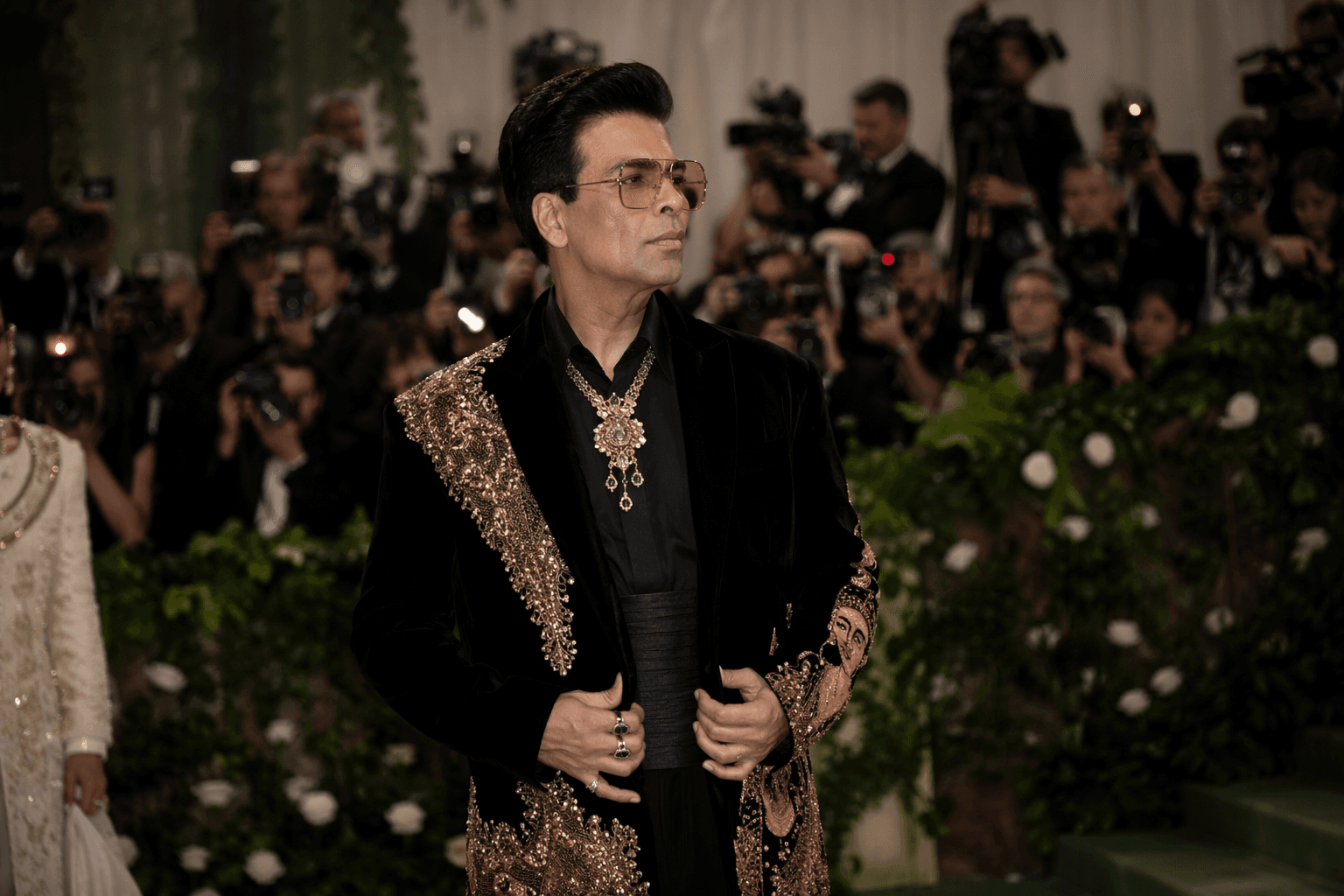
Karan Johar did not arrive at the Met Gala as a guest dressed for spectacle. He arrived as proof that Indian jewelry, craft and dressmaking can carry the intellectual weight of a look, not just the decorative finish.
That distinction mattered on a night built around the Costume Institute’s spring 2026 exhibition, Costume Art, and its dress code, “Fashion is Art.” The Met’s own framing of the show, which pairs garments with artworks to explore the relationship between clothing and the body, gave the evening a clear thesis. Johar’s appearance met it with a very different kind of answer: one rooted in heritage, handwork and the visual language of India.
A debut built from art history and handwork
Johar’s look, created by Manish Malhotra, drew on Raja Ravi Varma and translated that reference into a dramatic black bandhgala and sherwani structure with a cape-like sweep. The garment was not treated as background for jewelry. Instead, the clothes and ornaments worked together as one argument, with vintage zardozi, three-dimensional embroidery and hand-painted gold work giving the surface the feel of a framed object.
That is why the look read as wearable art rather than formalwear. Zardozi has long been one of India’s most precious textile arts, built through dense metal-thread embroidery that can catch light like jewelry itself. Hand-painted detailing pushes that further, collapsing the boundary between painted canvas, ceremonial dress and adornment. On Johar, the effect was not excess for its own sake, but an insistence that Indian craftsmanship can stand at the center of fashion discourse.
Johar’s own words captured that restraint. He said, “I didn’t want to arrive here trying to explain India.” The line lands because the outfit already did the explaining, through technique, iconography and silhouette.
Why the Met Gala frame matters
The annual benefit at The Metropolitan Museum of Art in New York is more than a celebrity red carpet. The Costume Institute says it is the department’s primary source of funding for exhibitions, publications, acquisitions and operations, which is why the first Monday in May matters so much to fashion museums and the industry around them.
This year’s gala, held on Monday, May 4, 2026, opened Costume Art and placed clothing in conversation with art history inside one of the world’s most visible museum stages. For Indian creators, that setting was especially useful. It gave room for the kind of work that is often flattened into “embellishment” to be read instead as cultural scholarship, with textiles, jewelry and surface work functioning like citations.
That is the larger significance of Johar’s debut. Multiple reports have described him as the first Indian filmmaker to attend the Met Gala, which turns a single entrance into a milestone. The moment was not just about who was on the carpet. It was about who got to define the language of the carpet.
The Indian contingent turned craft into the headline
Johar was not alone in that effort. The Indian contingent included the Maharaja of Jaipur, Isha Ambani, Ananya Birla, Diya Mehta Jatia and Sudha Reddy, each contributing to a broader red-carpet picture of heritage, technique and contemporary presentation. Together, they shifted the conversation away from generic luxury and toward provenance, labor and authorship.
That distinction is crucial in jewelry coverage, because the difference between decoration and meaning often lives in the making. Reports around the same night described Indian looks that took more than 1,200 hours and required more than 50 artisans, a reminder that these appearances were engineered by workshops, not assembled by stylists alone. Sudha Reddy’s Manish Malhotra ensemble was reported to have taken 3,459 hours and the work of 90 artisans, a scale that makes the craft impossible to dismiss as surface treatment.
This is where Indian high jewelry and couture gain visibility in a way trend pieces rarely achieve. The story is not simply that the pieces were expensive or intricate. It is that they carried the signatures of studio labor, regional techniques and historical reference into one of fashion’s most photographed spaces.
Heirloom references, not empty heritage language
The strongest Indian looks on the Met carpet did something that luxury branding often fails to do: they made heritage specific. “Heirloom” can become a vague word when brands use it as atmosphere, but here it was anchored in recognizable technique and art historical reference. Raja Ravi Varma’s imagery gave Johar’s look a narrative foundation, while the zardozi and hand-painted gold work made the history visible in the cloth.
That matters for jewelry, too. When a necklace, brooch or ornament is presented as part of a total authored look, it stops being an accessory and becomes evidence of lineage. The result is a more serious kind of glamour, one that asks the viewer to consider who made the piece, what traditions it draws from and how much labor sits beneath the final sparkle.
The online response reflected that shift. The Indian contingent was widely praised for “nailing” the theme, but the more interesting point is why it landed. It did not rely on gimmick or easy nationalism. It read as a set of carefully built works, each one using the Met Gala’s global stage to say that Indian craft is not supplementary to fashion history. It is part of it.
What Johar’s debut changes for jewelry storytelling
For jewelry, the lesson is straightforward. The most compelling luxury now travels with context: named makers, identifiable techniques and a clear relationship to art and identity. Johar’s debut showed how a red carpet can carry that weight without collapsing into costume, and how Indian high jewelry can be understood through the same lens as couture, not separated from it.
That is why this appearance resonates beyond a single night in New York. It placed Indian craft inside the museum logic of the Met Gala, where clothing is already framed as culture, not just commerce. In that frame, jewelry becomes more than brilliance. It becomes authorship, and authorship is what gives a look lasting power long after the flashbulbs fade.
This article was produced by Prism’s automated news system from verified source data, official records, and press releases, then run through automated quality and moderation checks before publishing. The system is built and supervised by the people who set the standards it runs under. Read our full AI policy.
Did this article answer your question?