Kavant & Sharart spotlights trapeze diamonds in sculptural Mingle collection
Kavant & Sharart turns trapeze diamonds into the star of Mingle, proving rare geometry can read more personal than a classic center stone.
Kavant & Sharart has done something smarter than simply revive a forgotten shape. In the Mingle Trapeze collection, the trapeze diamond stops behaving like a supporting character and becomes the point of view, giving the line a sharp, architectural pulse that feels deliberate rather than decorative. That shift matters because it turns a cut once used for balance into the source of tension, motion, and personality.
Why the trapeze cut feels newly relevant
The trapeze, or trapezoid, diamond is not a square or a round trying to look like something else. It is a four-sided shape with two parallel sides of different lengths and two non-parallel sides, which gives it an angled, structural presence that reads almost like a tiny piece of modern architecture. For years, it has been used mainly as a side stone in three-stone rings and side-stone settings, where its job was to frame a center gem rather than compete with it.
That is exactly why the cut now feels so interesting. Trade coverage has been spotting trapeze-cut diamonds again in bespoke rings and auction jewels, where their rarity and graphic outline fit the current appetite for sculptural, geometry-led jewelry. The shape also carries a quiet historical echo: jewelry sources trace its broader geometric roots to the early 20th century, when symmetrical, architectural design came into fashion, which helps explain why it can feel both retro and fresh at once.
How Kavant & Sharart makes geometry the hero
Kavant & Sharart’s Mingle Trapeze collection does not hide the cut inside a conventional formula. Instead, it uses trapeze diamonds as the visual engine of the design, making geometry, structure, and movement the collection’s central idea. That is a meaningful choice in a market where many diamond jewels still default to the same round brilliant or solitaire language.
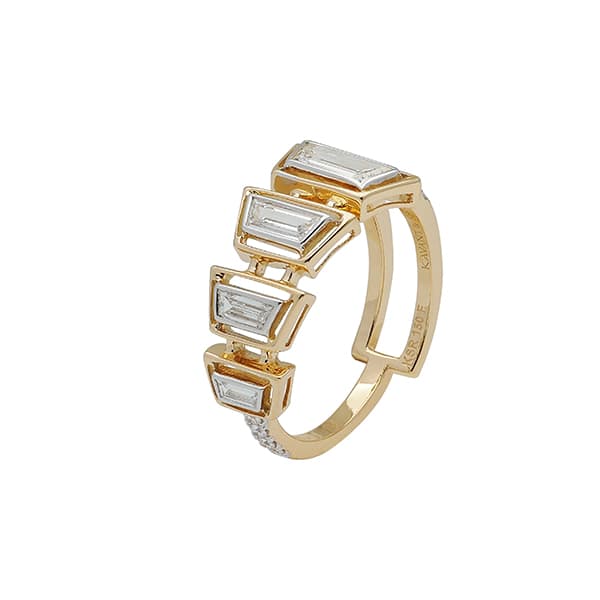
The clearest example is the Mingle Trapeze Step ring, which is made in 18k yellow gold with 0.68 ct. t.w. diamonds and priced at $9,880. That price places it firmly in fine-jewelry territory, where the value is not only in the diamond weight but in the way the gold, scale, and proportion are orchestrated. The ring reads less like a standard engagement silhouette and more like a composed object, one that asks the eye to follow its angles.
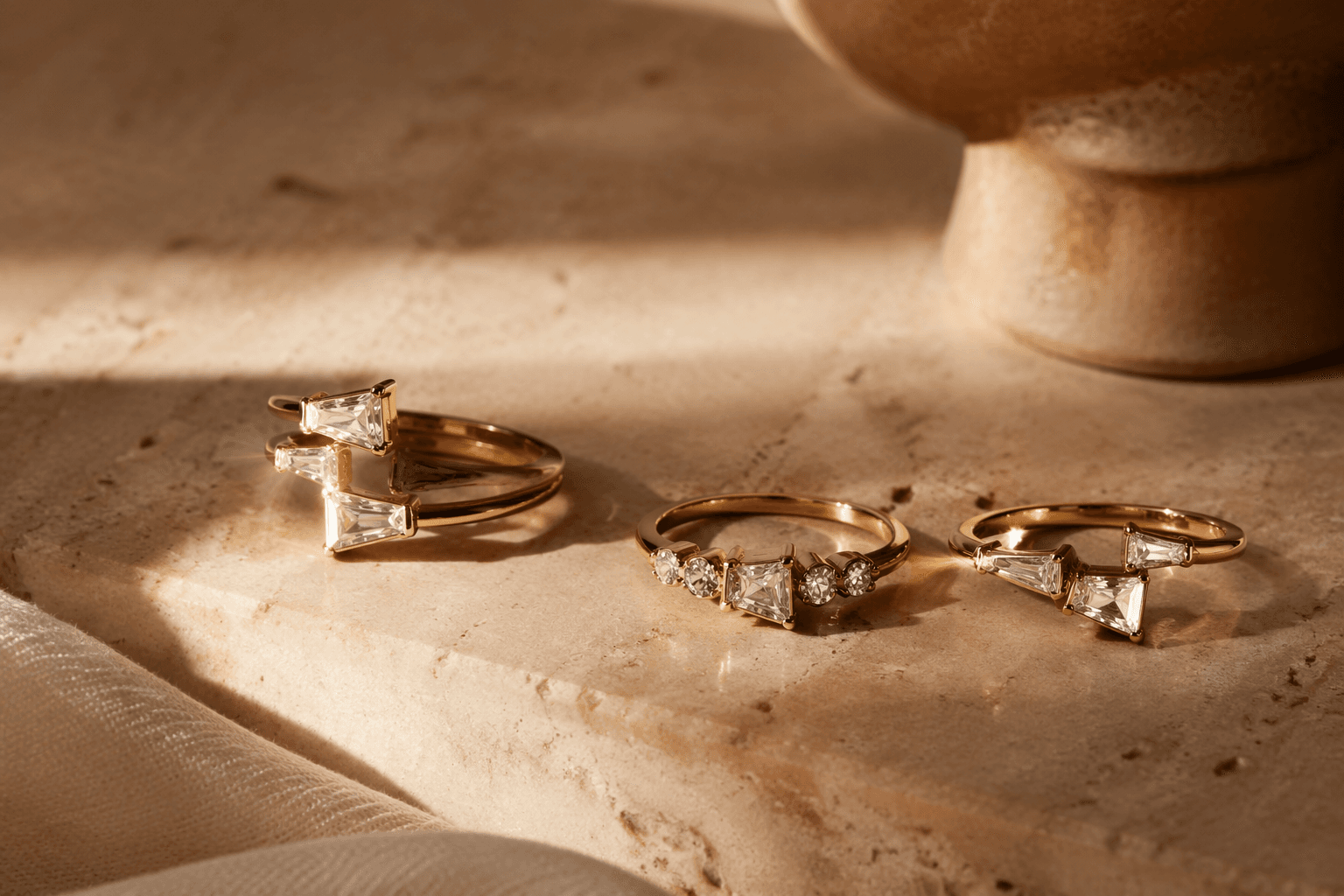
The earrings in the line sharpen that idea even further. They use a bold gold oblong frame, two rows of trapeze-cut diamonds in trapezoid-shaped frames, and a central round brilliant, a combination that makes the trapeze stones feel active rather than secondary. The round center softens the composition, but the angled stones give it rhythm and a sense of forward movement, which is exactly where the collection earns its sculptural edge.
What makes a strong trapeze-led design
A good trapeze jewel is not simply one that uses a rare cut. It is one that understands how the shape behaves in a setting, because the cut’s appeal comes from balance and asymmetry at the same time. When the lines are too loose, the result can feel like filler; when the geometry is too rigid, the piece can lose its life.
Look for these signs of a strong trapeze-led design:
- The trapeze stones are treated as the focal point, not hidden as side accents.
- The setting respects the stone’s angles, with clean edges and clear directional flow.
- There is visual contrast, as in Kavant & Sharart’s use of an oblong gold frame against trapezoid-shaped diamond frames and a round brilliant center.
- The piece feels wearable, not overbuilt, so the architecture adds tension without turning heavy.
Kavant & Sharart’s broader Mingle philosophy helps here too. The brand describes the collection as one designed to blend into existing wardrobes and evolve through layering, complementing, contrasting, and elevating what is already owned. That approach matters because it keeps the trapeze cut from feeling like a novelty exercise; instead, it becomes part of a styling system.
Why this shape can feel more personal than a classic center stone
There is a reason the trapeze cut lands differently from a standard center-stone formula. A round brilliant promises harmony and familiarity. A trapeze diamond offers interpretation. It looks intentional, slightly off-center in spirit even when perfectly placed, and that gives the wearer room to read their own meaning into it.
That emotional pull is part of the appeal of meaningful jewelry more broadly. A trapeze-led design can suggest movement, a shifting perspective, or even the feeling of two forces held in balance. In the Mingle collection, the cut’s angularity is not a complication to solve. It is the expression itself, which makes the piece feel more intimate because it does not aim for universal symmetry.
How to buy trapeze jewelry with a sharper eye
If you are drawn to trapeze diamonds, the best pieces will make the shape legible immediately. The silhouette should be crisp, the setting should not crowd the geometry, and the stone or stones should appear to belong to the design rather than be inserted into it as an afterthought. That is especially important because the cut’s long history as a side stone means many pieces still treat it as a supporting element instead of a star.
Kavant & Sharart’s Mingle Trapeze line shows what happens when that hierarchy is reversed. The jewelry becomes more dynamic, more personal, and more memorable because the cut’s architectural tension is allowed to lead. For buyers who want a diamond jewel that feels specific rather than generic, that is the real luxury: not more stone, but a clearer idea.
This article was produced by Prism’s automated news system from verified source data, official records, and press releases, then run through automated quality and moderation checks before publishing. The system is built and supervised by the people who set the standards it runs under. Read our full AI policy.
Know something we missed? Have a correction or additional information?
Submit a Tip