Lab-Grown Diamonds Move Upmarket as Lower-Quality Inventory Lingers
D-Flawless lab-grown stones are drawing attention even as lower-grade inventory piles up and prices keep sliding.
The lab-grown diamond market is tilting toward perfection. D-Flawless stones are getting more attention while lower-quality inventory becomes harder to move, a sign that buyers still want the cleanest color, the sharpest clarity and the brightest polish even in a category built on value.
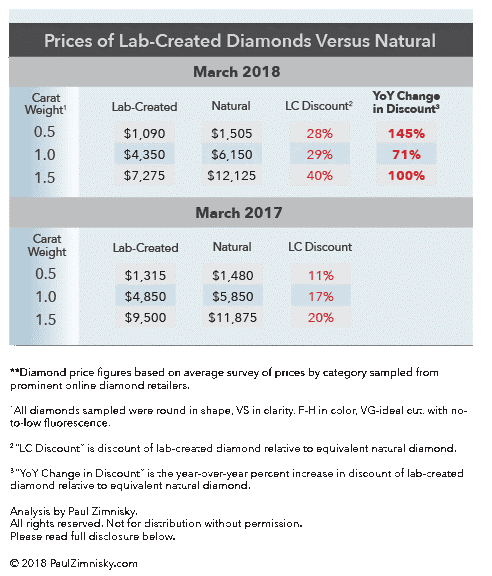
The numbers show how quickly the business has softened beneath the glossy top end. Tenoris said the inventory-to-sales ratio for lab-grown diamonds climbed from the high single digits in 2020 to nearly 50% now, a level that points to too much product chasing too few buyers. JCK reported wholesale lab-grown prices fell 14% in the first quarter of 2026, with 3-carat round stones dropping 28% and 1-carat rounds falling 15%. Paul Zimnisky said in March 2025 that wholesale prices were already down 90% to 95% from 2015 levels, and he said some producers in India were making stones for less than $10 per rough carat.
That pressure has forced a rethink of what lab-grown diamonds are supposed to be. De Beers cut Lightbox prices on May 12, 2024, lowering D-to-F color, VS clarity, excellent-cut stones to $900 per carat from $1,500 and I-to-J stones to $500 from $800. The move made plain that even the category’s most polished goods were no longer insulated from discounting. Tenoris said lab-grown diamonds accounted for 14% of the U.S. jewelry market in 2024, and The Knot said in 2026 that lab-grown center stones made up 61% of all engagement-ring purchases, which explains why retailers now care so much about how the top end is presented.
That shift is also changing the language around quality. Gaetano Cavalieri, president of CIBJO, warned that benchmarking lab-grown diamond prices against natural diamonds was a critical error, a reminder that the category has to stand on its own terms. The Gemological Institute of America has also announced a Laboratory-Grown Diamond Quality Assessment system, moving away from traditional 4Cs-style grading for lab-grown stones and signaling that the old natural-diamond hierarchy does not translate neatly.
For buyers, the appeal of higher-color, higher-clarity lab-grown stones is obvious. They deliver symbolism and visual purity without mined-stone pricing. But the market’s pivot also raises a sharper question: are these better specs deepening emotional value, or simply recreating the same status ladder in a different material? As lab-grown diamonds move upmarket, that tension is becoming the category’s defining story.
Know something we missed? Have a correction or additional information?
Submit a Tip