Rachel King Unpacks the Tudor Heart’s Royal Provenance and Rescue
A Tudor heart found in Warwickshire became a £3.5 million rescue story, carrying Henry VIII, Katherine of Aragon and Mary I in 24-carat gold.
A jewel recovered from the ground
The Tudor Heart began its modern life with a single startling find in Warwickshire, England, in December 2019. A metal detectorist uncovered the pendant after centuries in the soil, and the object was formally reported through the Portable Antiquities Scheme under the Treasure Act 1996, the route that turns accidental discovery into documented history.
That paperwork matters as much as the gold. The British Museum described the jewel as an important object associated with Henry VIII and Katherine of Aragon, and said it was unlike anything in its collection or elsewhere in the United Kingdom. In a field crowded with replicas, reinterpretations and courtly revivals, this is the real thing: a surviving Tudor object with a traceable find spot, a legal reporting trail and a story that reaches straight into royal life.
What makes the pendant extraordinary
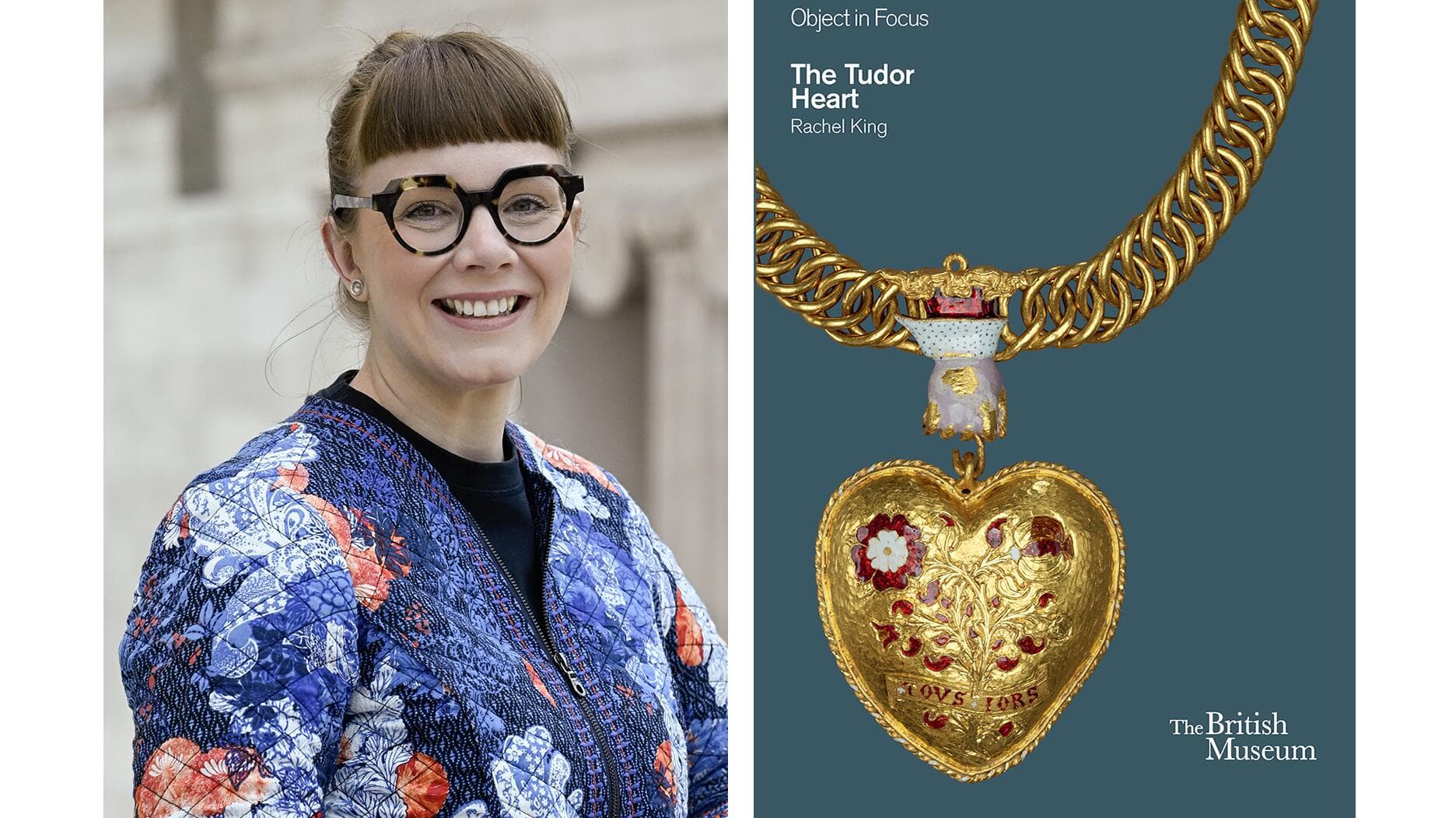
At its center is a heart-shaped pendant cast in 24-carat gold and suspended from a chain made of more than 3 metres of gold wire. That combination alone places it in rare territory. The British Museum has identified it as the oldest known example of its type to survive, which means it is not only beautiful, but singular enough to reset the timeline for Tudor jewelery.
The surface carries the language of dynastic identity. One side bears the Tudor rose, the most familiar emblem of the Tudor monarchy, while Katherine of Aragon’s pomegranate emblem appears alongside it. Those symbols are not decorative filler. They turn the jewel into a compact statement about marriage, sovereignty and lineage, and they also show how Tudor jewelers used ornament to encode allegiance and hope.
The heart shape adds another layer. In modern terms, it reads as romance. In the Tudor court, it could also signal devotion, dynastic ambition and a very public kind of love language, one that fused personal attachment with political necessity. This is why the object feels so immediate today: it is intimate, but it never stops being political.
Why Mary I is part of the story
The pendant’s emotional pull deepens because it is connected to Mary, Henry VIII and Katherine of Aragon’s only surviving child. That link transforms the jewel from a royal ornament into a family relic, a witness to a marriage that shaped succession, religion and the fate of the English court.
For readers of jewelry history, that connection is crucial. Provenance does not just increase value, it changes the way a piece is read. A jewel tied to a known royal couple and their child carries a different charge than an anonymous historic ornament. It becomes a physical vessel for memory, one that holds the pressure of dynastic politics and private feeling at the same time. The Tudor Heart does exactly that, which is why it has endured as more than a museum object. It is a piece of biography made in gold.
The rescue campaign that saved it for the nation
The pendant’s later value was set at £3.5 million, a figure that reflects both its rarity and its significance. In October 2025, the British Museum launched a fundraising appeal to keep the jewel in the United Kingdom and bring it into the national collection. By February 2026, the museum had reached the full target.
What made the effort notable was the scale of public support. More than 45,000 members of the public contributed around £380,000, turning the rescue into a civic act rather than a purely institutional purchase. Major gifts carried the rest: £500,000 from the Julia Rausing Trust, £400,000 from Art Fund, £300,000 from the American Friends of the British Museum and a £1.75 million award from the National Heritage Memorial Fund.
That mix matters. It shows how a historic jewel can move beyond elite collecting and become a shared national object. The fundraising did more than meet a price tag. It drew a line between private ownership and public inheritance, and it did so with enough speed to save a jewel that could easily have disappeared into a permanent private collection.
Rachel King’s book gives the object its wider meaning
Rachel King, curator of Renaissance Europe and the Waddesdon Bequest at the British Museum, has now turned the pendant’s story into a book, The Tudor Heart, for the museum’s Object in Focus series. Published by British Museum Press, the book is scheduled for 14 May 2026.
That framing is apt. A provenance-rich jewel needs interpretation as much as it needs conservation. King’s book treats the pendant not as a glittering curiosity but as a route into Tudor power, devotion and material culture. The object’s chain, its 24-carat gold body, its Tudor rose and pomegranate emblems, and its connection to Mary all make sense as part of one long historical sentence.
The pendant was also expected to go on a national tour after acquisition, which should widen its audience beyond London and place it before viewers who may never have seen a medieval or Tudor jewel this close. That kind of circulation is part of the rescue, too. A jewel like this does its best work when it is not hidden away as treasure, but seen as evidence.
Why the Tudor Heart still feels alive
The enduring force of the Tudor Heart is that it refuses to stay in one category. It is a royal artifact, a devotional object, a political symbol and a family relic. It is also a reminder that the most powerful jewels are not only about carat weight or craftsmanship, but about the lives and claims they carry forward.
In the end, the pendant’s survival is what gives it its meaning. It passed from court to ground, from discovery to public campaign, and from rescue to scholarship. That journey is why this heart still matters: it holds a dynasty, and it still beats.
This article was produced by Prism’s automated news system from verified source data, official records, and press releases, then run through automated quality and moderation checks before publishing. The system is built and supervised by the people who set the standards it runs under. Read our full AI policy.
Did this article answer your question?