Tiffany’s Hidden Garden reimagines Schlumberger with new gemstones
Tiffany’s Hidden Garden reworks Schlumberger’s birds and butterflies in aquamarine, emerald, ruby, and diamond. The strongest pieces add hidden convertibility, turning pendants into brooches.
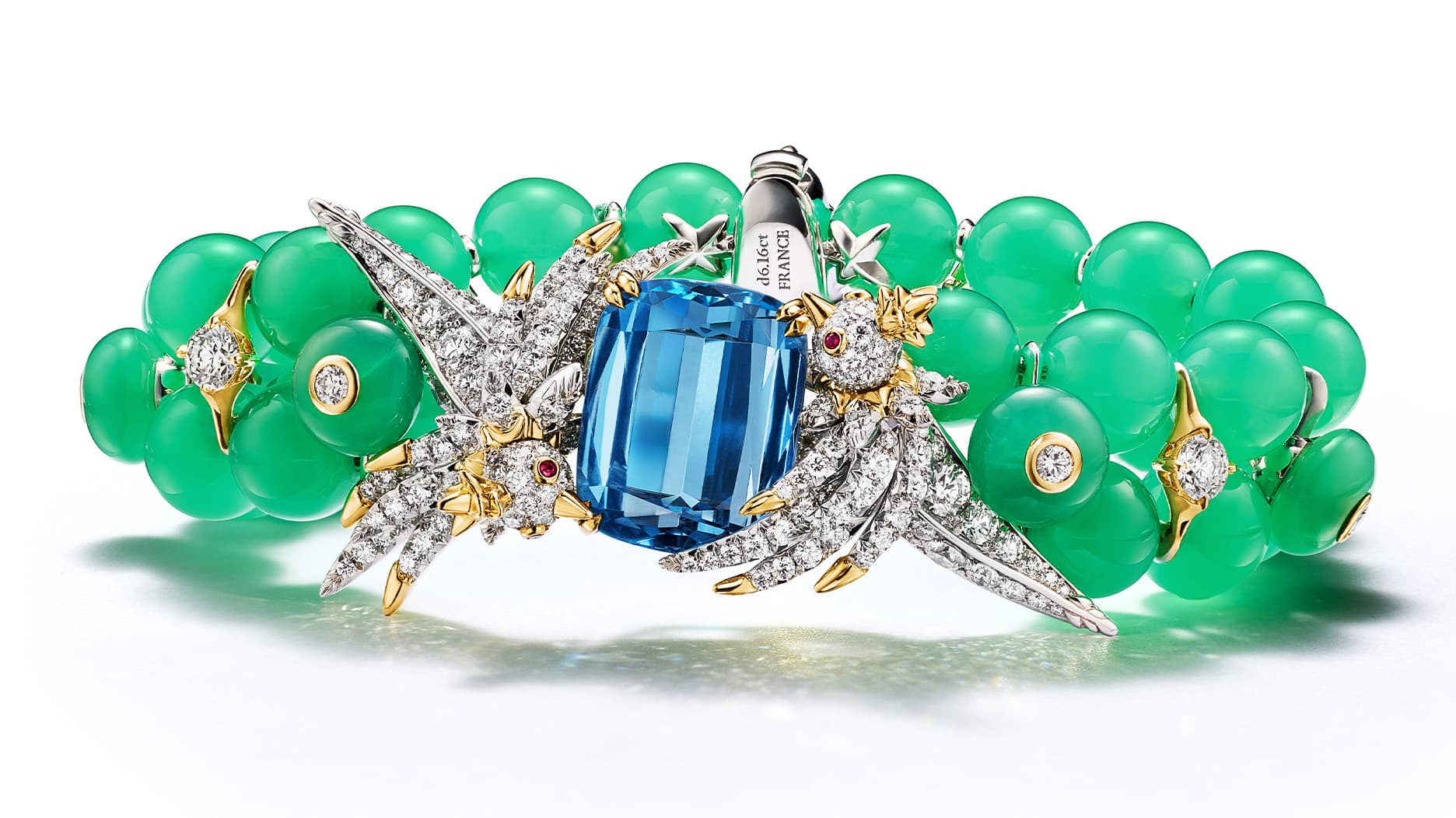
A 22-carat Santa Maria-hued aquamarine from Brazil gives Tiffany’s Bird on a Rock a fresh center of gravity, while diamond birds settle across the stone like a jeweled migration. That is the promise of Blue Book 2026: Hidden Garden, a spring high-jewelry chapter that treats Jean Schlumberger’s familiar flora-and-fauna language as a living system rather than a museum piece. Tiffany frames the collection as a secret landscape of nature’s quiet transformations, and the most persuasive twist is not just color, but motion: select pendants can convert into brooches.
Schlumberger’s code, refreshed
Jean Schlumberger’s importance to Tiffany is not a matter of style alone. Walter Hoving discovered him in 1956 and brought him on as vice president, a move that helped define the house’s modern high-jewelry identity and set up the bird, butterfly, flower, vine, and leaf motifs that still read instantly as Tiffany. Schlumberger retired in the late 1970s, but his design language never really left the brand’s bloodstream.
Hidden Garden works because it does not try to overwrite that code. Instead, it sharpens it, replacing the idea of a single iconic look with a series of gemstone-driven variations that keep the original silhouettes recognizable while shifting the mood through color, scale, and engineering. The result feels less like a revival for nostalgia’s sake and more like a proof point that heritage can still be edited with intelligence.
The spring 2026 chapter, piece by piece
The spring 2026 launch brings together Butterfly, Jasmine, Monarch, Bird on a Rock, Palm, Twin Bud, Paradise Bird, and Bird on a Rock by Tiffany. Taken together, the names already tell the story: this is a collection built on recurring natural forms, but the jewelry itself pushes those forms into new chromatic territory.
Butterfly is the clearest example of that shift. Tiffany pairs white and Fancy Vivid Yellow diamonds with rare colored gemstones such as padparadscha sapphires, a combination that makes the wings feel less literal and more atmospheric. It is the kind of palette that keeps the motif delicate while giving it enough visual voltage to hold its own in serious high jewelry.
Jasmine is split into two suites, and that split matters. One is sculptural platinum and diamonds, all cool precision and edge; the other blends platinum with 18k yellow gold and vivid kunzites, which Tiffany calls a “legacy gemstone.” That phrase is telling. It places a gem often treated as secondary into the center of a heritage narrative, and it gives the collection a warmer, more contemporary register without abandoning the brand’s formal rigor.
Birds, vines, and the return of an icon
Monarch reaches deepest into the archive. It draws from a Jean Schlumberger necklace that concealed a Monarch butterfly amid twisting vines and sculpted foliage, a reminder that Schlumberger’s work was never just decorative nature study. It was theatrical, layered, and engineered to reveal itself gradually. In Hidden Garden, that sense of discovery survives, but the visual language is cleaner and more legible for today’s collector.
Bird on a Rock, meanwhile, gets one of the collection’s most arresting updates. The statement necklace places diamond birds atop that 22-carat Santa Maria-hued aquamarine from Brazil, turning the composition into a study in contrast between icy brilliance and saturated blue. This is where Tiffany’s approach feels most assured: the icon remains the icon, but the gemstone changes the emotional temperature.
Palm and Twin Bud continue that logic with a more explicit materials story. Palm incorporates unenhanced rubies from Mozambique, a detail that matters because treatment status is part of what gives a stone both value and credibility. Twin Bud uses vivid Zambian emeralds and diamonds, pairing a named origin with the kind of saturated green that makes the motif feel botanical rather than decorative. Paradise Bird and Bird on a Rock by Tiffany extend the same idea across the chapter, reinforcing the collection’s commitment to a recognizable visual grammar.
Why the materials story matters
Tiffany’s strongest claim here is not vague sustainability language, it is specificity. The collection names where stones come from, which gems are untreated, and which color stories are being elevated into high jewelry. That level of detail is more persuasive than broad ethical language because it gives the reader something concrete to evaluate.
The convertibility also deserves attention. A pendant that can become a brooch is not just a clever novelty; it extends wearability, reduces the feeling that a piece is locked into one formal use, and echoes the collection’s broader theme of metamorphosis. In a market where many high-jewelry launches rely on spectacle alone, this kind of functional intelligence feels especially welcome.
Blue Book’s role in Tiffany’s modern identity
Blue Book is one of Tiffany’s most important traditions, and the house says it has endured for over a century. Blue Book 2026: Hidden Garden follows Blue Book 2025: Sea of Wonder and Blue Book 2024: Tiffany Céleste, and trade coverage places this as the fourth Blue Book collection under Nathalie Verdeille’s direction. That sequence matters because it shows how quickly Tiffany has been building a coherent contemporary high-jewelry narrative under her watch.
Verdeille, working with the Tiffany Design Studio, has kept Schlumberger at the center while making the line feel newly fluent in color and form. Anthony Ledru said the collection reflects Tiffany’s “continued commitment to creativity, craft and the highest standards of gemology,” and that is exactly where Hidden Garden lands best. It is not trying to outdo Schlumberger’s legacy. It is trying to prove that the legacy still has room to grow, bloom, and change shape.
This article was produced by Prism’s automated news system from verified source data, official records, and press releases, then run through automated quality and moderation checks before publishing. The system is built and supervised by the people who set the standards it runs under. Read our full AI policy.
Did this article answer your question?