Unoaerre marks 100 years of turning Arezzo into a jewelry hub
Unoaerre's centenary shows how a single Arezzo workshop became a global gold hub, and why scale still has to answer to craft, place, and traceable gold.
From a workshop to a gold district
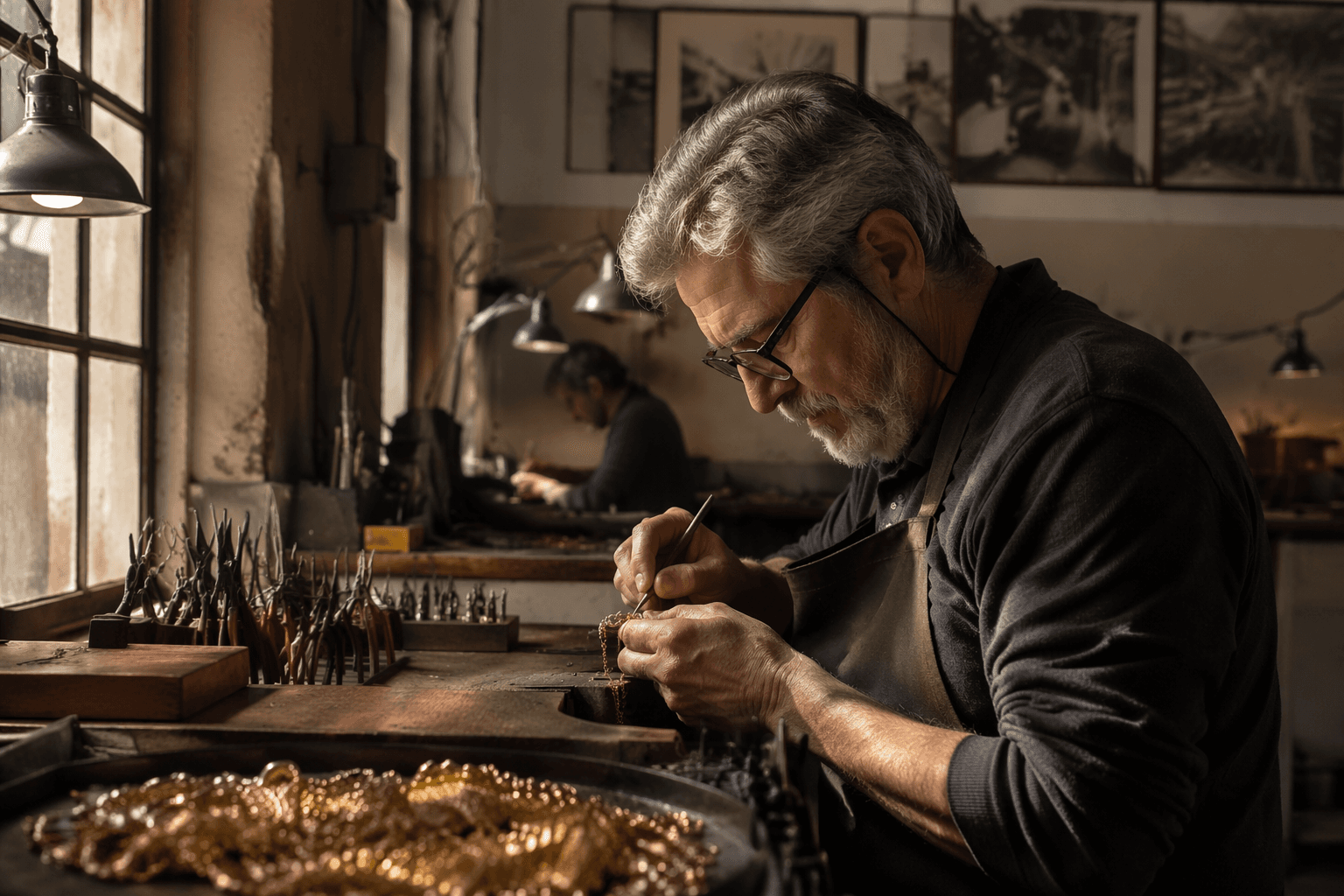
Unoaerre’s 100-year story is also the story of Arezzo’s rise from a city of small workshops to one of the most recognizable jewelry centers in Italy. The company began in Arezzo on 15 March 1926, when Carlo Zucchi and Leopoldo Gori launched what Unoaerre describes as the city’s first jewelry manufacturing company. Its first laboratories sat in Via di Seteria and in Corso Vittorio Emanuele, now Corso Italia, placing the business in the heart of the old city rather than at some distant industrial edge.

That geography matters. Arezzo did not become a jewelry hub by accident, but by layering specialized labor, machinery, and know-how into a dense local system. Academic research describes the district as an emerging industrial district formed by “gemmation” from a large enterprise, a phrase that captures how one strong company can generate an entire ecosystem of suppliers, technicians, and makers around it. The result was not only growth, but prestige: a regional identity that made goldsmithing part of Arezzo’s civic self-image.
The mark that changed everything
A key date in that transformation arrived on 2 April 1934, when Unoaerre received the first registered trademark of the gold industry, 1AR, the origin of the Uno A Erre name. That registration gave the business a formal identity at a moment when Italian jewelry was still negotiating between handmade tradition and industrial repeatability. The brand’s later success was built on that duality: recognizable enough to scale, but still tied to a maker’s discipline.
The company’s own history frames the 1950s and 1960s as the period when Italian Style accelerated demand and technological development. That was not just a matter of fashion; it pushed Unoaerre toward new chain constructions and more systematic production. The familiar names of gourmette, figaro, rolò, serpentine, and coda di volpe became part of the company’s visual language, proof that industrial jewelry can still carry strong stylistic signatures when design and machinery are developed together.
Why the centenary matters now
To mark the centenary in 2026, Unoaerre commissioned Felice Limosani’s immersive work *Polvere di Stelle*, shown at Palazzo della Fraternità dei Laici in Arezzo from 9 May to 8 June 2026. The gesture was fitting: a jewelry house celebrating not with a single showcase of product, but with an artwork that turns memory, light, and reflection into part of the anniversary itself.
Maria Cristina Squarcialupi said the centenary reflects a vision centered on innovation, craftsmanship, and openness to the world. That framing gets to the heart of Unoaerre’s appeal. Its legacy is not only the scale of the operation, but the insistence that precision machinery and artisanal identity can coexist, even as production becomes more systematized. About 340 employees gathered for the centenary celebration, alongside Squarcialupi, her brother Andrea, and CEO Luca Benvenuti, a reminder that the company’s identity remains tied to the people who keep the line moving.
What to look for in a house like Unoaerre
For readers who care about meaningful jewelry, the important question is not whether a brand sounds traditional, but whether its claims can be traced to real practice. Unoaerre says it emphasizes quality control and RJC certification, and that distinction matters. The Responsible Jewellery Council framework signals an external standard, while quality control speaks to what happens inside the factory, where consistency, finishing, and material stewardship have to be maintained at scale.
The company also says it works with vertical integration and gold recycling, two practices that help explain how it has stayed competitive while serving a broad market. Vertical integration can tighten oversight across stages of production, and gold recycling speaks directly to the environmental pressure points in precious-metal manufacturing. In a category where “responsible” is often used loosely, those are the details that deserve attention.
- Gold recycling can reduce dependence on newly mined metal, though the impact depends on how the material is sourced and tracked.
- RJC certification offers a more serious reference point than generic sustainability language.
- Precision machinery helps preserve consistency in chains, rings, and mass-market pieces, but craftsmanship still shows in finishing and proportion.
The museum as a statement of intent
Unoaerre’s commitment to its own history is unusually concrete. On 7 March 1988, it opened Italy’s first museum dedicated to goldsmith art in Arezzo, and the collection now includes more than 2,000 works. That is not just corporate nostalgia. It is a way of placing production inside a longer cultural narrative, where tools, forms, and techniques are treated as heritage rather than background noise.
The museum also helps explain why the brand has remained influential in categories that can otherwise feel anonymous. Unoaerre says it is the market leader in gold jewelry and basic chains, and in Italy it says it holds more than 70 percent of the wedding-ring market. It serves more than 4,000 points of sale through a network of about 100 distributors, and it distributes gold in more than 40 countries. Those numbers reveal a business built for breadth, but the museum insists that breadth does not have to erase memory.
Arezzo’s global reach, still rooted in place
The tension between industrial scale and artisanal identity is exactly what makes Unoaerre’s centenary interesting. The brand’s fashion-jewelry division has been active since 1968, yet the company still trades on a city-specific origin story, a first trademark, and a museum that protects the visual archive of the trade. In other words, the legacy is not simply that Unoaerre grew large. It is that it helped make Arezzo large without severing the city’s link to goldsmithing as a cultural practice.
Arezzo’s jewelry district remains a case study in how regional pride can survive industrialization when a company keeps investing in skill, design, and memory. Unoaerre’s 100 years suggest that the most durable luxury stories are not the ones that deny scale, but the ones that learn how to make scale feel accountable to craft.
This article was produced by Prism’s automated news system from verified source data, official records, and press releases, then run through automated quality and moderation checks before publishing. The system is built and supervised by the people who set the standards it runs under. Read our full AI policy.
Did this article answer your question?