Van Cleef & Arpels turns dance into a signature jewelry language
From rose-cut diamond ballerinas to Balanchine’s Jewels, Van Cleef & Arpels turned ballet into a code of silhouette, movement, and light.
From the Paris Opera to the jewelry bench
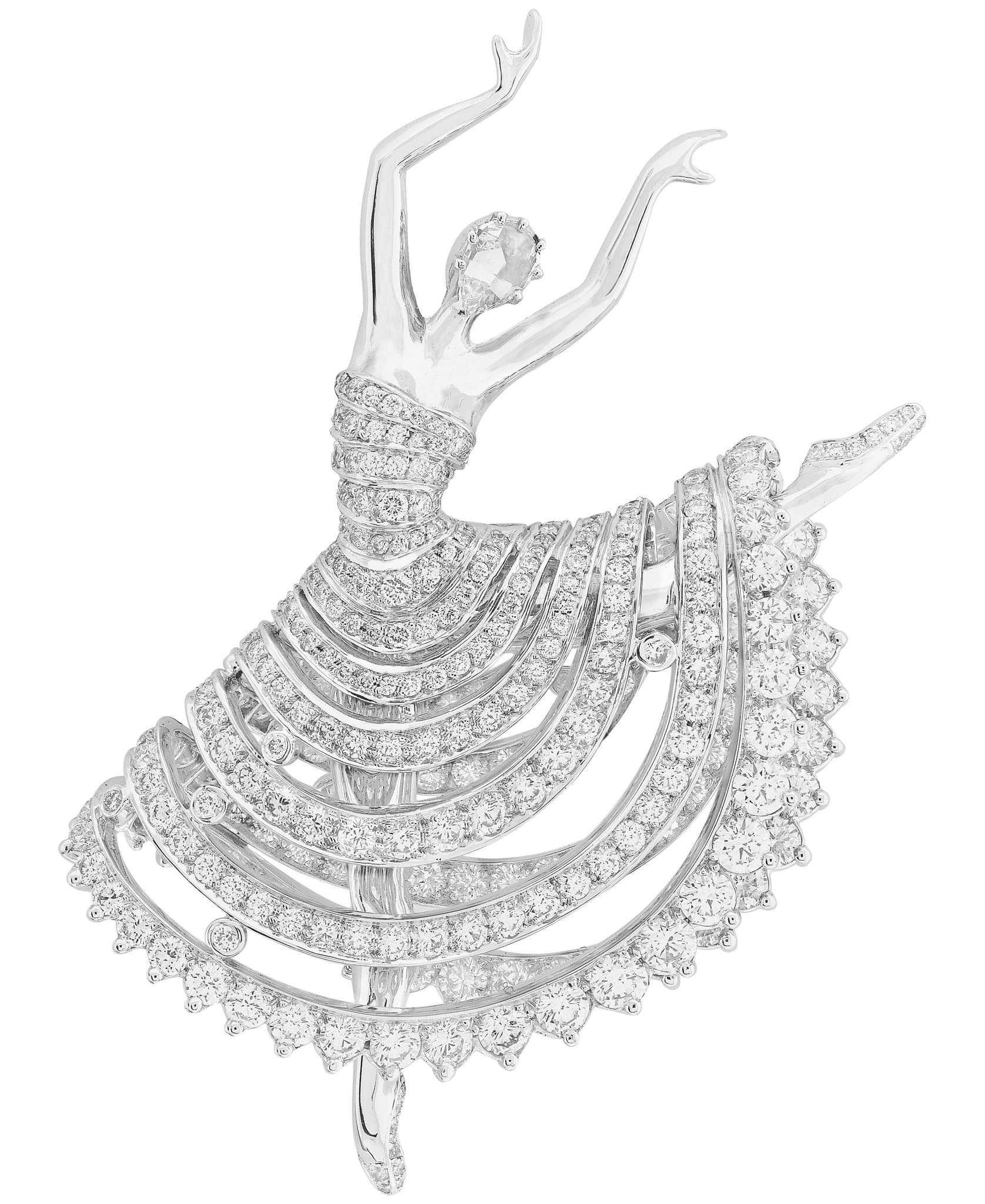
A rose-cut diamond face, a jeweled headdress, pointe shoes, and a tutu rendered in diamonds or colored stones: Van Cleef & Arpels has made ballet into one of jewelry’s most recognizable visual languages. The story begins not in a display case, but in the Paris Opera, where Louis Arpels took his nephew Claude Arpels in the 1920s and helped set a private devotion to dance into motion.
That attachment would become design. Van Cleef & Arpels says its first ballerina clips were created in New York in the early 1940s, and the maison’s timeline places its first ballerina and fairy clips in 1941. Among them was the Little Winged Fairy clip, later called Spirit of Beauty, created as a symbol of hope. In a field where classical ballet dancers are exceptionally rare as a motif, the house was not merely borrowing a pretty image. It was inventing a collectible code for movement itself.
How a dancer becomes a jewel
The power of these clips lies in how specifically they translate performance into form. The ballerina is never a generic figure. Her face is usually a rose-cut diamond, her headdress is jeweled, and her costume becomes either a diamond tutu or a colored-stone composition that reads like stage light caught in metal. Even at small scale, the gesture is exact: the house wants the figure to seem caught mid-turn, balanced on pointe, suspended in a moment that looks temporary but has been engineered to last.
That precision matters. Jewelry and dance share an obsession with line, discipline, and finesse, and Van Cleef & Arpels has used that overlap to build pieces that feel less like ornament than choreography in miniature. The ballerina clips do not simply depict a dancer. They preserve the illusion of motion, turning a stage gesture into something that can be worn on a lapel, pinned to a dress, and passed from one collector to another as a tiny theatre of sparkle and silhouette.
The result is more than whimsy. Because ballet is so rarely used as a jewelry motif, these clips stand apart from the usual floral, animal, and celestial vocabulary of high jewelry. Their appeal is partly technical and partly emotional: they are precious objects, but they also carry the poise, strain, and balance of a performance art that depends on exactitude.
Balanchine and the architecture of movement
The language deepened when Claude Arpels met George Balanchine in 1961. That meeting sparked the idea for Jewels, a ballet dedicated to precious stones and conceived as a dialogue between choreography and gemology. When it premiered in April 1967 at New York City Ballet, the three-act structure, Emeralds, Rubies, and Diamonds, was set to music by Fauré, Stravinsky, and Tchaikovsky, giving the production the same kind of tonal contrast that defines a finely composed necklace.
Balanchine’s influence sharpened the maison’s understanding of movement, line, and femininity. Where the ballerina clips had already suggested a dancer held in a luminous instant, Jewels expanded that logic into an entire stage work. Each act became a study in color and rhythm, and the ballet’s title itself reaffirmed what Van Cleef & Arpels had been saying through jewelry all along: precious stones can function like a visual score.

That is why the house’s dance stories feel so durable. They are not isolated inspirations, but repeatable structures. Ballet provides Van Cleef & Arpels with a grammar of gesture, a way to make silhouette legible, and a language in which femininity is articulated through balance, lift, and poise rather than excess.
Dance Reflections and patronage as part of the design code
In 2020, Van Cleef & Arpels launched Dance Reflections by Van Cleef & Arpels, extending its relationship with dance beyond motif and into sustained patronage. The house describes the initiative as dedicated to dance and institutions that disseminate choreographic heritage and support creation, guided by creation, transmission, and education. That framework matters because it makes the brand’s interest in dance feel structural, not decorative.
The program has since expanded to 16 countries and 57 partner dance companies and art institutions, and its festival format has brought events to London in March 2022 and Hong Kong in May 2023. Those dates tell their own story: the maison is not treating dance as a one-time inspiration, but as a living network of performance, scholarship, and support. The initiative gives the brand’s aesthetic language a public life beyond the jewel box.
This broader patronage also keeps the relationship contemporary. Van Cleef & Arpels sponsored Balanchine’s Jewels with Hong Kong Ballet in 2021, reinforcing the link between the original ballet and the house’s jewelry vocabulary. In the same year, it presented Jewels with the Korean National Ballet, extending a partnership that began in 2017 with Anna Karenina and continued with Mata Hari in 2018 and Swan Lake in 2019.
Why the language endures
What Van Cleef & Arpels has built is not a house history in the usual sense. It is a visual system in which ballet can be read instantly through a silhouette, a tutu of stones, or a dancer frozen in the shimmer of a lapel clip. The earliest ballerinas, the Balanchine collaboration, and the modern Dance Reflections initiative all point to the same conviction: dance is not simply a theme, but a method of making jewelry move emotionally.
That is what makes the story collectible. A Van Cleef & Arpels ballerina is never just a figurative jewel. She is a distilled performance, shaped by Parisian stage culture, refined through Balanchine’s clarity of line, and sustained by a house that understood early on that the most enduring luxury codes are the ones that can hold both beauty and motion at once.
This article was produced by Prism’s automated news system from verified source data, official records, and press releases, then run through automated quality and moderation checks before publishing. The system is built and supervised by the people who set the standards it runs under. Read our full AI policy.
Did this article answer your question?