Why jewelers say the trade is a calling, not a job
A childhood jewelry box, a family bench, or an accidental first job can become a vocation, and the trade now depends on that kind of devotion.
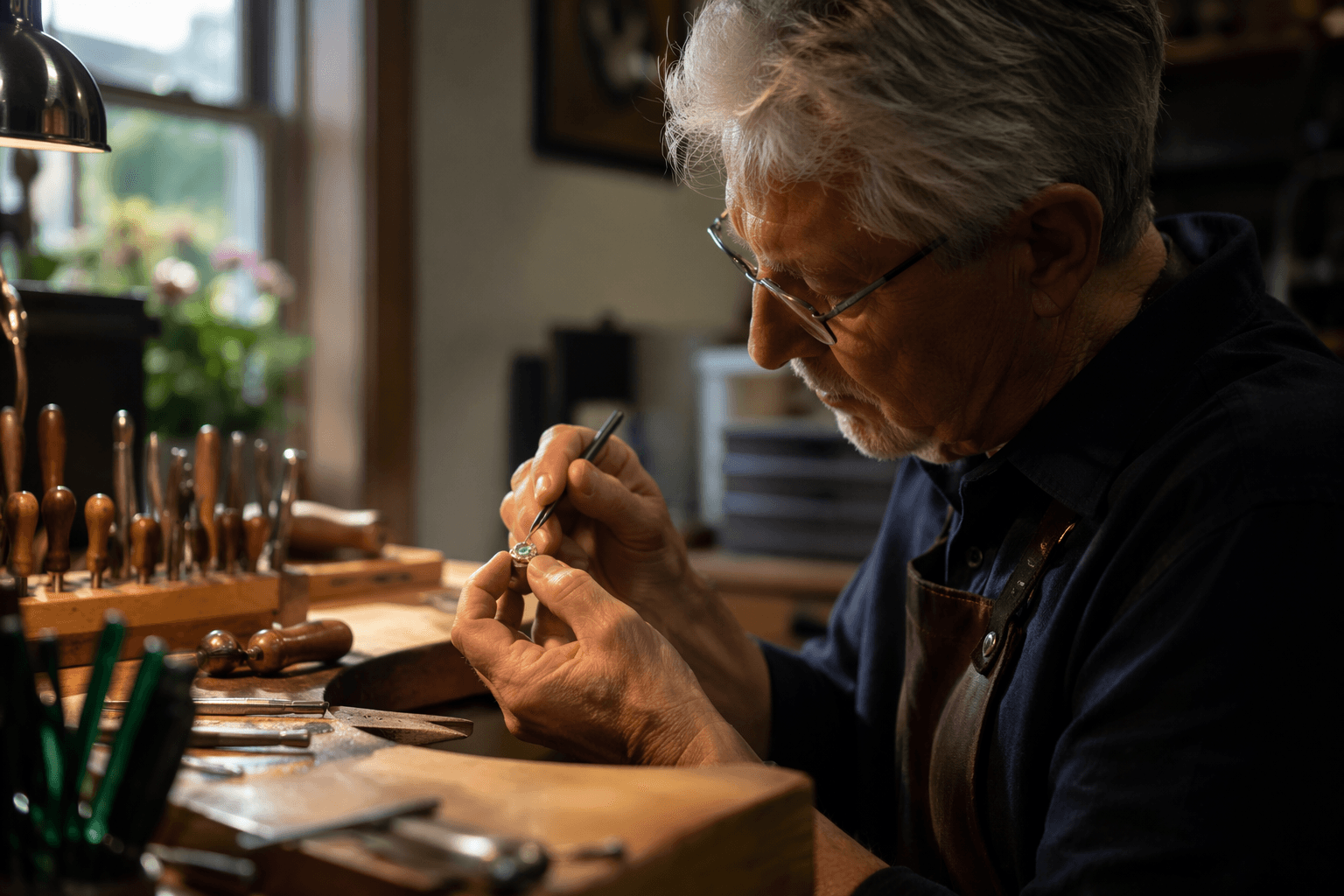
A jewelry box is rarely just a box. In INSTORE’s survey, jewelers traced their careers back to childhood keepsakes, family businesses, rock clubs, benches, and accidental first jobs, a reminder that the first emotional encounter with jewelry often comes long before the first sale. That is why so many in the trade describe it as a calling rather than a career: the work begins as attachment, then hardens into skill.
Meaning starts before mastery
The most revealing detail in that survey is not simply that jewelers love what they do, but how early that love begins. A child opening a velvet-lined box, a teenager spending time around a family counter, or a young worker finding a first job in the trade all enter jewelry through memory before they enter it through technique. Even the mechanics of the piece matter to that story: a bezel can make a jewel feel sheltered and close to the body, while prongs lift a stone into light and movement, changing not just how it looks, but how it lives on the wearer.
That emotional inheritance gives the category its strange power. Jewelry is one of the few luxury objects expected to do more than sparkle, because it is asked to remember birthdays, inheritances, milestones, and private rituals. The jewelers in the survey seem to understand that instinctively, and it shapes how they design, sell, and value the work itself.
The trade sits on a real labor market
The romance of the bench sits inside a hard-nosed employment picture. The U.S. Bureau of Labor Statistics counted 23,600 jobs for jewelers and precious stone and metal workers in May 2023, and its Occupational Outlook Handbook projects employment will decline 5% from 2024 to 2034. Even so, the field is expected to generate about 4,000 openings a year, mostly because workers will need to be replaced as they retire or leave the profession.
That tension between shrinking headcount and steady openings makes recruitment more than a feel-good talking point. It also helps explain why the median annual wage of $49,140 in May 2024 matters: the trade is not only about passion, but about whether the next generation can build a viable life around craftsmanship. In other words, jewelry needs more than admirers. It needs people willing to learn the language of metal, stones, finishing, repair, and service.
Education is becoming the new entrance door
The industry has begun answering that need with more formal pathways. Jewelers of America says its jewelry schools directory is regularly updated, and its career resources point to creative, technical, and hands-on routes into the field. It also offers self-study courses and certification for sales associates, managers, and bench jewelers, which gives the trade a ladder from the showroom floor to the workbench.
The Gemological Institute of America offers another route with its Graduate Jeweler program, a hands-on course focused on jewelry fabrication and repair. That emphasis matters because the industry’s future depends on more than sales fluency; it depends on the ability to size a ring cleanly, set a stone securely, finish a surface properly, and understand why a repair that looks simple can be the difference between a jewel that lasts and one that fails.
Apprenticeship is making a comeback
MJSA, the Manufacturing Jeweler & Suppliers of America, has pushed the argument even further by saying apprenticeships were once vital to the jewelry industry and should be again. Its Mentor & Apprenticeship Program is designed to revive that model, and it received U.S. Department of Labor approval in 2024 as National Guidelines Standards. That approval gives the program a formal structure in a trade that still depends heavily on bench skills and mentorship.
The significance is cultural as well as practical. Apprenticeship preserves the old jewelry-world truth that some knowledge cannot be rushed, because solder seams, stone security, and finishing work are learned through repetition, correction, and time at the bench. It also acknowledges what many jewelers already know: a good mentor does more than teach technique. A good mentor teaches judgment.
Providence shows what the trade can become
If jewelry is a calling, Providence, Rhode Island, is one of its great proving grounds. The Providence Jewelry Museum describes itself as the first museum dedicated to the history of American jewelry, design, and manufacturing industries, and the Providence Jewelry District has long been a major center of the trade. The city’s history makes the present look sharper, because it shows how much craft, labor, and local identity have always been bound together here.
Providence’s jewelry sector peaked in 1978, when 32,500 workers were employed. At the height of the boom in the 1980s, the city had more than 900 jewelry firms employing 24,400 workers. Those numbers do more than signal old prosperity. They explain why the region’s museums, schools, and apprenticeship efforts feel urgent now, as the trade looks for ways to preserve know-how that once powered an entire local economy.
What customers really value
For buyers, the lesson is clear: meaning is not a soft extra. A pendant bought for a graduation, a signet ring passed down at a wedding, or a repair that restores a family piece all carry a value that cannot be measured by metal weight alone. The most successful jewelers understand that instinct because they came into the trade through the same emotional door.
That is why the language of jewelry keeps circling back to inheritance, identity, and memory. The best pieces are not simply beautiful objects. They are vessels for a life story, made by people who learned early that the trade survives when skill is treated as stewardship and craft is treated as something worth passing on.
This article was produced by Prism’s automated news system from verified source data, official records, and press releases, then run through automated quality and moderation checks before publishing. The system is built and supervised by the people who set the standards it runs under. Read our full AI policy.
Know something we missed? Have a correction or additional information?
Submit a Tip