Aryna Sabalenka turns Roland-Garros kit into a jewelry moment
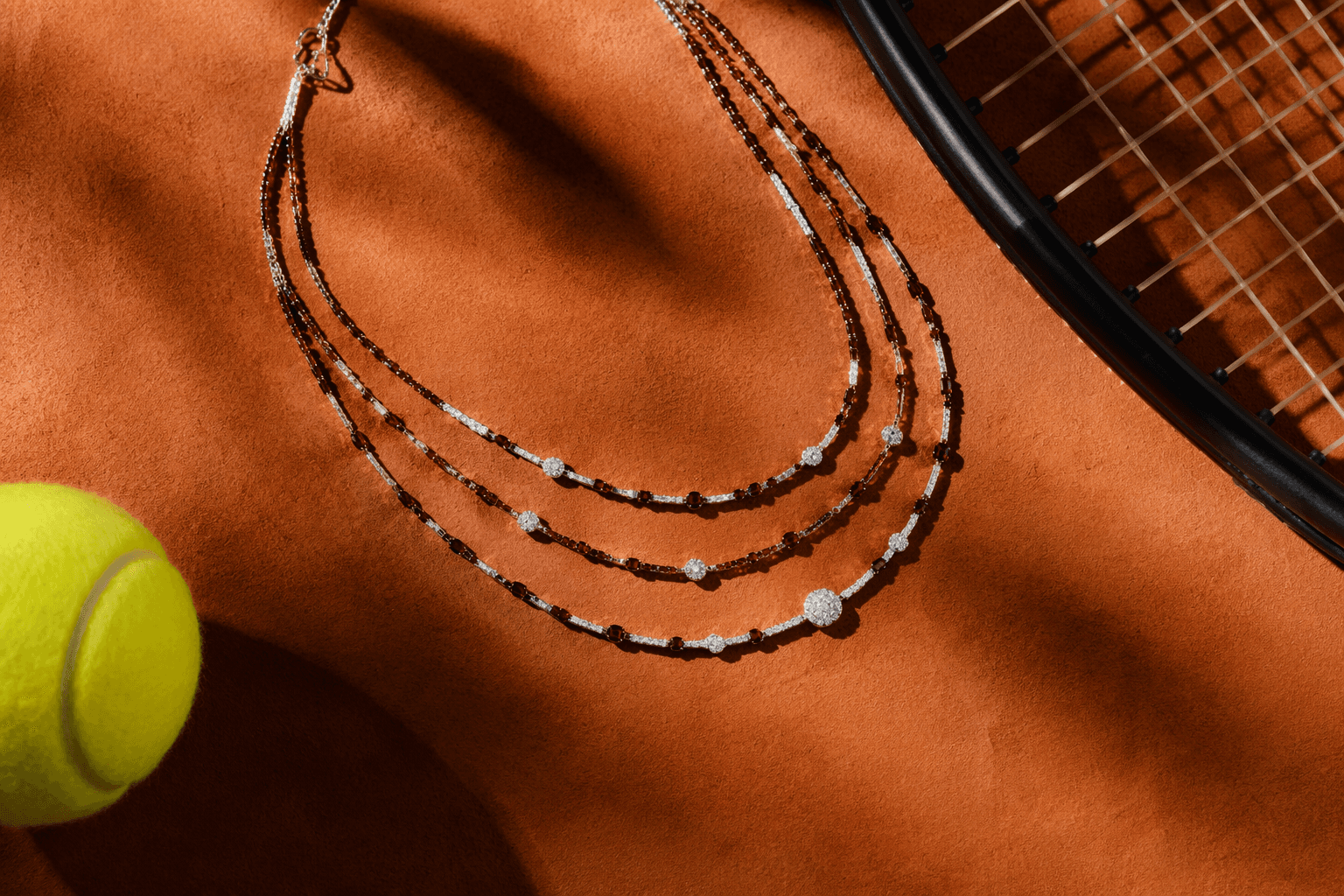
Aryna Sabalenka’s Roland-Garros necklace turned a Nike kit into a study in court-ready minimalism, with three strands of garnets and diamonds doing the talking.
Court-ready jewelry has arrived
Aryna Sabalenka made Roland-Garros look like a runway for the wrists and neck, stepping onto Court Philippe-Chatrier in a stripped-back black Nike kit and a custom Material Good necklace that changed the mood of the outfit in an instant. On Tuesday, May 26, 2026, she wore the piece in her first-round match in Paris and beat Jessica Bouzas Maneiro in straight sets, but the real point of attention was how the jewelry held its own without overwhelming the athletic line of the clothes.
The look captured a specific kind of minimalist power: not bare, not ornate, but controlled. That is what made it feel relevant far beyond tennis. The necklace did not compete with the kit’s clean silhouette; it sharpened it, turning a performance uniform into a polished editorial statement.
The anatomy of the necklace
The Material Good suite built for Sabalenka was reported to include more than 200 carats of garnets and 23 carats of diamonds, arranged as three necklaces that stacked with intention. The palette was no accident. It drew from the red clay courts of Roland Garros, using deep garnet color to echo the surface beneath her feet while the diamonds kept the composition bright and precise.
That balance is the secret to why the piece reads as minimalist even at luxury scale. The eye sees one disciplined color story, one clear idea, and a silhouette that stays close to the body. Instead of relying on volume alone, the design uses layering and repetition, which is exactly what makes it feel modern. The jewelry moves with the athlete rather than against her, so the effect is statement-making without becoming fussy.
Material Good, the New York-based luxury jewelry and watch boutique behind the piece, has already become part of Sabalenka’s personal style narrative. Reports describe her as a brand ambassador, and she has worn the label’s jewels at the Australian Open, the US Open, and other Grand Slam appearances. That kind of continuity matters in jewelry: it suggests a relationship built on fit and identity, not one-off spectacle.
Why the look reads as minimalist, not maximalist
The strongest minimalist jewelry always knows where to stop. Sabalenka’s necklace works because it keeps a disciplined profile, even while using serious material weight. The three-strand construction gives the eye a rhythm, but the look never fragments into clutter. There is no visual noise, no competing metal story, and no excess color beyond the garnet and diamond contrast.
That restraint is what makes the piece so easy to translate beyond center court. The lesson is not to copy the carat weight; it is to borrow the structure. A single color family, layered cleanly, can feel more luxurious than a crowded mix of stones. The necklace proves that minimalism does not have to mean delicate in a fragile way. It can be bold, provided the design is edited enough to let each line breathe.
This is also why the jewelry feels relevant to readers who think about wearability, not just red-carpet drama. The same principles that make a piece work during a match, controlled color, close-to-body layering, and movement that does not distract, are the ones that make it easy to carry from day into evening. Sport-to-evening versatility is not a marketing phrase here; it is the design logic.
Paris made the jewelry story bigger
Roland-Garros 2026 gave the conversation additional fuel. The tournament confirmed a total prize-money pool of €61.723 million, up 9.53 percent from the previous year, with singles champions set to earn €2.8 million each. Even as the figures grew, several leading players criticized the revenue split and pushed for a larger share for players, turning the French Open into a broader argument about money, fairness, and who benefits from the sport’s global scale.
Sabalenka’s jewelry was drawn into that debate because visibility changes the meaning of luxury. Later reports estimated the full Material Good set worn in Paris at roughly $102,000 to nearly $148,000, which made the necklace feel less like a simple accessory and more like a business object. It sat at the intersection of performance wear, sponsorship, and high jewelry, exactly where modern sport culture is increasingly headed.
Sabalenka addressed the criticism directly, making clear that the prize-money fight was about lower-ranked players and a fair percentage of revenue, not about her personally. That distinction matters. It reframes the necklace as part of an athlete’s public image rather than a contradiction, and it reminds us that luxury in sport is now read through both style and economics.
What to borrow from Sabalenka’s Roland-Garros look
The takeaways are practical, and they are easy to apply without losing the elegance of the original. Keep the color story tight. Layer with intention rather than abundance. Let one piece carry the visual weight, whether that is a multi-strand necklace or a pared-back chain stack that sits neatly against the collarbone.
The other lesson is that minimalist jewelry can still feel decisive when it is grounded in a strong point of view. Sabalenka’s necklace was not about soft sparkle or polite understatement. It was about precision, with garnets and diamonds doing different jobs inside one composed silhouette. That is what makes the look linger: it showed that on the clay at Roland-Garros, fine jewelry can be as athletic as the person wearing it, and just as memorable.
This article was produced by Prism’s automated news system from verified source data, official records, and press releases, then run through automated quality and moderation checks before publishing. The system is built and supervised by the people who set the standards it runs under. Read our full AI policy.
Did this article answer your question?


