Cartilage earrings turn the curated ear into polished everyday style
A polished cartilage stack works best with two or three low-profile pieces, flat backs and metal consistency that respects the ear’s anatomy.
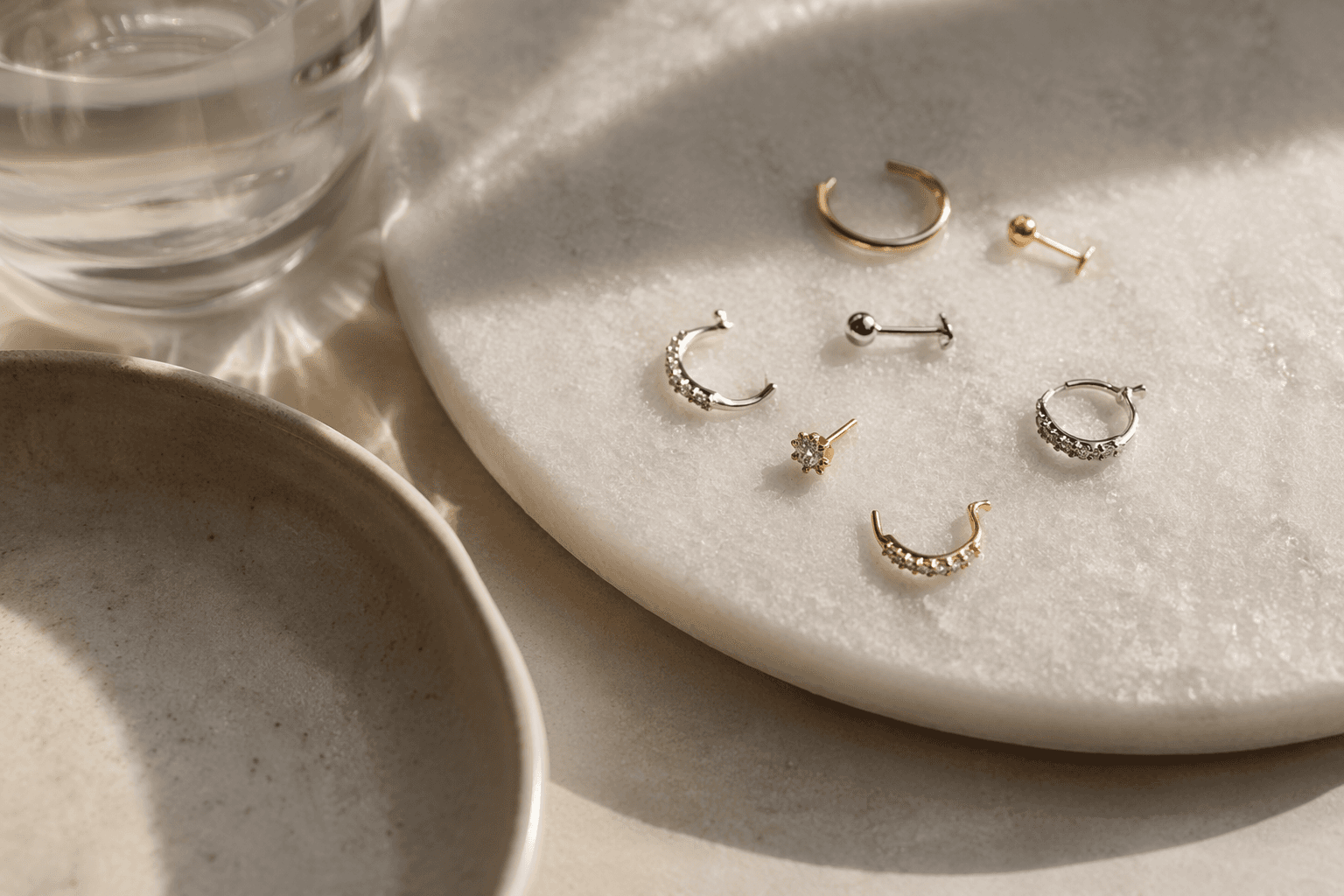
A slim cartilage hoop, a tiny crystal stud and a flat-back labret can look deliberate when the metal stays consistent and the placement follows the ear’s anatomy.
The cleanest cartilage stack starts with restraint
A minimalist ear stack works because each piece has a job. One hoop can trace the curve of the helix, one tiny stone can catch light at the conch or tragus, and one low-profile backing keeps the profile tidy against the skin. Cartilage jewelry looks best when it feels edited, not crowded, so the strongest combinations are often the smallest ones.
The shapes matter as much as the sparkle. Cartilage hoops soften the outline of the ear, while tiny crystal studs add just enough shine to keep the stack from disappearing. Flat-back earrings and labrets have become the practical backbone of the category because they are comfortable, secure and suitable for 24/7 wear, including fresh or sensitive piercings.
Know the map of the ear before you build it
Cartilage piercing is not one category so much as a set of placements with different visual effects. Helix, conch, daith, rook, tragus, anti-tragus, snug, orbital and industrial piercings all change how the ear reads, and each one shifts where a hoop or stud will sit best. A good stack uses those placements sparingly, leaving enough open space for the jewelry to breathe.
Healing time is part of the design brief. Cartilage piercings can take several months to a year to fully heal, which is why the safest-looking ear is often the one that was planned with patience. The Association of Professional Piercers, established in 1994, provides health and safety information on body piercing.
The American Academy of Family Physicians says auricular cartilage infections may require fluoroquinolone antibiotics because of antipseudomonal activity.
The curated ear is about placement, not accumulation
Maria Tash remains the clearest reference point for the curated-ear idea. Maria Tash says it popularized the Curated Ear® concept by introducing clients to delicate, elaborate and versatile jewelry designed to be mixed and matched according to personal style and ear anatomy. Its first Manhattan studio opened in the East Village in 1993.
Astrid & Miyu approaches the same idea from the studio side. Astrid & Miyu says it first started piercing in London in 2018 and now has more than 20 piercing studios. It charges a flat £20 service fee for a 20-minute appointment and allows up to three piercings in that time, a model that makes planning essential because you are deciding not just what to wear, but where the ear can carry it.
Astrid & Miyu says its piercing team walks clients through jewellery choice, placement and aftercare.
Materials should be as considered as the silhouette
Otiumberg was founded by sisters Christie and Rosanna Wollenberg in 2016 and is positioned around understated elegance and sustainability. Edge of Ember is female-founded, uses recycled gold and silver, and says it has reduced its carbon footprint by 42 percent, details that give the category some hard material language instead of vague green gloss.
That matters in cartilage jewelry because these pieces are worn close to the skin and often kept in place longer than a fashion earring. A small hoop in recycled gold or a restrained stud in silver does more work here than a trend-led oversized shape, because the visual language of the stack depends on clean lines and continuity. Even when a brand is selling sparkle, the most convincing version is usually the one with the quietest profile.
ELLE UK grouped cartilage hoops, tiny crystal studs, piercing sets and flat-back clasps together as polished everyday tools. The highlighted names, including By Lucia, Laura Bond, Maria Tash, Astrid & Miyu, Otiumberg and Edge of Ember, span fine-jewelry houses, piercing-led studios and sustainability-minded labels.
How to make the stack feel finished
The most elegant ear stacks usually share three traits: the same metal family, low-profile backs and a mix of one hoop and one or two stud shapes. A tiny crystal gives enough light to keep the composition from looking flat, while a plain hoop or polished stud keeps the look grounded. If the ear already has a piercing, the new piece should answer it, not compete with it.
Think in terms of balance rather than quantity. One well-placed helix hoop, one discreet conch stud and one secure flat-back at the tragus can read more polished than a crowded arrangement of mismatched shapes.
This article was produced by Prism’s automated news system from verified source data, official records, and press releases, then run through automated quality and moderation checks before publishing. The system is built and supervised by the people who set the standards it runs under. Read our full AI policy.
Did this article answer your question?


