Copenhagen Twin Founders of Lié Studio Turn Practicality Into Minimalist Gold
Twin sisters Cecilie and Amalie Moosgaard built Lié Studio into a minimalist jewelry brand by resisting the influencer playbook and letting the work speak for itself.

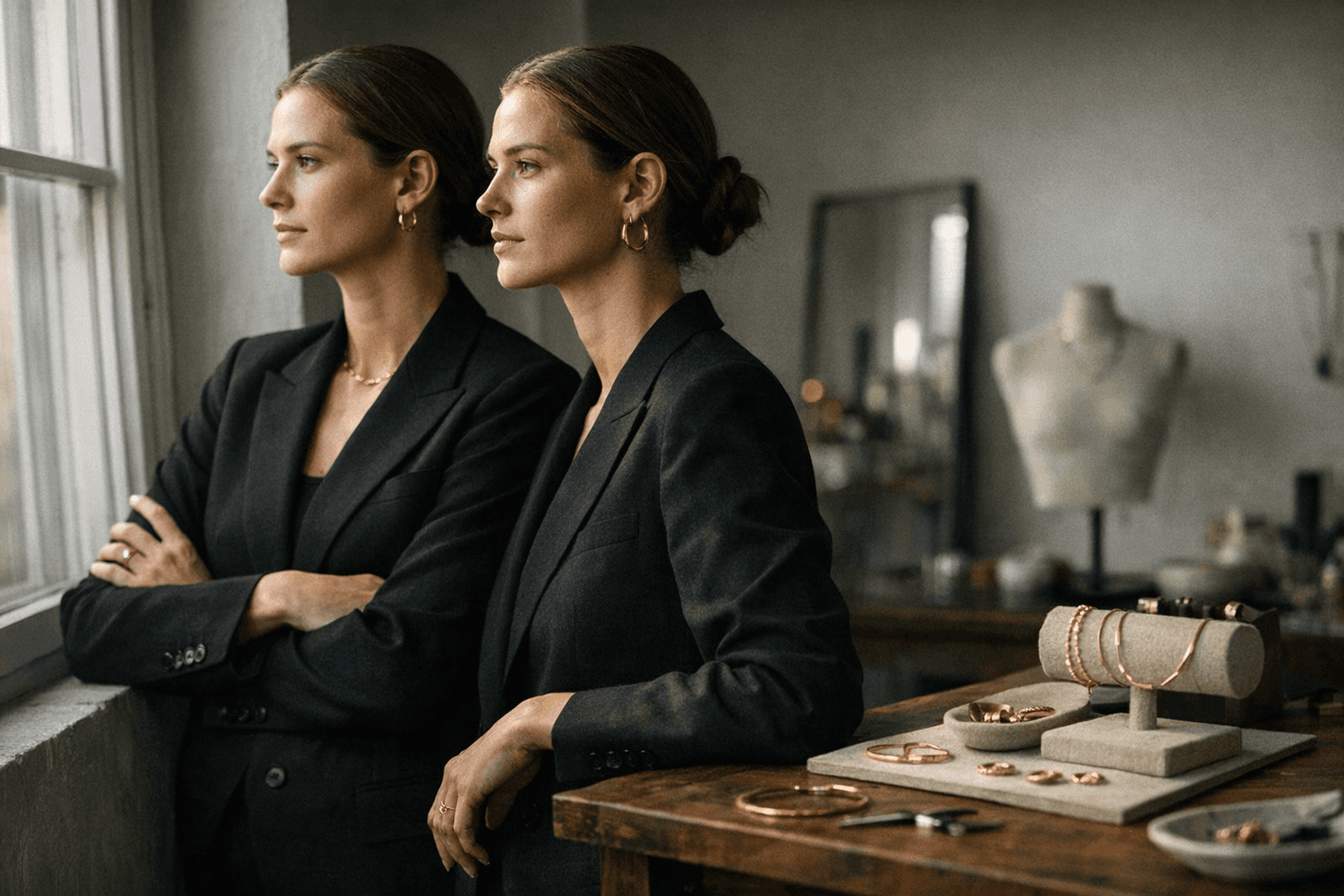
Lié Studio is not your average influencer brand. You might be surprised to learn that it's one at all, which is exactly how twin sisters and co-founders Cecilie and Amalie Moosgaard intended. That framing, direct from the brand's own story, tells you nearly everything about what makes this Copenhagen-born accessories label so quietly compelling in a market crowded with founder-forward social media aesthetics and logo-stamped everything.
The Anti-Influencer Brand Built by Influencers
The Moosgaard twins occupy an unusual position in the contemporary accessories landscape. They have the reach and the audience that most emerging brands spend years trying to cultivate, yet they have deliberately chosen not to weaponize it. "We wanted Lié to be a steady-growing company that could stand on its own, without us pushing it on our social channels," Amalie says. In an era when founder visibility is treated as a growth strategy unto itself, that restraint is practically a provocation. It also reflects something deeply Scandinavian: a design philosophy that trusts the object to do its own convincing.
The result is a brand that has built its reputation on craft and coherence rather than content calendars. Lié Studio's pieces, sculptural hairpins, small hoops, bags, belts, and small leather goods, earn their following through the kind of slow accumulation that happens when people actually wear something repeatedly and others ask where it came from. That word-of-mouth economy is harder to engineer than a paid campaign, and arguably more durable.
What Copenhagen Practicality Actually Looks Like in Gold
Scandinavian minimalism is a phrase that gets applied so broadly it risks meaning nothing. What distinguishes Lié Studio's interpretation is the word "practical." Copenhagen's design culture has always prized function alongside form, a city of cyclists and commuters who need their accessories to work as hard as they look. That ethos shows up directly in the brand's product vocabulary: hairpins that hold their shape without sacrificing sculptural elegance, small leather goods that complement rather than compete with the jewelry, hoops minimal enough to wear from morning to evening without adjustment.
Cecilie's description of the brand's design language is precise: "We still use the same shapes: soft and rounded. We create pieces that strike the balance between minimalist and standouts." That balance is harder to achieve than it sounds. A piece that is purely minimalist disappears; a piece that is purely a standout can overwhelm a look. The sweet spot, which Lié Studio appears to have found and committed to, is a piece that reads quietly at a glance and reveals its considered geometry only on closer inspection.
The Seasonless Commitment
In an industry structured around seasonal drops and trend cycles, Lié Studio's insistence on seasonless design is a genuine position, not just a talking point. Amalie is explicit about it: the team "still focuses on seasonless designs that stand the test of time." When you remove the pressure of each season's novelty, you can invest that creative energy into proportion, finish, and material quality instead. A piece designed to be worn in 2026 and again in 2036 requires a different kind of rigor than something calibrated to feel current for three months.
This is also where the no-logo stance becomes meaningful in context. "One thing we'll never do is logos or big branding," Amalie says flatly. That commitment is not simply an aesthetic preference; it is a structural decision about longevity. Logos date. They tie a piece to a particular moment in a brand's cultural status. A clean sculptural form, by contrast, belongs to no era in particular and therefore belongs to every one.
Growing a Brand Beyond Its Founders
The more philosophically interesting tension at Lié Studio right now is the founders' conscious effort to make the brand legible without them at the center of it. "Part of the evolution is us growing out of the brand," Amalie says. "It's no longer about Amelie and Cecilie, it's just Lié. We're figuring out what Lié looks like without the two of us at the front of it."
That transition is significant. Many founder-led brands discover, often painfully, that the brand and the founders have become synonymous to a degree that limits both. Lié Studio appears to be navigating this deliberately, before necessity forces the issue. The founders acknowledge that this evolution is not always easy: "It's really difficult because we feel very loyal to what we know and how we created the brand," Amalie says, "but our team is good at pushing us to look broader." The team's role here is worth noting. A design team that can push founders beyond their comfort zones while preserving the founding aesthetic is a rarer asset than most brands admit.
Cecilie frames this creative tension with characteristic directness: "Trying new things and developing the brand is the fun part." That lightness feels earned rather than performed, the confidence of founders who have a clear enough visual identity that they can experiment from a stable foundation rather than a shaky one.
What Comes Next
The most concrete signal of that broadening is an eyewear category set to launch in April. The move from jewelry and leather goods into frames is not an obvious leap, but it is a logical one for a brand whose strength lies in sculptural form at the scale of the face and neck. Eyewear, like a well-chosen hoop or hairpin, frames the face without overwhelming it. If Lié Studio applies the same soft-and-rounded vocabulary to its frames that it has to its accessories, the category extension will feel continuous rather than opportunistic.
The broader lesson from Cecilie and Amalie Moosgaard is less about any specific product category than about a philosophy of building. Steady growth, seasonless design, no logos, shapes that balance restraint with presence: these are not constraints but convictions. In a market that rewards noise, Lié Studio has bet on quiet. So far, Copenhagen's practicality appears to be paying dividends.
This article was produced by Prism’s automated news system from verified source data, official records, and press releases, then run through automated quality and moderation checks before publishing. The system is built and supervised by the people who set the standards it runs under. Read our full AI policy.
Did this article answer your question?


