Damson Idris’s Oscars brooch spotlights minimalist, one-of-a-kind craftsmanship
Damson Idris turned one brooch into a master class in restraint, proving minimalist jewelry can reveal its richest details only at close range.
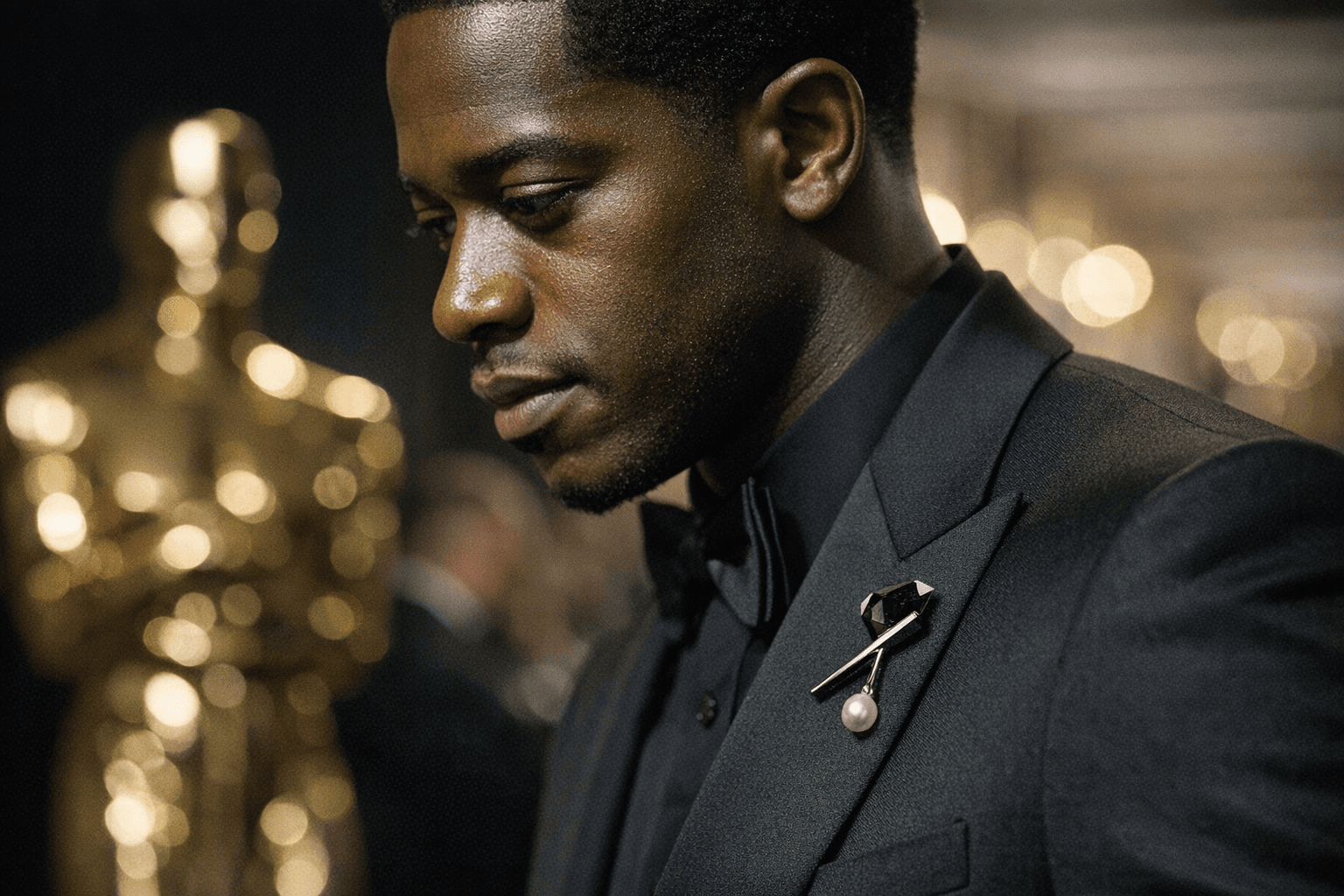
The power of one jewel
Damson Idris did not arrive at the Oscars dressed in ornament overload. He arrived with a single bespoke brooch, and that restraint is exactly what made it memorable. In a red-carpet moment crowded with polished men’s jewelry, the piece read like a lesson in how minimalism can feel more charged, not less, when every detail has been considered.
The brooch itself was built around a 7 ct. marquise blue diamond, framed by 42 diamonds and finished with an F1 engraving on the back. It took two months to design, and it became the final project of London-based craftsman Theo Lannou, a detail that gives the jewel a quietly poignant sense of closure. The marquise cut sharpened the silhouette, while the surrounding stones and hidden engraving made the piece feel intimate rather than merely large.
That is the central paradox of minimalist fine jewelry: the less surface clutter you show, the more the craftsmanship has to do. A piece like this does not depend on volume or layering to announce itself. Instead, it asks for a second look, and then rewards that scrutiny with proportion, precision, and personal meaning.
Why this brooch felt modern
The Oscars red carpet was already leaning toward restraint, with men’s jewelry favoring a cleaner, less-is-more approach. Brooches were one of the clearest expressions of that mood, appearing alongside Michael B. Jordan’s David Yurman brooch suite and Channing Tatum’s Tiffany & Co. Bird on a Rock interpretation. Idris’s brooch fit the moment because it offered a single focal point rather than a scattered display of embellishment.
That matters for minimalist jewelry because the strongest pieces are often the ones that resolve into one clear idea. Here, the idea was not just sparkle, but specificity: an F1 reference on the back, a marquise blue diamond at the center, and a constellation of 42 diamonds supporting the composition. The jewel looked spare from a distance, then became far more personal the closer you got.
Idris also wore additional Didris pieces with the look, including a signet ring with emerald, a baguette ring with tourmaline, and a solitaire ring with tourmaline. Those choices extended the same language of restraint, where shape and stone color matter more than obvious excess. Even in a more pared-back register, the styling still carried intention.
What Didris is building behind the scenes
The brooch also says something larger about the brand behind it. Didris is a year-old business, and this Oscars appearance was its first. Chief operating officer Chip Longenecker said the jewel was exceptionally well received, a response that suggests the brand’s appetite for quiet distinction is landing quickly.
The house presents itself as more than a celebrity label. On its own site, Didris describes itself as a fine jewelry house founded by Damson Idris, one that hand-selects artisans and collaborators from around the world and unites traditional techniques with bold, innovative artistry. That framing matters, because minimalist jewelry can easily veer into generic simplicity unless it is anchored by real making.
The brand’s backstory gives that making a personal edge. Idris has rooted Didris in family history, especially his mother, Silifat, which gives the label a sense of inheritance rather than pure image-building. In fine jewelry, that kind of narrative is not decorative. It becomes part of how a piece earns its weight.
The materials tell their own story
Didris also works in a vocabulary that feels luxurious without becoming flashy. The pieces use 18-karat yellow and rose gold, are handcrafted in Mumbai, and draw diamonds and gemstones from Namibia, Botswana, and South Africa. The stones are Kimberley Process-certified, which places provenance and accountability at the center of the brand’s identity.
For minimalist jewelry, this kind of sourcing and craft detail is not background noise. It is the point. A simple design can look empty if the materials are ordinary, but the same design becomes arresting when the gold has depth, the stones have pedigree, and the workmanship is visible in the polish, fit, and finish.
That is why the brooch matters as more than a red-carpet talking point. It demonstrates how a jewel can stay visually restrained while carrying a dense web of labor, geography, and memory. Minimalism, in the right hands, is not about withholding interest. It is about concentrating it.
What to look for in understated fine jewelry
The most compelling minimalist pieces rarely rely on one trick. They tend to combine a clear silhouette with a hidden detail that only appears up close, whether that is an engraving, an unusual stone choice, or a precise handmade finish. Idris’s brooch hit all three notes: a strong marquise shape, a vivid blue center, and a personal inscription on the back.
Look for these signs when a piece claims minimalism:
- A single focal stone or form that holds the eye without needing a crowd around it
- Finishing details on the back, inside, or underside, where craftsmanship often becomes most revealing
- Materials with a real story, from the gold alloy to the origin of the stones
- Proportion that feels deliberate, not simply small
- A design that still reads as personal when separated from an outfit or red-carpet setting
The best understated jewelry does not disappear. It waits. Damson Idris’s brooch proved that the most disciplined objects can also be the most expressive, because in fine jewelry, restraint is only truly powerful when every hidden detail has been built to withstand a close look.
This article was produced by Prism’s automated news system from verified source data, official records, and press releases, then run through automated quality and moderation checks before publishing. The system is built and supervised by the people who set the standards it runs under. Read our full AI policy.
Did this article answer your question?


