DR Congo’s World Cup suits turn leopard brooches into a statement
DR Congo turned a World Cup arrival into disciplined men’s jewelry, using one leopard brooch to carry identity, history and polish. The look made restraint feel ceremonial.

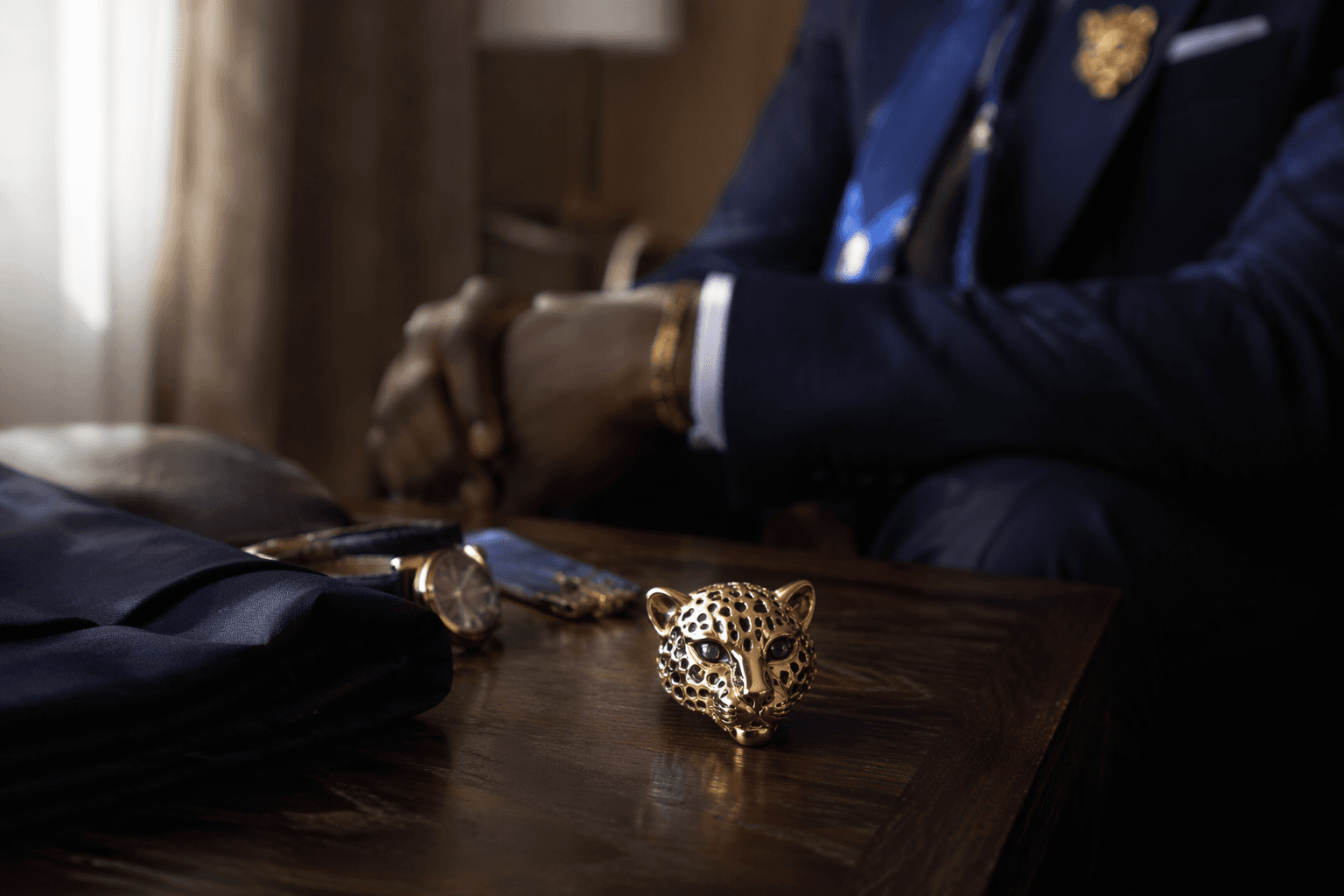
The sharpest accessory in DR Congo’s World Cup arrival was not a chain, watch or bracelet. It was the leopard brooch pinned at the lapel, repeated across the squad so the motif read like a uniform rather than a flourish. Designed by Alvin Junior Mak of JMAKxPARIS, the look folded Congolese identity, Sape elegance and the Leopards nickname into one disciplined visual system.
One brooch, repeated across 26 suits
Mak built the arrival look around black suits with leopard-print or leopard-panel detailing, gold leopard pins or brooches, and matching leopard-print travel bags. That repetition matters: instead of letting each player improvise with separate accessories, the team wore one emblem in sync, which made the jewelry feel deliberate and modern. In minimalist terms, the brooch did the work of several pieces at once, signaling status, unity and a clear point of view without crowding the chest.
The effect was especially strong because the leopard motif was not random ornament. It belonged to the team’s nickname, the Leopards, so the brooches read as identity markers before they read as decoration. When every lapel carries the same symbol, the eye does not drift from one accessory to the next. It locks onto a single motif and remembers it.
The tailoring is part of the jewelry
The jewelry only worked because the clothes around it were so controlled. The suits were sharply cut, with the leopard detail set against dark fabric, so the gold brooches had the contrast they needed to flash without looking loud. Even the travel bags were coordinated, which extended the visual language beyond the lapel and made the whole arrival feel choreographed from head to toe.
That is the lesson for minimalist jewelry: the setting matters as much as the object. A brooch on a plain jacket front has a cleaner read than the same piece pinned onto a busy outfit, and gold hits harder against black than against a softer palette. Mak’s approach used those simple rules with precision, letting one motif travel across tailoring, hardware and luggage without losing clarity.
Why the leopard means more than fashion
Mak said the design was inspired by Congolese culture and the Sape tradition of elegant dress, a style language built on dignity, aspiration and careful presentation. He also said he wanted the outfit to change perceptions of Congo and to celebrate those who “dare to dream bigger.” That gives the brooches a social role as well as an aesthetic one: they are not just decorative pins, but small, legible symbols of national pride.
The references run deeper than the current squad. The styling nods to the 1974 Zaire team, the first sub-Saharan African side to qualify for a World Cup finals, which gives the leopard motif a historical spine. This is why the look felt more like a statement of continuity than a costume. It linked the present team to a landmark moment in African football history while still looking contemporary enough to race across social media.
DR Congo earned the return by beating Jamaica 1-0 after extra time in Guadalajara on 31 March 2026. FIFA says this is the country’s second World Cup appearance and its first since 1974, after a 52-year absence from the tournament. FIFA also describes the squad as 26 players carrying the flag for a country of 100 million football lovers, which helps explain why the arrival look landed so widely and so quickly.
How the brooch becomes a minimalist statement
The power of this look is that it proves a single brooch can replace a whole stack of accessories. It can carry symbolism the way a ring stack, a chain or a loud tie might, but with more discipline and far less noise. In that sense, the DR Congo arrival is a useful template for men’s minimalist jewelry: choose one form, repeat it cleanly, and let the object’s meaning do the rest.
- one motif, the leopard, repeated across the group rather than scattered into different symbols
- one metal tone, gold, set against dark tailoring for maximum contrast
- one placement, the lapel, which kept the jewelry close to the face and visible in photographs
- one supporting system, from panelled suits to matching bags, so the brooch did not float alone
A few visual cues made the formula work:
Even the humor around the look mattered. Mak joked on local television that the leopard motif was not meant literally, which softened the presentation and kept it from tipping into costume. That self-awareness is part of what made the styling feel current: it was proud, but not pompous; ceremonial, but not overworked.
The result is a reminder that the most memorable men’s jewelry does not always come in multiples. Sometimes the strongest answer is one sharp motif, repeated with discipline until it reads like identity itself.
This article was produced by Prism’s automated news system from verified source data, official records, and press releases, then run through automated quality and moderation checks before publishing. The system is built and supervised by the people who set the standards it runs under. Read our full AI policy.
Did this article answer your question?


