Flat-back earrings, the minimalist pick for all-day comfort
Flat-back earrings solve the poke-factor of traditional backs, but only if the gauge and fit match your piercing. Here is how to wear them for sleeping, healing, and long days.
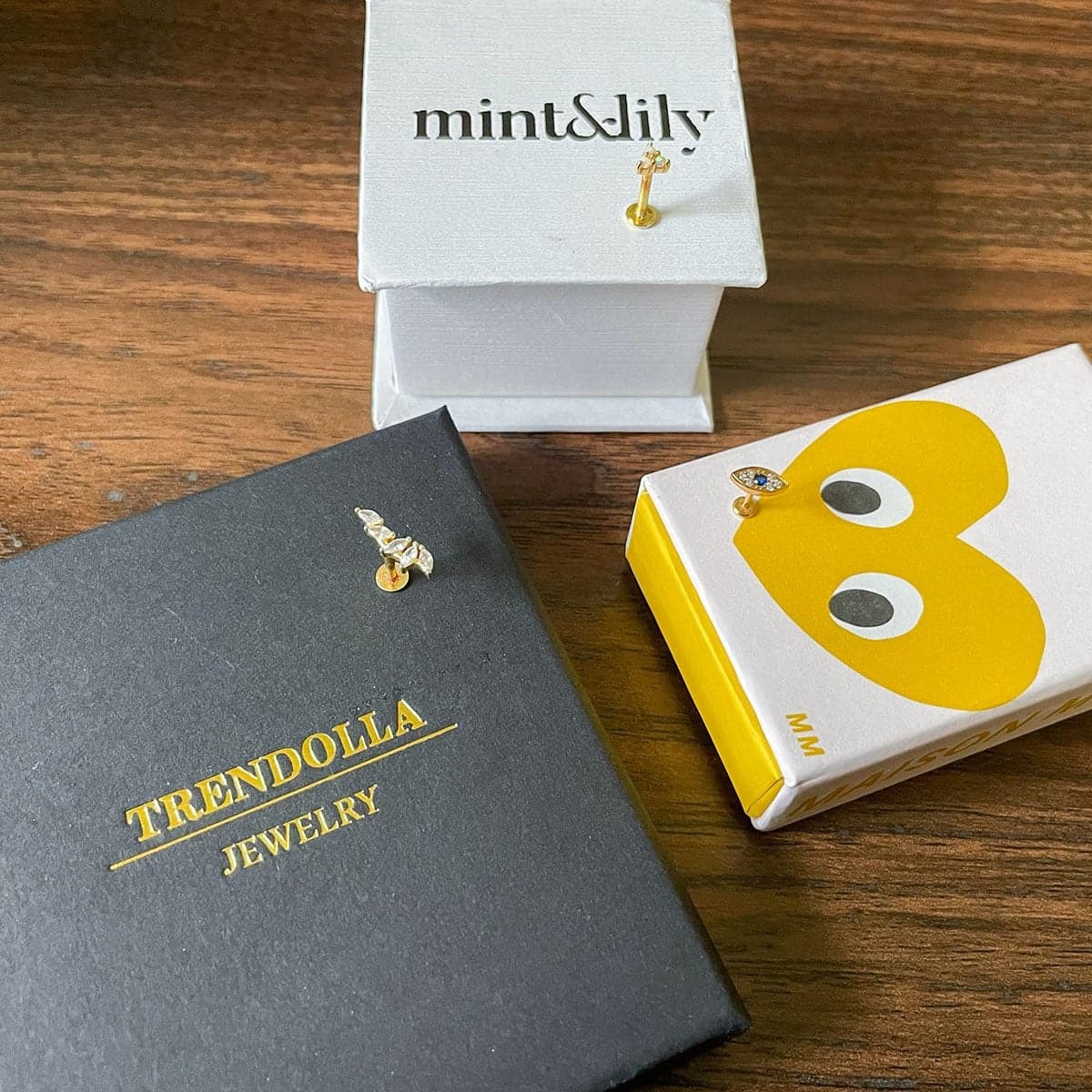
Flat-back earrings earn their minimalist reputation by disappearing into the ear. Instead of a butterfly back or a protruding post that presses into skin, the back sits flush, which is why the category is often called nap earrings. That low-profile shape makes them appealing for people who want jewelry that can move from morning to night without feeling fussy, but comfort still depends on the right fit.
What flat-back earrings actually are
The simplest way to think about flat-back earrings is as precision jewelry for the ear: small, close to the skin, and designed to avoid the poke-factor of traditional backs. The best versions are petite studs, tiny hoops, or endless hoops that keep the silhouette clean and compact. They fit neatly into the broader minimalist ear-stacking look, where the goal is not decoration for its own sake but a line of jewelry that sits quietly and consistently.
The name matters because it explains the function. Nap earrings are built to be comfortable enough to sleep in, but that does not mean every earring with a small profile belongs in that category. The shape, the post length, and the way the piece meets the anatomy all have to work together.
Fit is the difference between comfort and irritation
This is where professional piercing guidance becomes essential. The Association of Professional Piercers, a California-based international nonprofit founded in 1994, stresses that jewelry must be the correct style and gauge for the specific piercing location and the wearer’s anatomy. When the fit is wrong, the risks rise quickly: swelling, embedding, catching, migration, and rejection all become more likely.

That is the part of the story that many minimalist shoppers miss. A flat back is not automatically a better back. If the piece is too small, it can press into tissue and create swelling or embedding. If it is too large, it can catch and cause unnecessary trauma. The most wearable minimalist earring is the one that disappears into the ear because it was chosen for that ear, not just for the look.
For that reason, flat-back earrings are especially useful in the healing phase of a new piercing, when jewelry needs to stay in place. Initial ear piercings are often done with flat-backed studs rather than hoops or butterfly backs, because the flatter profile is easier to live with while the tissue settles.
Best tiny stud: the quietest version of all-day wear
If what you want is the least visible, least intrusive option, the tiny stud is the clearest answer. A petite flat-back stud gives you the comfort of a low-profile back with the cleanest possible front, which is ideal if you want one piercing to read as polished rather than styled. It is the version most likely to feel natural under hair, headphones, or a collar because there is so little to snag.
This is also the easiest shape to imagine sleeping in, provided the piercing is appropriate for that kind of wear. The key is not just size, but smoothness. Bustle’s sleep-in earring guidance points toward petite pieces with no sharp edges or dangling elements, which is exactly why tiny flat-back studs make sense for the minimalist ear.
Best tiny hoop: when you want shape without bulk
Tiny hoops bring a little more movement while staying within the minimalist lane. They are useful for readers who do not want the look of a straight post or a visible butterfly back, but still want a slim line that sits close to the ear. Kept small and smooth, they preserve the clean profile that makes this category appealing in the first place.
The caution here is that hoops and sleep do not always mix as neatly as marketing suggests. The safest sleep-in styles are still the petite, low-profile ones without sharp or dangling parts. A tiny hoop can work beautifully in an everyday stack, but the less it shifts and catches, the better it behaves in real life.
Best for sensitive ears: the piercing-first option
For sensitive ears, the most important detail is not trend, but placement and fit. Flat-back studs are the practical choice because they reduce pressure behind the ear and are commonly used for initial piercings, where stability matters most. If a piercing is fresh, healing, or easily irritated, the flat-backed form is often the smarter default than a hoop.
This is also where vague comfort claims should be treated with skepticism. A brand can call something gentle or easy-wearing all day long, but if it does not tell you the gauge, the intended piercing location, or whether the design is meant for new or healed piercings, the claim is unfinished. Comfort in piercing is engineered, not wished into existence.
Best for never taking off: only if the anatomy agrees
The dream of never taking off an earring is built into the flat-back category, but experts still draw a line. Sleeping with earrings is generally not recommended for older piercings, and the main exception is a new piercing that needs the jewelry kept in place while it heals. In other words, the earrings that work best for nonstop wear are the ones selected with discipline, not sentiment.
That discipline is what makes the style useful in everyday life. For showering, workouts, and long days, the appeal is the same: less surface to catch, less pressure behind the ear, and less visual clutter. The piece is doing a quiet job in the background, which is exactly what minimalist jewelry should do when it is working well.
Why the style feels more mainstream now
Flat-back earrings no longer read as a niche piercing-studio choice. Luxe piercing spaces and chains like Studs, Rowan, and Mejuri helped make the category feel polished and public-facing, not hidden away in the language of healing. That shift matters, because it moved flat backs out of the purely functional bucket and into the wardrobe of people who want a cleaner, more considered ear.
The broader trend is still about restraint: curated stacks, low-profile silhouettes, and jewelry that solves a practical problem without looking clinical. Flat-back earrings fit that mood perfectly. They are not about announcing themselves, but about making the ear look composed from every angle, even when life does not stop for the jewelry.
This article was produced by Prism’s automated news system from verified source data, official records, and press releases, then run through automated quality and moderation checks before publishing. The system is built and supervised by the people who set the standards it runs under. Read our full AI policy.
Did this article answer your question?


