Heritage Auctions mixes blue-chip gems with playful Cartier duck brooches
Blue-chip Kashmir sapphires and a $10,000 Cartier duck pair show how collectors now chase rarity with personality, not pedigree alone.
Heritage Auctions has built a sale around a beautifully modern collecting instinct: the desire for a jewel that can hold value and still make you smile. In Dallas, the Spring Fine Jewelry Signature Auction pairs serious stones, including Kashmir sapphires, fancy-color diamonds, rubies, and emeralds, with Cartier whimsy so specific it feels almost mischievous. For collectors of minimalist jewelry, that contrast is the point: the cleanest objects often carry the most meaning when the material is exceptional and the design is distilled to its essentials.
Blue-chip stones, pared down to their purest form
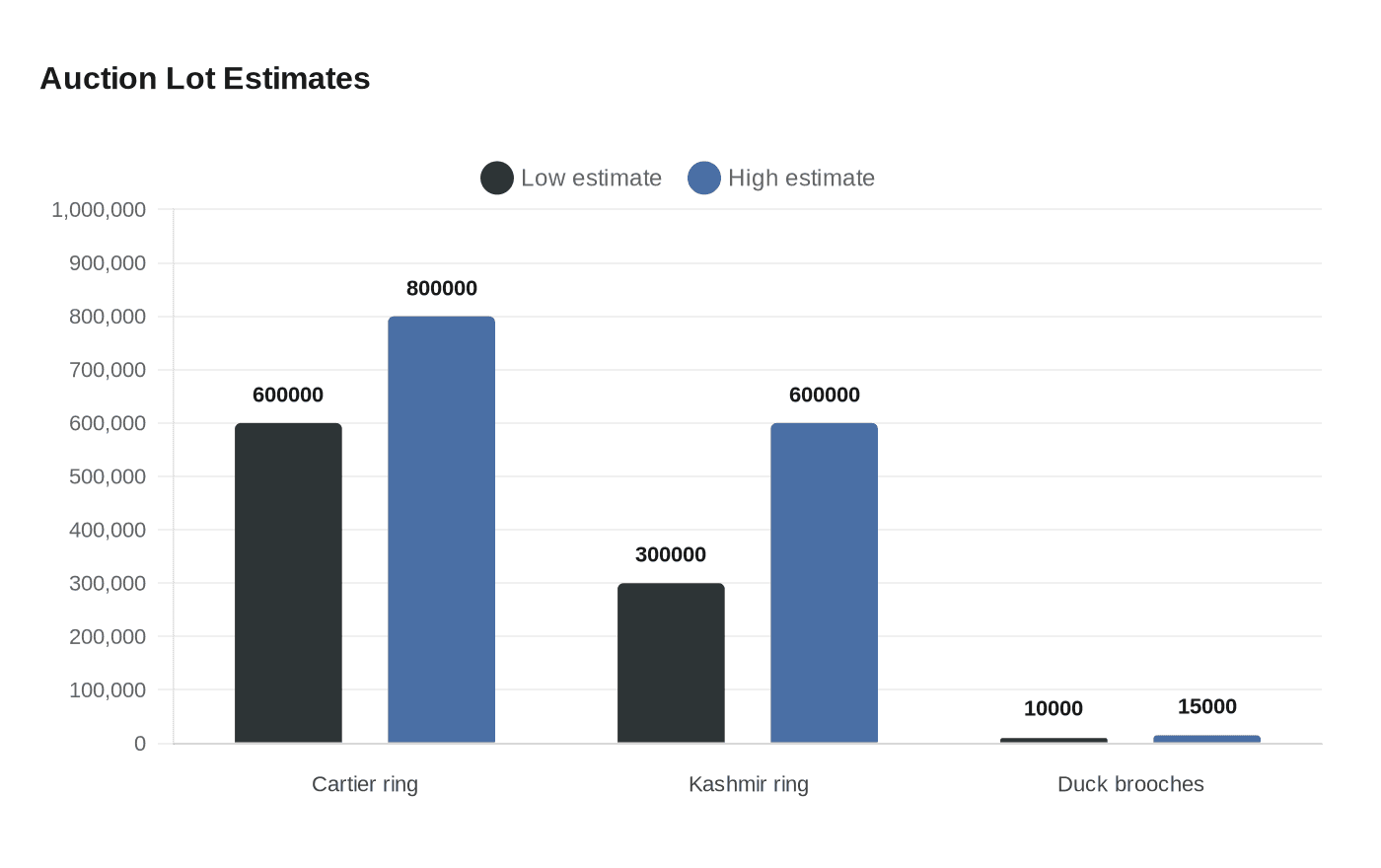
The anchor lot is a Cartier ring set with a 20.03-carat fancy intense yellow diamond, estimated at $600,000 to $800,000. Its current bid has already climbed to $525,000, a reminder that top-color diamonds remain the most legible form of jewelry investment. The appeal is not just size, but clarity of purpose: one remarkable stone, one restrained setting, no excess.
Another major lot is even more aligned with minimalist thinking, despite its scale. A platinum ring centered on a 6.59-carat octagonal Kashmir sapphire carries an estimate of $300,000 to $600,000, and Heritage says American Gemological Laboratories identified the stone as Classic Kashmir Origin. The octagonal cut keeps the silhouette crisp, while platinum lets the color do the work. That combination, stone first and structure second, is the quiet architecture of serious collecting.
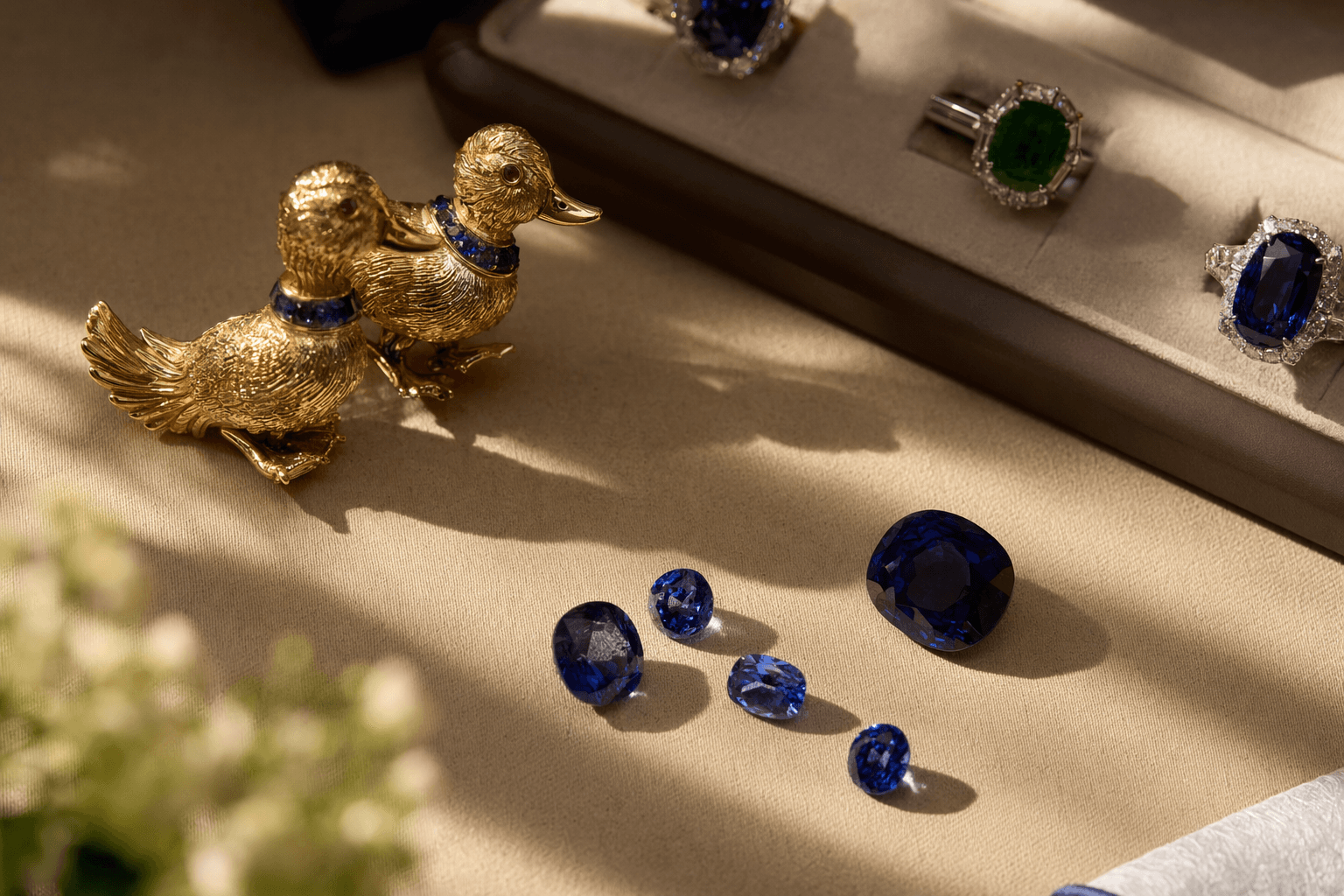
The sale goes deeper into this rarefied territory with a 10.01-carat Kashmir sapphire, a 6.45-carat faint pink diamond, a 4.93-carat light pink diamond, and a 10.85-carat fancy dark yellowish brown diamond. There are also sapphires from Burma, Ceylon, and Padparadscha, alongside Burmese rubies and Colombian emeralds, including a 25-carat Colombian emerald ring. Cartier, Van Cleef & Arpels, and Oscar Heyman appear throughout the catalog, a pedigree that matters because name alone is never the whole story. In a strong auction, maker, material, and cut must all speak in the same accent.
Why Kashmir still casts such a long shadow
Kashmir sapphires occupy a rare place in jewelry collecting because their mystique is geological as much as aesthetic. Heritage’s fine jewelry director, Gina D’Onofrio, points out that the mines discovered in the 1880s were depleted within just a few decades, which means the market now depends heavily on private collections and the occasional rediscovery of old stock. That scarcity explains why dealers have increasingly been sourcing rare material at auction, where provenance and condition can matter as much as the stone itself.
For a collector who favors understatement, Kashmir is the ultimate proposition. These stones rarely need elaborate framing; their velvety saturation and historic cachet do the heavy lifting. A well-cut sapphire in platinum can feel as modern as any newly designed jewel, precisely because it refuses ornament for ornament’s sake.
The Cartier ducks bring the sale to life
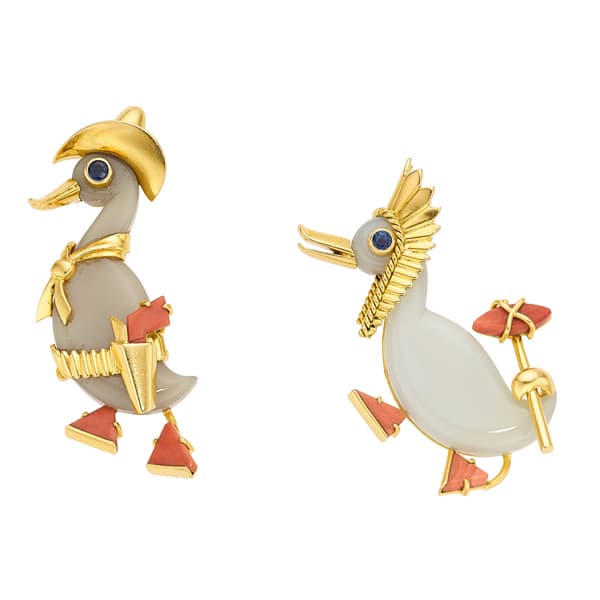
Then the mood shifts, and the room opens up. Two Cartier duck brooches, dating to circa 1952, introduce a playful register to a lineup of investment-grade gems. One is a cowboy duck, the other wears a Native American headdress, both carved from chalcedony and coral with sapphire eyes, and Heritage estimates the pair at $10,000 to $15,000.
These are not simply cute objects. Heritage says Cartier produced the ducks in extremely limited numbers, likely as boutique pieces or special commissions, which makes them desirable in the same way great signed jewelry always is: they are tiny artifacts of a design house at full imagination. Jill Burgum frames them as a postwar return to joy and lightness after years of austerity, and that reading fits the objects perfectly. Their charm lies in the tension between fine materials and almost cartoonish character, a balance Cartier once handled with remarkable confidence.
A useful market comparison comes from Christie’s, which sold a similar Cartier duck brooch lot in 2018 for $35,000. That result suggests the appetite for these pieces sits far above their estimate when collectors respond to rarity, condition, and subject matter at once. In a market crowded with polished seriousness, a duck brooch can become a prestige object precisely because it dares to be delightful.
What this sale says about taste now
Heritage’s lineup also includes a Van Cleef & Arpels scarecrow brooch and a De Beers hourglass containing more than 2,000 natural octahedral diamonds, both of which reinforce the same idea: collectors are no longer choosing between beauty and personality. They want the hard evidence of value, the colored stone with pedigree, the signed jewel with recognizable craftsmanship, and they also want a piece that carries a wink, a story, or a small bit of theater.
That is where this sale feels most current. The blue-chip stones offer the reassurance of enduring taste, while the Cartier ducks, the scarecrow, and the diamond hourglass supply the emotional charge that keeps jewelry from becoming merely financial. The real lesson is that collecting has grown more nuanced: pedigree still matters, but personality now has a market, and the most compelling jewels are the ones that can hold both.
Know something we missed? Have a correction or additional information?
Submit a Tip