How to Buy Delicate Jewelry: Quality, Construction, and Value Explained
Dainty chains and wafer rings demand tighter tolerances than almost any other jewelry category. Here's exactly when it's worth spending more, and when it isn't.
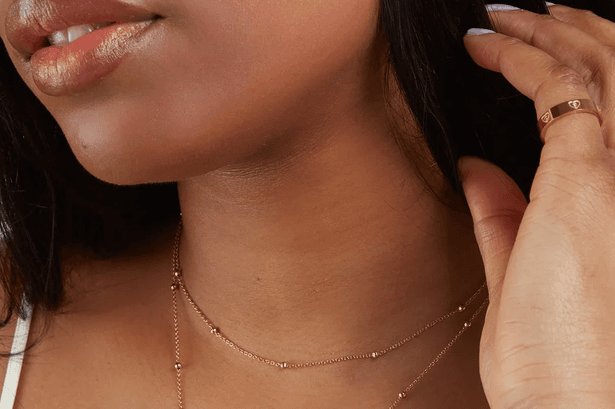
The thinnest chain in the room is doing the hardest work.
There is a version of a gold necklace so fine it disappears against the clavicle, perceptible only as a thread of light when you tilt your head. That chain, whether it costs $40 or $400, is performing more engineering work per millimeter than almost any chunky statement piece. The difference between those two prices isn't simply gold content; it's tolerance, construction, and the kind of longevity that turns a purchase into a cost-per-wear calculation worth making. Before you buy any delicate piece, the question isn't "do I love it?" but "will it survive being worn by me for the next five years?"
Why Smaller Means More Technical
Delicate jewelry is counterintuitively demanding to make well. A thick band can absorb imperfections in alloy composition; a 1mm ring cannot. Thin chains require tighter tolerances at every link because there is no structural redundancy, and each soldered point carries the full load. This is precisely why metal quality matters more in dainty pieces than in heavier ones.
A chain made from solid 14K gold, stamped 585 to indicate 58.3% pure gold alloyed with copper and silver for strength, will resist the daily micro-stress of fabric, movement, and skin chemistry in ways that lower-karat or plated pieces cannot. A 0.7mm sterling silver chain may look elegant on a mood board, but under real daily wear, catching on scarves, snagging in hair, and brushing against a laptop edge, it can kink, stretch, or break within weeks. That's not a flaw in sterling silver as a material; it's the physics of gauge at that scale. For long-term daily wear, 14K is the reliable floor. At 18K, stamped 750 for 75% pure gold, the alloy composition also reduces the risk of skin reaction for the roughly 15 percent of wearers who develop sensitivity to the nickel present in many standard white gold alloys.
Construction Cues That Actually Matter
Once the metal is established, look at how the piece is built. Soldered clasps and closed jump rings are the most important construction details most buyers never check. An unsoldered jump ring, one that was pinched shut rather than fused, can work open under the weight of a pendant or the tension of a clasp over time. Solid chain links, rather than hollow ones, resist flattening and kinking at fine gauges.
For necklace clasps, a lobster closure is the everyday standard because it won't pull open under tension the way a spring ring can. On dainty necklaces, look for micro-lobsters in the 5 to 7 millimeter range: they maintain structural security while keeping proportions visually correct. The hallmark is your verification tool. Purity marks are stamped inside a ring band, on the necklace clasp, or on the back of a pendant. They tell you exact metal composition: 585 for 14K gold, 750 for 18K, 925 for sterling silver. A maker's mark alongside the purity stamp provides traceability, a basis for resale, and confirmation that the piece came from an accountable source.
Gem Choices for Tiny Settings
In delicate jewelry, the setting does as much structural work as the stone itself. A bezel setting, where metal wraps fully around the stone's girdle, is the most protective option for daily wear and for ultra-thin bands where exposed prong tips would snag fabric or bend under repeated contact. A flush or burnish setting, where the stone sits level with the metal surface, offers similar durability with an even lower profile and no catch points.
Prong settings allow maximum light into a stone and are beautiful in the right context, but on an ultra-thin band or a chain-set pendant they carry real risk. A single bent prong on a piece too delicate for a standard repair tool means a stone waiting to be lost. If you love a prong-set piece, confirm that the band is substantial enough to support the setting without flex, and look for four prongs at minimum on any stone you plan to wear daily.
Styling and Longevity: The Capsule Approach
One of the most effective decisions in building a minimalist jewelry wardrobe is to allocate budget asymmetrically. Spend on one well-made foundational piece and stack it with less expensive companions. A solid 14K gold chain worn alongside a gold-filled or sterling silver layer reads as considered layering rather than mismatched budget; the quality piece anchors the look while the less expensive ones provide variety at lower risk. When a fashion piece tarnishes or breaks, you replace it. The 14K chain stays.
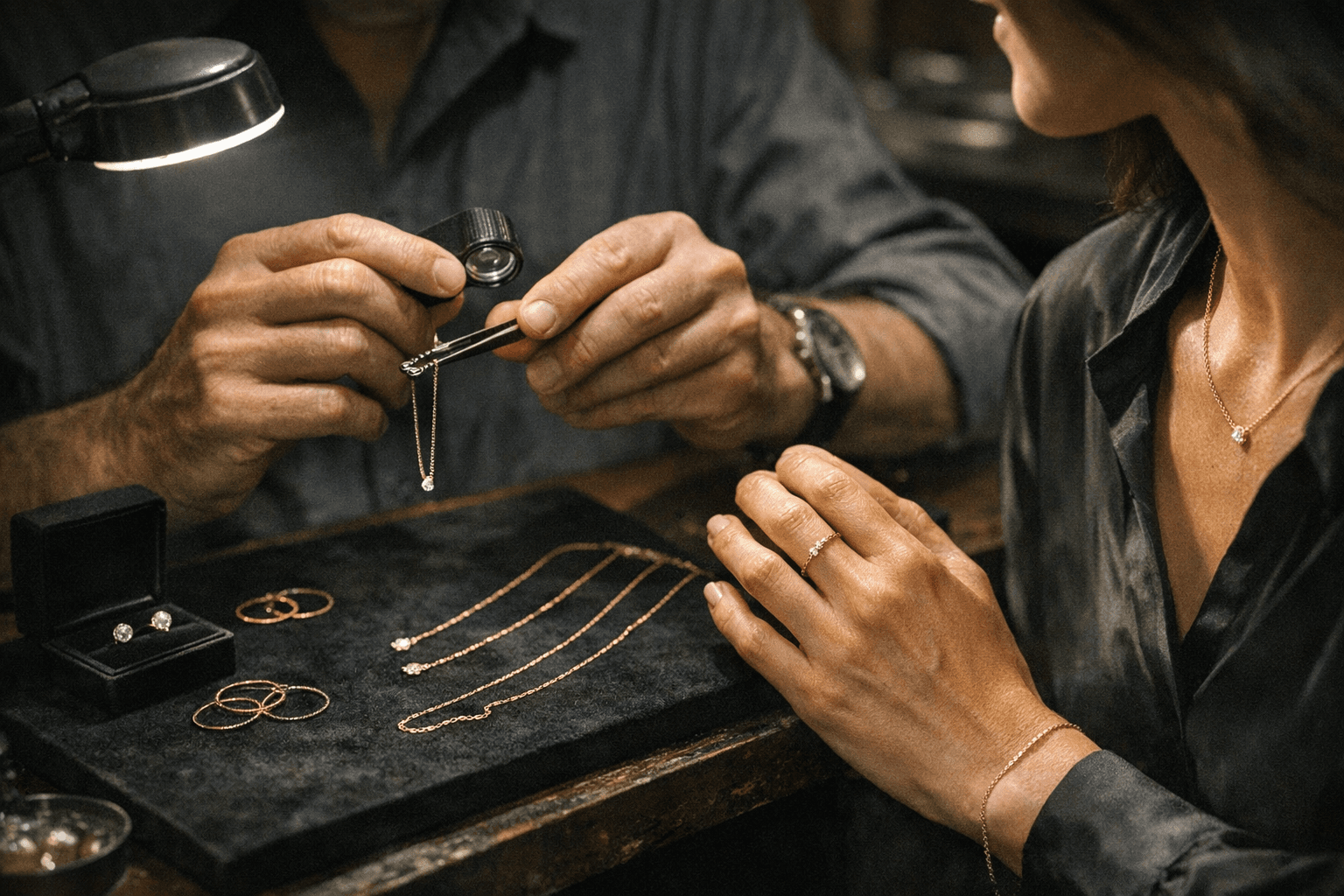
This approach extends the effective cost-per-wear of your better pieces dramatically. A $250 solid gold chain worn 300 days a year for a decade costs well under ten cents per wear. A $25 fashion chain replaced three times a year costs more per wear and generates considerably more waste.
Care, Cleaning, and When to Call a Professional
Dainty pieces need simple, consistent maintenance. A mild soap solution and a very soft brush applied once a month removes the body oils and product buildup that dull gold and silver faster than physical wear does. Store pieces individually in soft pouches to prevent the chain-on-chain contact that creates surface abrasion over time.
Professional servicing is worth scheduling once a year for anything worn daily. A jeweler can check prong integrity, re-solder weakened links, and replate white gold if the rhodium finish has worn through. Laser welding has become the standard for repairing fine chains because it reinforces tiny links with minimal heat spread, preserving the surrounding metal. Before purchasing, ask whether the maker offers repair services and whether the warranty extends beyond the standard 30-day return window. A policy covering manufacturing defects for a year or more is a meaningful differentiator for pieces you intend to wear for decades.
Three Archetypes: When to Spend, When to Save
The Everyday Chain
This is the clearest case for spending. It lives on your body 365 days a year, endures sweat, movement, and in many cases sleep and showers. It is also the piece most likely to fail at a weak link or an unsoldered clasp. Solid 14K in a cable or box link style is the minimum bar worth setting. Save on length variations or layering companions in gold-fill, which offers better longevity than standard plating and is a reasonable companion to a quality anchor chain.
Tiny Studs
The splurge-versus-save decision here pivots on closure type as much as metal. A pair of 14K gold posts with friction backs is a sound entry point. The upgrade argument strengthens when you move to a flat-back or threadless closure, which sits more securely through an active day and dramatically reduces the lost-earring risk that ends up costing more over time than buying a better pair upfront. A bezel-set stone adds protection without adding profile.
The Stackable Ring
This is the one category in a minimalist capsule where saving makes consistent sense, with one exception. Thin bands in solid gold do wear at contact points over years of stacking, and budget bands go oval faster than fine ones. But the stack's composition doesn't need to be uniformly expensive: one solid 14K band anchors the stack structurally and aesthetically, while sterling or gold-fill companions add visual weight without the same durability requirement, since they're easily replaced as they wear. The trigger to splurge on every ring in the stack is specific: a signed maker, a stone you care about, or a band you intend to wear alone.
Delicate jewelry rewards a different kind of attention than bold pieces do. The details that make a thin chain last a decade, a soldered clasp, a hallmarked alloy, a bezel-set stone, are invisible at arm's length. That invisibility is precisely the point, and precisely why they matter.
This article was produced by Prism’s automated news system from verified source data, official records, and press releases, then run through automated quality and moderation checks before publishing. The system is built and supervised by the people who set the standards it runs under. Read our full AI policy.
Did this article answer your question?


