How to care for minimalist jewelry, from silver to pearls
Minimalist jewelry shows every fingerprint, film, and tangle. A few disciplined habits keep silver, gold, and pearls looking crisp enough for daily wear.
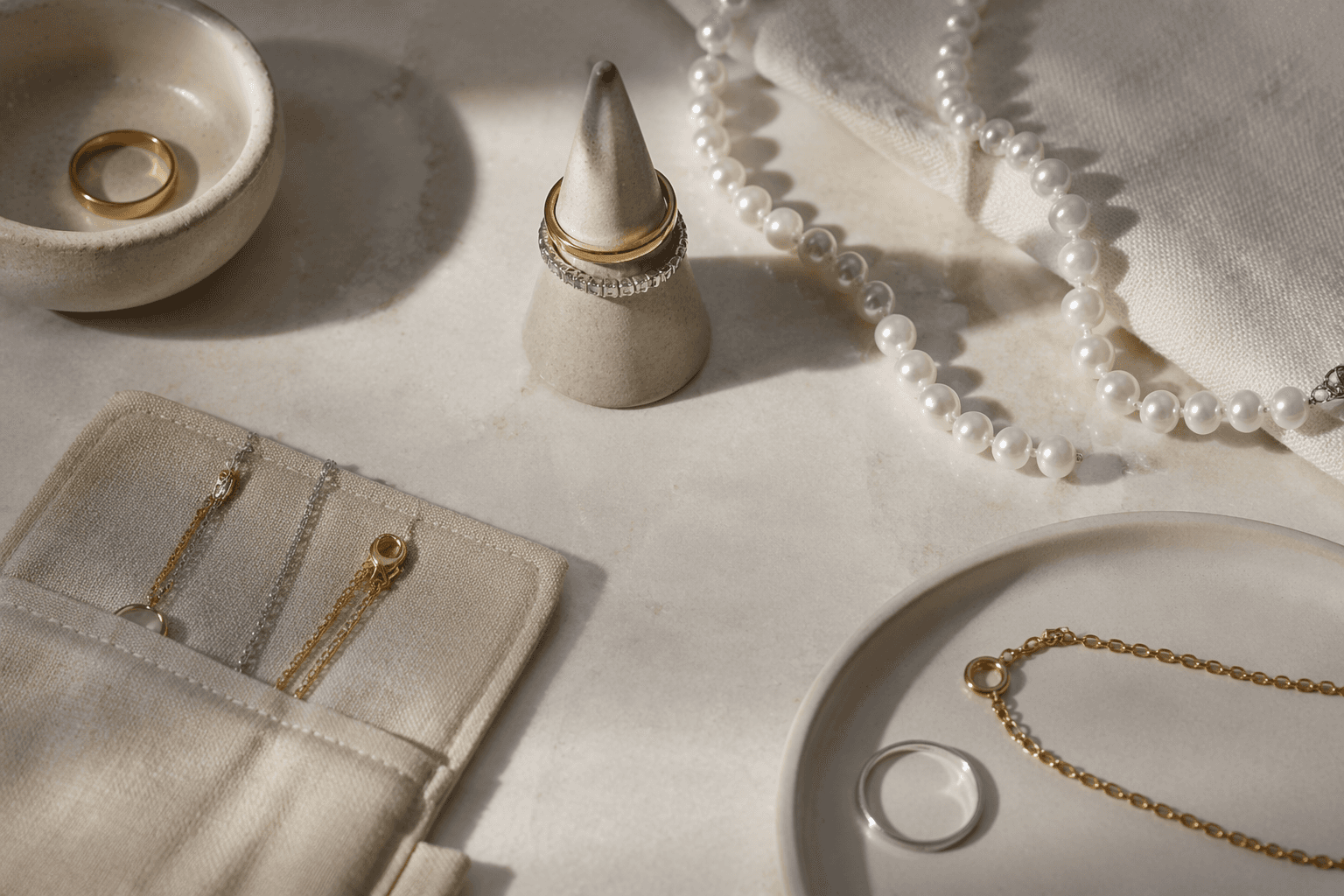
A slim chain, a small hoop, a stack of narrow rings, or a polished pearl pendant has almost no ornament to hide residue. Lotion haze, fingerprints, and fine scratches become part of the view if care slips.
Start with the daily reset
The simplest habit is also the most effective: wipe each piece after every wear with a clean, soft, slightly damp cloth. That single gesture removes the invisible film left by skin oils, perfume, makeup, and city air before it hardens into dullness. On minimalist jewelry, where a tiny surface often carries the whole design, that clean finish keeps a thin chain bright, a small hoop reflective, and a stacking ring sharp against the skin.
This is most important after the kind of wear minimalist jewelry is built for: all-day use. A necklace worn against lotion, a ring slid on and off through the day, or earrings touched repeatedly during a commute will collect more than you can see at first glance. The sheen disappears gradually, then suddenly, and the piece stops reading as crisp.
Keep chemistry out of the story
Gold, silver, and platinum all suffer when they are left in the path of cosmetics and household chemicals. Hairspray, lotion, perfume, cosmetics, chlorine, bleach, and ordinary cleaners can damage or discolor precious metal, and chlorine bleach can pit gold alloys. Often the cleanest-looking jewelry owes its polish less to a dramatic cleaning session than to taking it off before trouble starts.
Remove fine jewelry before swimming in a chlorinated pool, getting into a hot tub, or using household cleaners. Take jewelry off before salt water, sunscreen, lotions, and the shower, where even a quick rinse can leave a thin film that makes metal look dull and dingy. On minimalist pieces, that residue catches the eye immediately because there is nowhere for it to disappear.
Silver needs its own storage logic
Sterling silver is especially vulnerable to tarnish, which is why storage matters as much as cleaning. Keep silver in an anti-tarnish bag or cloth, rather than letting it sit exposed in a tray or dish where air and moisture can do their work. For fine chains and delicate bracelets, separate storage also prevents the sort of abrasion that can flatten a reflective surface.
Store each piece separately to avoid scratching and tangling. That advice is especially useful for minimalist necklaces and bracelets, where one kink in a chain or one scrape across a polished bangle can change the entire look. A jewelry box with individual compartments, soft pouches, or fabric-lined slots helps preserve the clean lines these pieces depend on.
Pearls deserve a gentler hand
Pearls are the delicate outlier in a minimalist collection, and their softness explains why. They rate about 2.5 on the Mohs hardness scale, which means they are very soft and easily scratched or abraded. In practical terms, that makes even small scuffs, rough edges, and careless storage habits more consequential for pearl studs, pendants, and thin-strand pieces than for harder stones.
Clean pearls with an unused makeup brush and warm, soapy water, a method that suits dainty settings where dust can lodge around a pearl cap or along a small clasp. Pearls should also be wiped clean after wear and stored in a soft pouch or case. Just as important, keep them away from sharp or rough objects. A single scrape against a ring with a rough edge, a metal zipper, or another hard piece in a crowded box can mark a pearl that otherwise looks effortless on the ear or at the throat.
Know when a tool is too aggressive
Convenience cleaners can be tempting, but not every piece is meant for them. Ultrasonic cleaners are not safe for all gems and jewelry, especially treated, delicate, or vintage pieces. Heat, solvents, steam, and ultrasonics can also affect many gemstone treatments. In minimalist jewelry, a tiny colored accent can carry the whole design, and a damaged treatment may be more visible because the stone is so small.
Care depends on whether a gemstone is natural, man-made, or treated. In practice, that means the tiny accent in a slim ring or pendant may need a different routine than the plain gold band beside it. A soft-bristled toothbrush can help remove buildup from crevices, but it should be used gently and with awareness of what sits in those crevices. A bezel, a prong, or a tiny setting around a colored stone may all hold grime differently, but none of them benefits from aggressive scrubbing.
Make annual service part of the system
Minimalist jewelry can look pristine for a long time, which is exactly why problems are easy to miss. Professional cleaning and inspection at least once a year can check for loose prongs, worn mountings, and general wear and tear. That annual check is especially useful for slim rings, small hoops, and fine chains, where a weak link or loose setting can go unnoticed until something slips free.
Annual servicing can also uncover hidden damage. A piece that still sits beautifully on the body may already have a stressed clasp, a thinned hinge, or a setting that is beginning to loosen. Jewelers of America, founded in 1906, recommends treating that kind of maintenance as part of proper ownership rather than an occasional repair.
This article was produced by Prism’s automated news system from verified source data, official records, and press releases, then run through automated quality and moderation checks before publishing. The system is built and supervised by the people who set the standards it runs under. Read our full AI policy.
Did this article answer your question?


