How to care for minimalist rings without losing their sparkle
Minimalist rings reward careful rituals: a weekly soap-and-water clean, a fast exit before workouts or chores, and insurance that can cover the moments sparkle can’t.
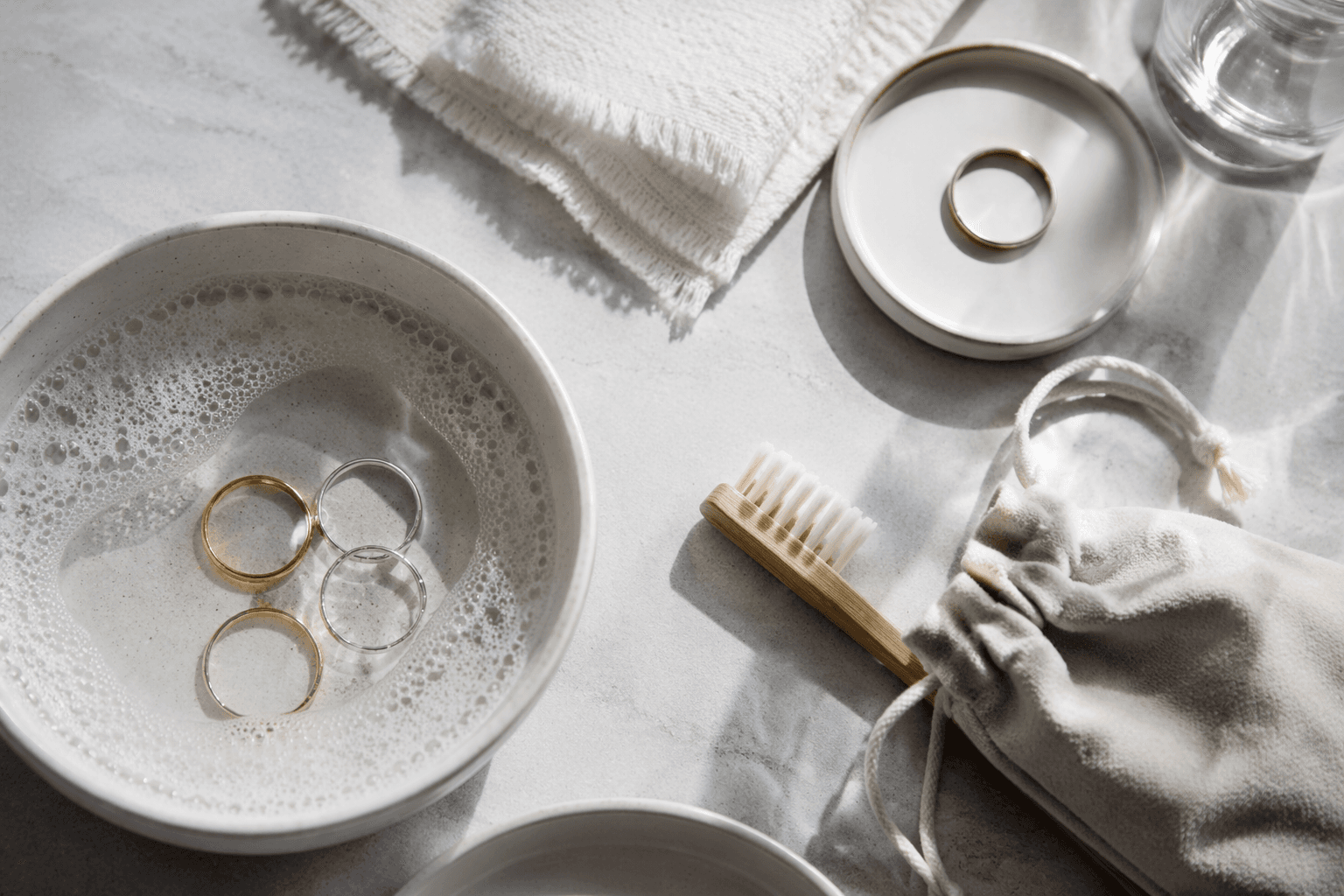
Thin-band engagement rings have become the new “it” sparkler, putting the center stone front and center but leaving slim shanks, low-profile settings, and tiny prongs to reveal wear quickly. Polished simplicity leaves little room to hide scratches, loosened stones, or dulling from daily residue.
Why delicate design asks for a lighter touch
The style looks airy and elegant, but that same spare construction can age faster than a heavier mount if it is treated casually. A narrow band bends more easily under pressure than a thicker one, and low settings can still collect hand cream, soap film, and kitchen grease along the metal where the eye least expects it.
GIA breaks diamond durability into three separate qualities: hardness, toughness, and stability. Hardness is the stone’s resistance to scratches and abrasion, which is why diamonds hold their polish so well, but toughness and stability matter just as much in real life, where rings get knocked against counters, exposed to detergents, and worn through long stretches of ordinary activity. The stone may be resilient; the setting around it is often the first weak point.
Clean more often, but clean gently
The simplest way to keep a minimalist ring bright is also the least dramatic. GIA recommends cleaning diamond jewelry once or twice a week with water and a few drops of mild dish soap. Let the ring soak, then use a soft, clean toothbrush reserved only for jewelry cleaning to loosen grime around the stone and under the setting, where lotion and dust tend to gather.
That cleaning routine matters because oils and grease can mute the fire of a diamond long before any real damage appears. A ring can look merely “a little tired” when what you are seeing is residue layered across the facets and the metal. A lint-free cloth should finish the job, leaving no fibers behind to catch on a prong or cling to the underside of a bezel.
Fragile settings, especially older prongs, should not be scrubbed aggressively, even if the ring looks heavily soiled. Excess pressure can distort the tiny claws that hold the center stone, and once a prong weakens, the repair is far more expensive than a careful cleaning ever would have been.
Treat the sink like a hazard zone
One of the easiest ways to lose a stone is also one of the most ordinary: rinsing a ring directly in the sink. GIA advises rinsing jewelry in a glass of water instead, because a loose stone or even the entire piece can slip away into the drain in an instant. That warning is especially relevant for minimalist rings, where the stone may be held by minimal metal and the setting can be easier to disturb than it appears.
A splash under the tap, a hurried scrub with a kitchen brush, or a paper towel left to catch a ring on the counter may feel efficient, but each one invites damage through speed. Use a glass of water, a reserved toothbrush, and a soft cloth instead.
Take the ring off at the right moments
A diamond ring can usually be worn every day, and The Knot dismisses the old superstitions about removing an engagement ring as myths. Taking it off when it makes sense is cleanliness and protection, especially when the day involves chemicals, impact, or repeated friction.
That means removing a ring before cleaning the house, exercising, or doing anything that can expose the setting to sudden knocks or harsh products. Soap, bleach, polish, and gym equipment can all be harder on a ring than people assume, and a minimalist design gives those hazards fewer barriers. Even the sleekest low-profile ring is still vulnerable when it is squeezed under a weight, scraped against a barbell, or soaked in solvents that dull the metal over time.
The same logic applies to anything that turns the ring into a tool. Open a jar without it, lift weights without it, scrub a sink without it. These are the moments when a delicate ring is most likely to bend, scuff, or catch, and each small impact leaves a mark that becomes easier to see on a simple, pared-back design.
Insurance is part of maintenance, not an afterthought
For a ring worn every day, protection is not only about polishing cloths and cautious habits. Jewelers Mutual says engagement-ring insurance can start as low as $5 per month or $60 per year and cover loss, theft, damage, and disappearance. It recommends insuring a ring as soon as possible after purchase, a sensible step when the piece is both emotionally loaded and physically exposed to the accidents of daily life.
Jewelers Mutual says its engagement-ring insurance is backed by more than 110 years of expertise and trusted by over a million jewelry owners.
This article was produced by Prism’s automated news system from verified source data, official records, and press releases, then run through automated quality and moderation checks before publishing. The system is built and supervised by the people who set the standards it runs under. Read our full AI policy.
Did this article answer your question?


