India Gems and Jewellery Show 2026 Opens in Mumbai with 400 Exhibitors
India's biggest jewellery trade floor opens in Mumbai today, as 400+ exhibitors signal a clear consumer shift toward lighter gold and diamond-accented everyday designs.
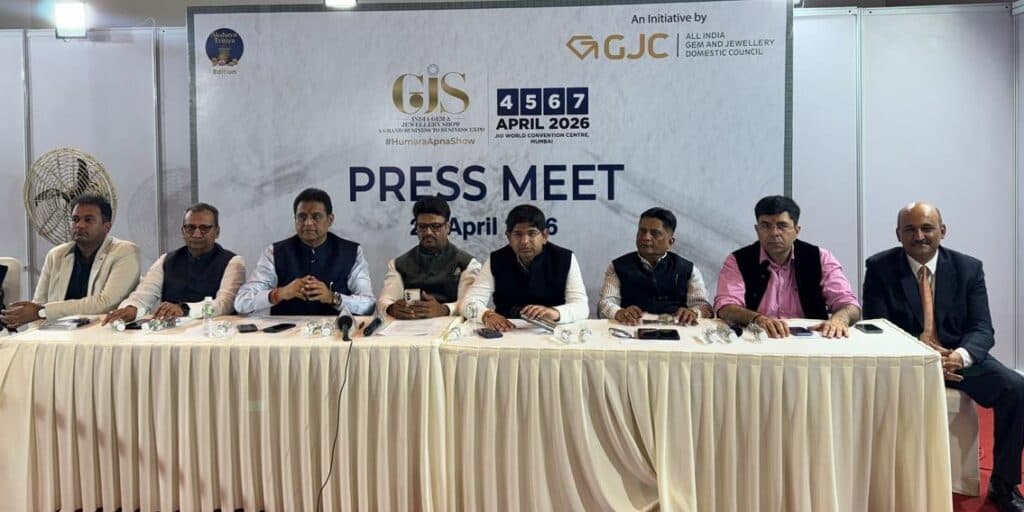
The name says everything. "Akshay Kala," Sanskrit for eternal art, isn't simply a show theme. When the All India Gem & Jewellery Domestic Council opened the 9th edition of the India Gems and Jewellery Show this morning at the Jio World Convention Centre in Mumbai, it was naming a sensibility that is actively reshaping how India's industry thinks about craft, wearability, and weight.
Running through April 7, GJS 2026 brings together more than 400 exhibitors across 700-plus booths, making it the country's largest B2B jewellery exhibition. Organizers expect upward of 15,000 visitors, with more than 2,000 hotel room nights arranged for hosted buyers sourcing ahead of Akshaya Tritiya. The dates are deliberate: the show sits precisely between Gudi Padwa and Akshaya Tritiya, India's two most auspicious windows for gold buying, placing it inside the peak wedding and festive demand cycle. Inaugurating the show was Chandrashekhar Bawankule, Maharashtra's Minister of Revenue, with jewellery patriarch Zaverilal V. Mandalia, known throughout the trade as Zaveri Kaka, serving as Guest of Honour.
Three design signals from the floor are worth tracking globally. The first is the sustained pivot toward lightweight gold. As prices have swung on geopolitical pressures, Indian consumers have responded not by retreating from the metal but by demanding less of it: thinner bands, smaller pendants, chains with reduced gauge. The shift maps precisely onto the international appetite for dainty, everyday-wear gold that needs no occasion to justify it.
The second signal is the growing preference for diamond-accented pieces over solid gold statement jewellery. Diamond-studded designs are gaining ground across price points, and India's sourcing capacity here is considerable; the country processes more than 90 percent of the world's diamonds by volume, with Surat and Mumbai at the center of global supply. For a minimalist wearer, this trend resolves into a single-stone solitaire drop, a pavé-edge hoop, or a slim bangle with a line of brilliant-cuts along the top rail, restraint with punctuation rather than maximalism.
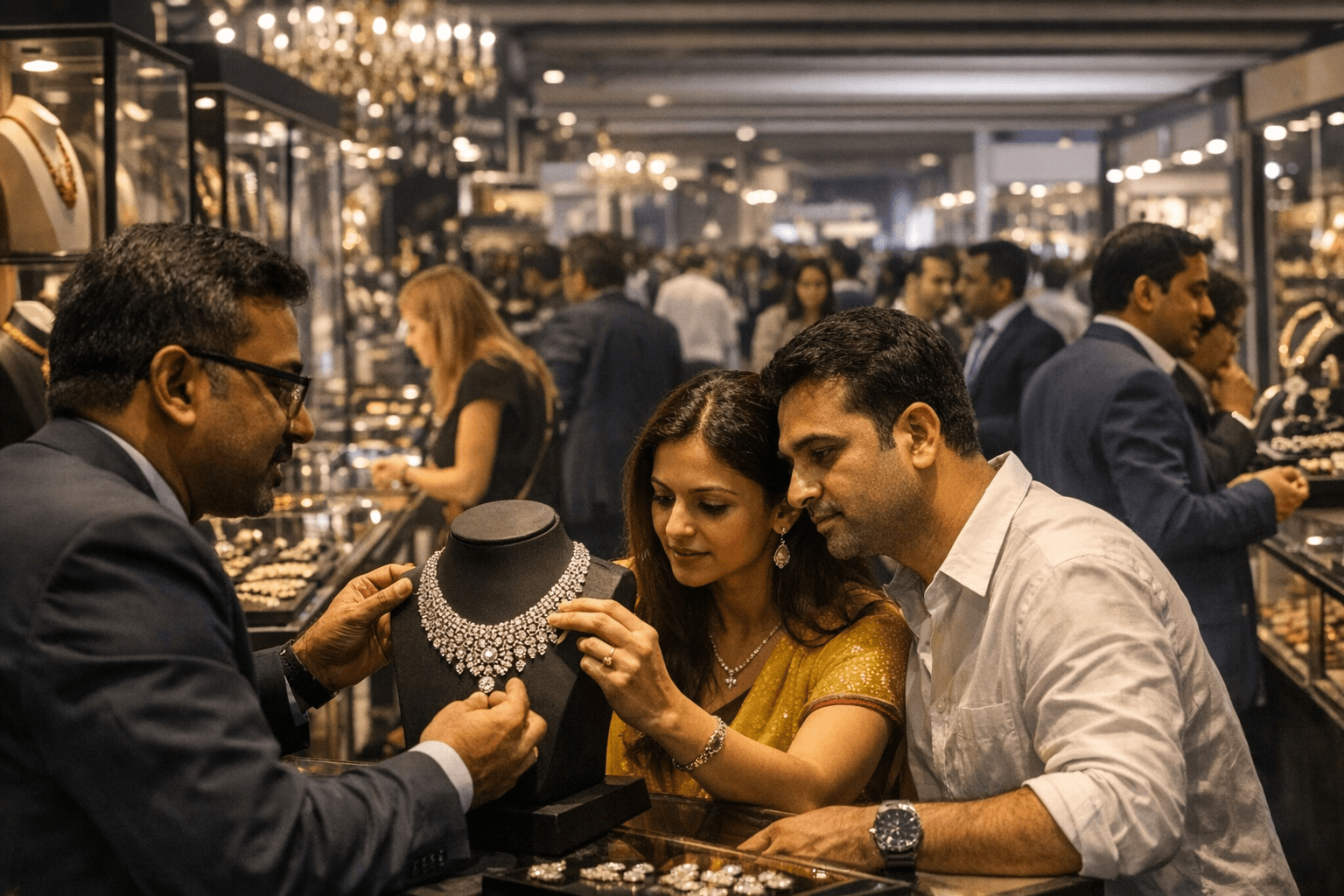
The third is craft legibility. The "Akshay Kala" concept positions artisanal technique as a premium differentiator, not an afterthought. As GJC frames India's Vision 2047 ambition around becoming what it calls the "Jeweller to the World," the internal conversation is shifting toward handcraft as a mark of distinction. On a pared-back piece, that reads as hand-engraved surface detail, granulation on a dome ring, or a woven chain construction that rewards close looking without announcing itself.
The show's programming reinforces these directions. Manthan, the pre-show conclave held April 3 at the same venue in collaboration with the India Gold Policy Centre, IIM Ahmedabad, the World Gold Council, GIA, and MCX, framed policy and trade strategy around Vision 2047 and India's global competitiveness. The Mindspeak seminar series running across all four days addresses consumer trends, product innovation, and retail transformation, while GJC Nite gives the trade floor's conversations a place to continue after hours.
GJC Chairman Rajesh Rokde called the edition "a proud celebration of India's eternal artistry and festive spirit" and said the show would "strengthen trade ties across the value chain." The collections sourced here over the next four days will reach retail floors in time for Akshaya Tritiya, carrying with them a clear design argument: that lighter, more precise, and more craft-conscious gold is where the Indian market is heading.
This article was produced by Prism’s automated news system from verified source data, official records, and press releases, then run through automated quality and moderation checks before publishing. The system is built and supervised by the people who set the standards it runs under. Read our full AI policy.
Did this article answer your question?


