Jade Ruzzo’s Lady capsule turns self-love into wearable objects
Jade Ruzzo’s Lady capsule turns a mirror, combs and hair pins into high jewelry, making self-care feel like heirloom ritual rather than costume.
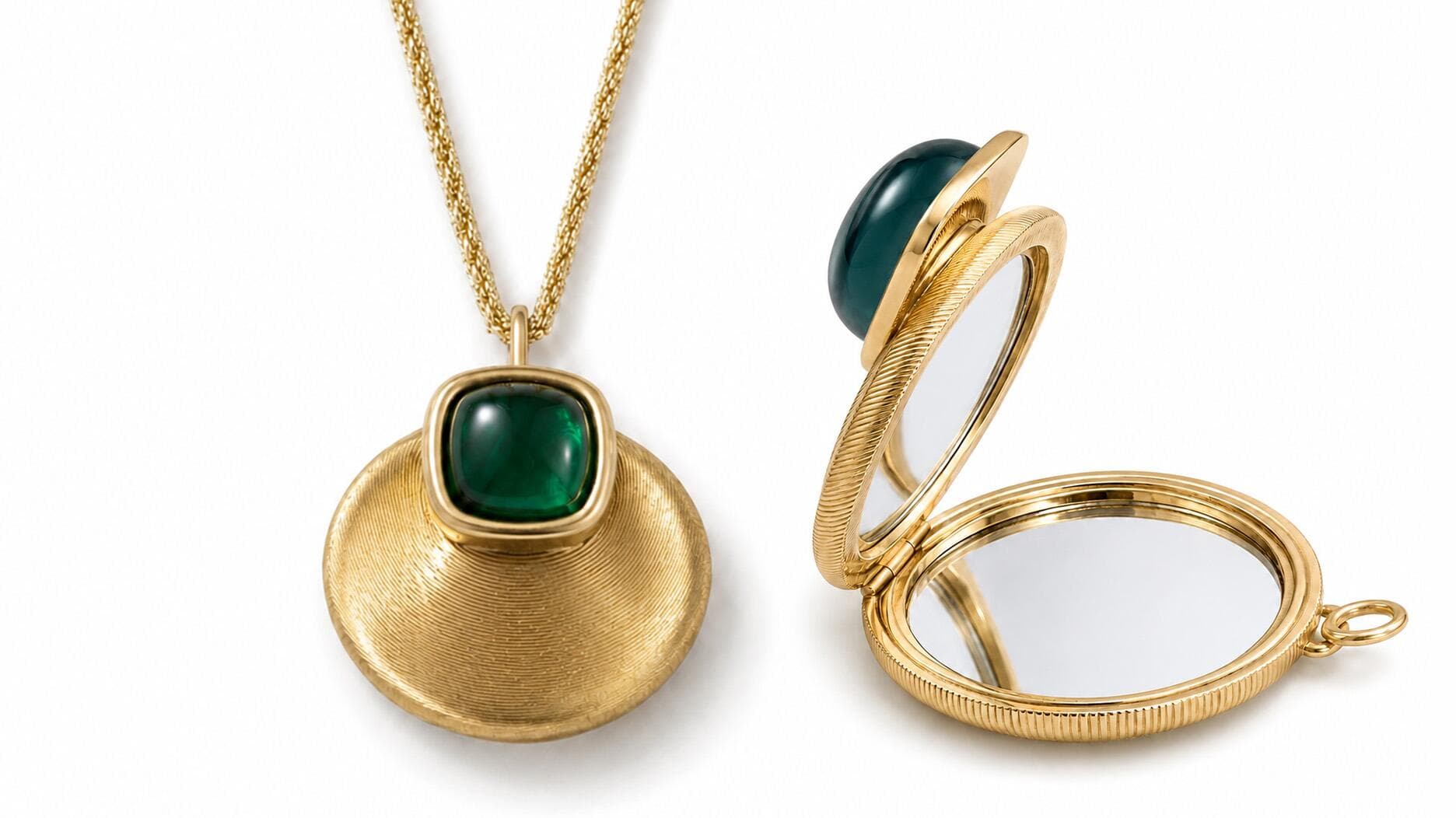
Jade Ruzzo’s latest capsule takes the vanity table and recasts it in 18-karat yellow gold. At its center is a compact-mirror necklace set with a 20.02-carat blue-green tourmaline, handmade in New York City and designed to open into a working mirror, so the object performs even as it adorns.
A capsule built around ritual
The Lady collection is built on self-love, divine femininity, and what the brand calls the raw power of truly adoring who you are. That framing gives the pieces a purpose beyond decoration: they are meant to celebrate femininity and, in the brand’s own language, “make you feel at home in yourself.”
The vocabulary is deliberately intimate. Instead of leaning on grand settings or hard-edged glamour, the capsule borrows from grooming objects that once lived on dressing tables and in evening bags, then translates them into jewelry. The result is a collection that feels functional as well as decorative, a rare balance in a market that often separates utility from beauty.
The Lady lineup includes a compact mirror pendant, a Lady Comb Necklace, a Lady Comb, a Lady Hair Stick, a Lady Hair Pin, and a Lady Bracelet. Seen together, they read like a set of wearable essentials, each one anchored in an action rather than a pose.
- Lady Compact Mirror with 20.02ct Blue-Green Tourmaline Cabochon
- Lady Comb Necklace
- Lady Comb
- Lady Hair Stick
- Lady Hair Pin
- Lady Bracelet
Why the mirror pendant matters
The centerpiece is the piece that makes the clearest argument for Ruzzo’s approach. Handmade in New York City and cast in satin-finish 18-karat yellow gold, the compact mirror is strung on a chain and opens to reveal a functional mirror inside. That alone gives it more narrative weight than a standard pendant, because the object is not merely symbolic, it works.
Its listed price of $51,200 puts it squarely in fine-jewelry territory, but the number makes sense when the materials are taken seriously. A large blue-green tourmaline in 18-karat gold, combined with handwork and a hidden mechanism, pushes the piece closer to a bespoke objet than a conventional necklace. It is the kind of jewel that asks to be judged not only on sparkle, but on engineering and intent.
That tension between ornament and utility is what gives the capsule its edge. A mirror, after all, is one of the most personal objects a person can carry. Translated into gold and gemstone, it becomes a statement about self-regard that is quieter than a logo and more intimate than a status piece.
Ruzzo’s minimalist language
Ruzzo launched her eponymous fine-jewelry line in 2022 after about a decade in fashion and personal styling, and that background still shapes the work. Her brand’s vocabulary is consistent: clean lines, classic shapes, unexpected edges, and a philosophy of “less is more.” She has also described fine jewelry as appealing because of its immutability as a form of creative self-expression.
That instinct shows up in the names and mood of her earlier collections too. Vic, Gloria, and Tennessee suggest a designer interested in memory, family echoes, and personal reference rather than anonymous luxury. Lady continues that thread, but with a sharper focus on feminine ritual, taking the compact mirror and hair tools as seriously as a ring or pendant.
Ruzzo’s own framing of the brand is revealing. “To me, nothing is more beautiful than a simple design that whispers instead of yells,” she has said, and Lady lives inside that sentence. Even when the pieces are expensive and gemstone-heavy, they do not reach for volume; they rely on proportion, restraint, and the authority of one strong object.
Why this feels bigger than one capsule
The broader appeal of Lady is not difficult to read. Quiet-luxury jewelry has been rewarding pieces that feel considered rather than flashy, and Ruzzo’s work has been described as trend-resistant for good reason. The capsule does not chase novelty for its own sake; instead, it makes a case for adornment that feels inherited, personal, and useful at once.
That is where the collection connects to a wider appetite for sentimental, ritual-based adornment over overt statement dressing. A comb necklace or mirrored pendant carries the scent of daily habit, but in Ruzzo’s hands those habits are elevated into heirloom form. The appeal lies in that duality: the jewelry looks precious because it is precious, but it also feels emotionally legible, as if it belongs to a life rather than a look.
Ruzzo’s inclusion in the Fashion Trust U.S. cohort underscores how firmly her work sits inside the current conversation about independent fine jewelry. Yet Lady does not read like a trend forecast. It reads like a polished answer to a very specific desire, for objects that hold memory, make room for ritual, and let luxury feel personal instead of performative.
In that sense, Lady is less about dressing up and more about returning to oneself with better-made tools. That is a far more durable idea than statement dressing, and one that gives the capsule its staying power.
This article was produced by Prism’s automated news system from verified source data, official records, and press releases, then run through automated quality and moderation checks before publishing. The system is built and supervised by the people who set the standards it runs under. Read our full AI policy.
Did this article answer your question?


