L’ÉCOLE Hong Kong exhibition spotlights precious coral and heritage jewelry
L’ÉCOLE Hong Kong uses precious coral to show how a restrained jewel can still feel alive, architectural, and deeply made.
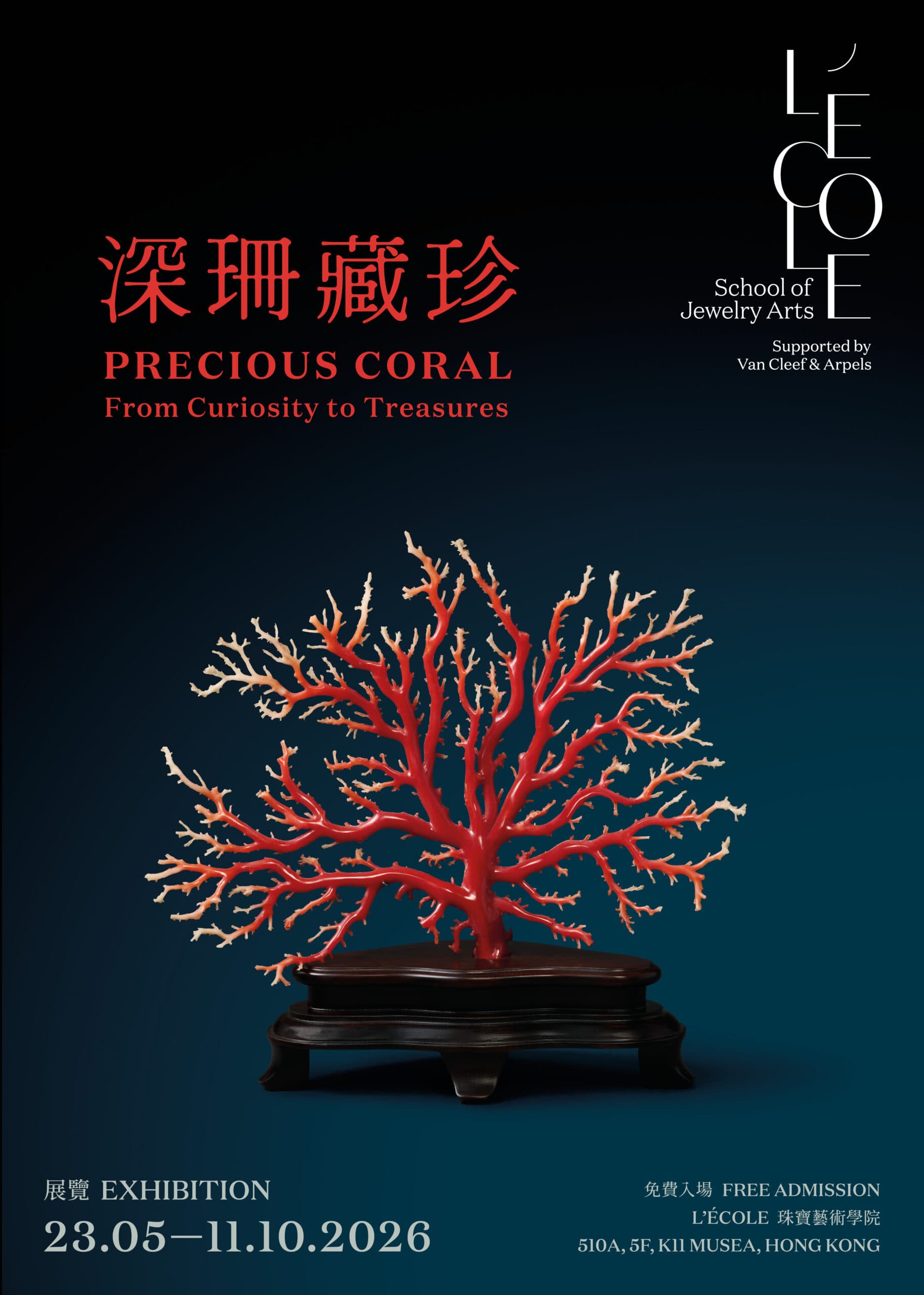
Precious coral can look lavish, but in the right setting it reads almost austere. L’ÉCOLE Hong Kong’s exhibition, “Precious Coral, from Curiosity to Treasures,” makes that case with about 120 jewelry creations and exceptional specimens, turning a material often associated with ornament into a lesson in color, structure, and disciplined craft. The show is free and open to the public, and its guided tours in English, Cantonese, and Mandarin make the subject accessible without stripping away its depth.
A museum-like coral lesson in the middle of Hong Kong
The exhibition runs from May 23, 2026 to October 11, 2026 at L’ÉCOLE’s Hong Kong campus in K11 MUSEA, Victoria Dockside, 18 Salisbury Road, Tsim Sha Tsui, Hong Kong SAR. L’ÉCOLE describes it as its largest exhibition in Hong Kong to date, and the scale matters: this is not a trend floor dressed up as culture, but a serious presentation built around material knowledge. That makes it especially useful for readers who want to understand why one coral jewel can feel refined and another can slide into costume.
The curation looks at precious coral through biology, gemology, craftsmanship, and history, which is exactly the right framework for minimalist jewelry. Minimalism is not just about having less metal or fewer stones. It is about whether every element earns its place, and coral is a strong test case because its appeal depends on both natural color and the quality of the cut, polish, and setting.
Why coral works when the design is disciplined
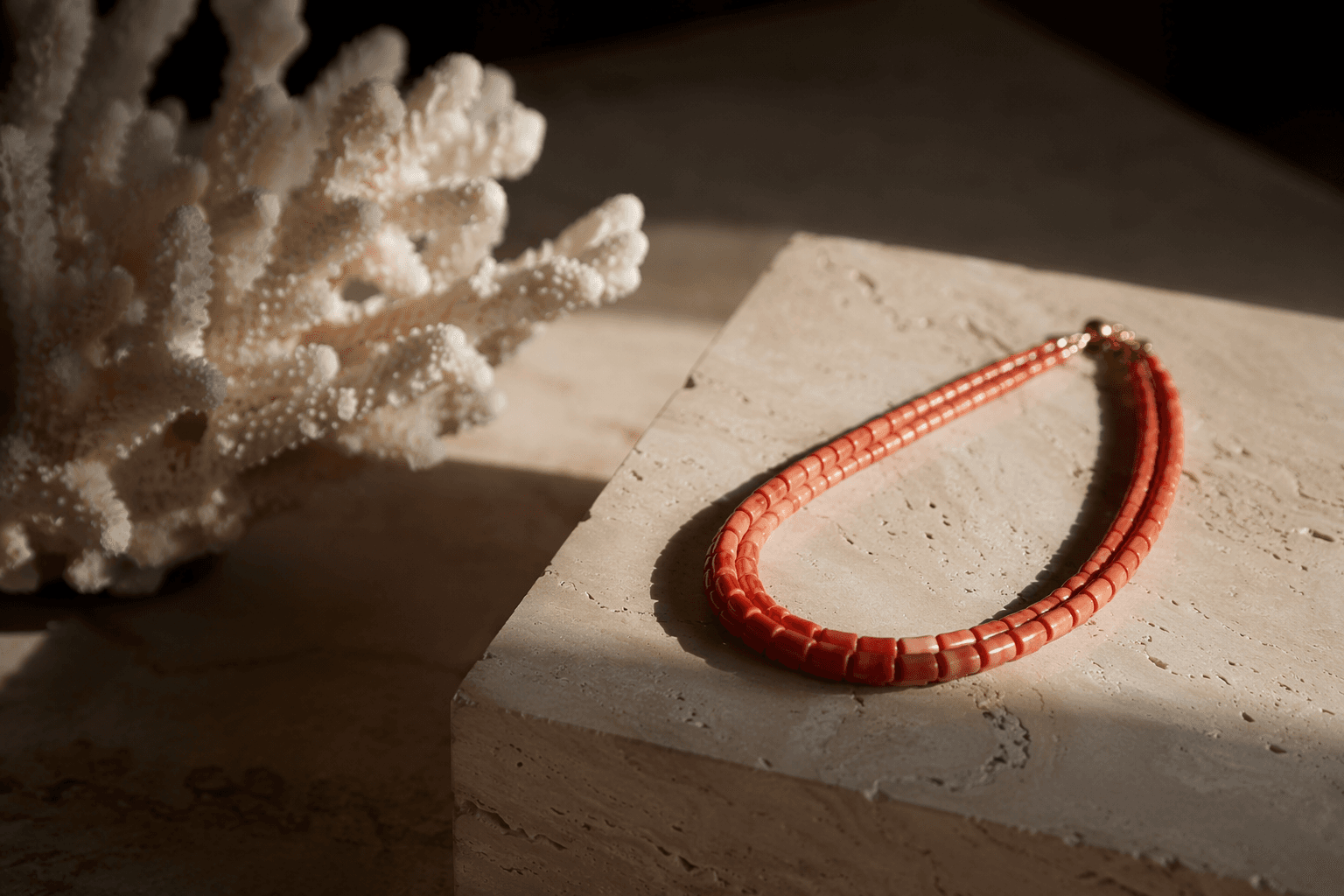
Precious coral is a biogenic gemstone, and its beauty begins with a durable red or pink-orange skeleton. Gemological references identify the major historic species as Corallium rubrum from the Mediterranean Sea and Corallium japonicum from the Pacific Ocean, while GIA notes that coral’s red coloration comes from carotenoid pigments. That color story matters in jewelry because coral does not need much help to make an impression. It already carries presence.
In a minimalist wardrobe, that presence works best when the design stays quiet. Coral reads most refined when the form is clean enough to let the material do the speaking: a small polished bead, a smooth cabochon, or a simple carved element set against a restrained metal frame. When coral is crowded by scrollwork, heavy embellishment, or too many competing textures, the piece starts to feel ornate rather than architectural. The difference is not size alone. It is whether the setting clarifies the coral or tries to compete with it.
A useful way to judge a piece is by asking a few visual questions:
- Does the coral have a clear silhouette, or is it lost in decoration?
- Is the color allowed to read as itself, or is the finish overworked?
- Does the metal support the coral with a clean line, or does it add visual noise?
- Would the piece still look strong with a white shirt, a black knit, or bare skin?
Those are minimalist standards, but they are also craft standards. If a coral jewel depends on volume, sparkle, or excess to feel finished, it is probably not the most elegant version of itself.
History gives the material weight, not just mood
The exhibition’s historical framing is one of its strongest arguments. Precious coral has been used in jewelry since very early history, and archaeological beads found in Germany date back almost 25,000 years. Historical sources also describe coral as an amulet and protective talisman in ancient and medieval cultures, which gives the material a symbolic charge that goes beyond color alone. Long before coral became a marker of style, it was already a carrier of belief.
That heritage helps explain why coral has endured in jewelry across so many eras. A minimalist piece can sometimes feel emotionally thin if it lacks context, but coral comes with centuries of use embedded in its form. A small coral jewel can therefore carry more gravity than a larger, trend-led object, because the material itself suggests continuity, not novelty. That is part of the reason the exhibition feels relevant to readers looking for restraint with substance.
Why provenance matters as much as beauty
Coral is also a reminder that precious materials are not just aesthetic choices. Recent scientific literature emphasizes conservation and sustainable-use concerns around precious coral resources, which makes the subject impossible to treat as mere decoration. In other words, the prettiest coral piece is not necessarily the most responsible one.
Identification can also require advanced testing. CIBJO’s coral guidance notes that trace-element analysis and DNA fingerprinting may be needed to identify coral accurately. That kind of scrutiny matters because “coral” is not a single simple category, and vague claims should never be enough. For buyers, the practical takeaway is to look for specificity about material and species, and to value pieces that can stand up to scrutiny as well as admiration.
What this exhibition says about a restrained jewelry wardrobe
This is a coral show, but it doubles as a guide to minimalist judgment. The best coral jewelry does not behave like costume because it does not rely on excess. It feels refined when the organic material is framed with discipline, when color is used with intention, and when craftsmanship is visible in the finish rather than hidden under decoration. That can mean a single coral accent that punctuates an outfit, or a heritage-style jewel whose structure is pared down enough to let the stone, or skeletal material, remain legible.
L’ÉCOLE’s presentation makes that case elegantly. By placing precious coral inside a conversation about biology, gemology, craftsmanship, and history, it shows that restraint is not the absence of character. It is the art of letting a material with a long, complicated life speak clearly.
This article was produced by Prism’s automated news system from verified source data, official records, and press releases, then run through automated quality and moderation checks before publishing. The system is built and supervised by the people who set the standards it runs under. Read our full AI policy.
Did this article answer your question?


