L’École Paris presents Daniel Brush’s first major wearable-art survey
Daniel Brush’s Paris survey turns minimal jewelry into a lesson in line, light, and restraint, with more than 75 works leaving his New York studio for the first time.
A master class in how little a jewel needs
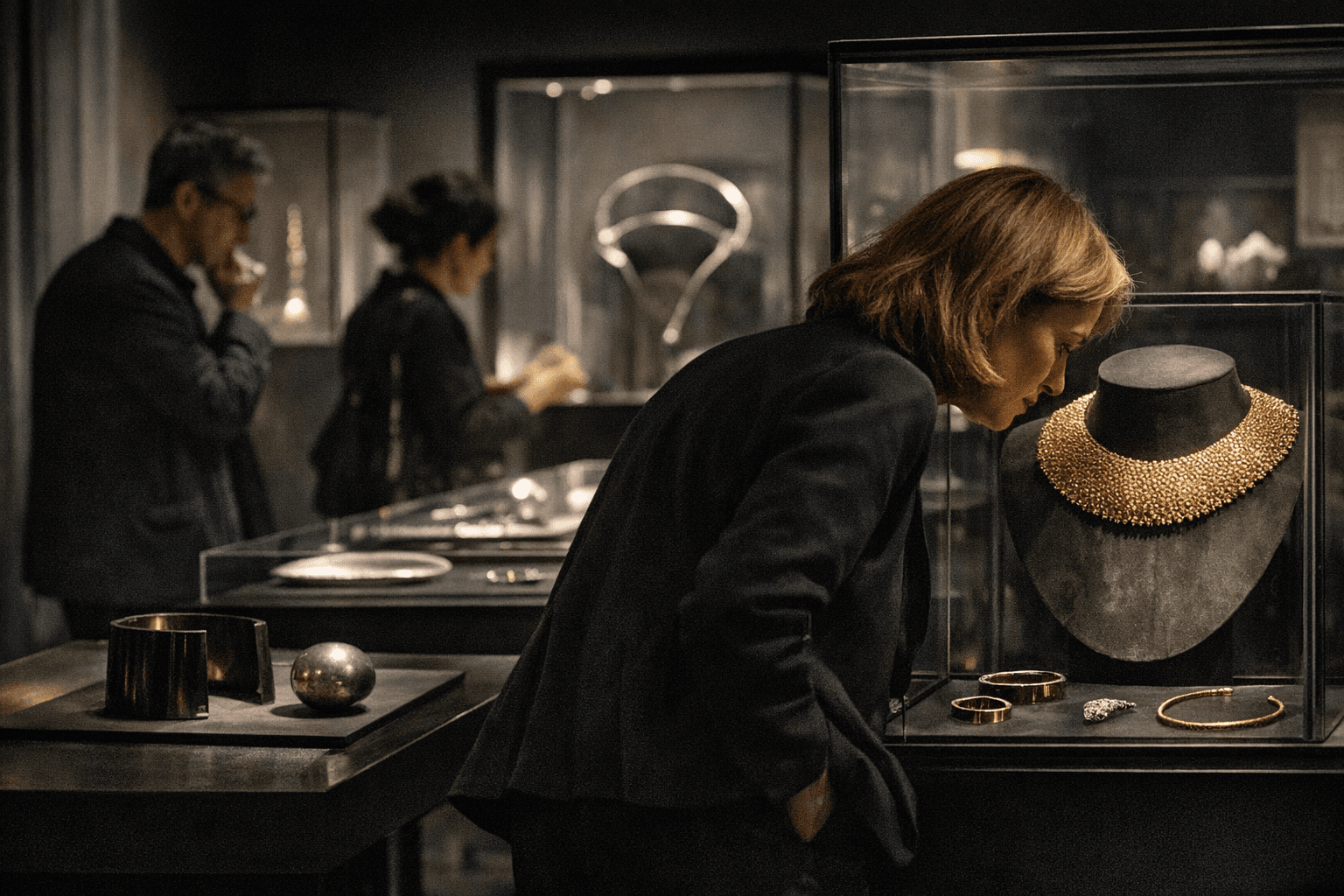
Daniel Brush’s work proves that minimalism is not about emptiness. It is about pressure, precision, and the decision to stop exactly where the form feels complete. At L’ÉCOLE, School of Jewelry Arts in Paris, more than 75 jewels, paintings, and sculptures will gather for the first major survey of his wearable art, and many of them are leaving his New York studio for the first time. That alone is a shareable shock: a body of work once held close now stepping into the light, where every line, edge, and reflection can be read like a sentence.
The exhibition, titled Daniel Brush, the Art of Line and Light, runs from June 8, 2026 to October 4, 2026. It is not being framed as a conventional jewelry show, but as a study in how a maker can dissolve the border between adornment and sculpture. Brush, born in 1947 and gone in 2022, was self-taught and worked across jewelry, sculpture, painting, and other forms. That breadth matters to minimalist jewelry readers because his pieces show what happens when a jewel is treated as an object of thought, not just decoration.
1. Start with line, not ornament
Brush’s strongest lesson is that line can carry an entire design. L’ÉCOLE describes the show as tracing his imagination through gold, aluminum, and steel, and those materials become carriers of outline rather than surface excess. In a minimalist piece, the first question is not how much stone you can add, but whether the silhouette still reads when the eye strips everything away.
That is why Brush’s work feels modern. The shape has tension before it has sparkle. A clean arc, a sharp torque, or a slender bar can feel more authoritative than a crowded setting because the line itself becomes the subject. For readers shopping minimalist jewelry, that means looking for pieces where the profile is unmistakable from across a room and still interesting up close.
2. Let negative space do the work
Brush spent much of his career testing the boundaries of jewelry, and that boundary testing is especially useful to anyone drawn to understated pieces. Negative space is not a gap to be filled. In the best minimalist jewelry, it acts like structure, giving the eye room to register form, motion, and proportion.
That principle is visible in the way Brush’s work moves between jewel and sculpture. The form can open out around the body instead of sitting flat against it, which makes the surrounding air part of the composition. For styling, that translates into one disciplined rule: if a piece already has a strong shape, do not overlayer it until its silhouette disappears. Minimalism looks most refined when the space around the jewel remains visible.
3. Light matters as much as material
Brush’s title is not just poetic branding. Light is one of the artist’s enduring preoccupations, and the exhibition also points to his fascination with French Impressionists and color. That matters because it explains why his restrained pieces never feel dead or purely austere. They are built to catch and release light, not merely to sit there.
The clearest proof is The Metropolitan Museum of Art’s 2010 to 2014 aluminum torque, inspired by Scythian torques in the museum’s own collection. Brush fashioned it from aluminum tubing sourced from airplane refrigeration coils, turning an industrial material into something luminous and jewel-like. That transformation is a reminder that minimalism is not always about preciousness in the conventional sense. It is about how a material performs on the body, how it reflects daylight, and whether it can look alive without needing a large stone to animate it.
For buyers, this is a useful filter. Ask not only whether a piece is gold or silver, but whether the finish, weight, and polish are doing something specific. A minimalist jewel should still catch light with intention.
4. Restraint is strongest when it has a point of view
Brush was never making blank, anonymous objects. His work carried philosophy, memory, and often a dialogue with art history. L’ÉCOLE’s programming around the exhibition includes conversations with Olivia Brush, his partner in life and work, along with his son Silla Brush and jewelry historian Vivienne Becker, and art historian and decorative arts specialist Paul Paradis. That family and scholarly stewardship gives the survey a rare intimacy, but it also underlines a larger point: restraint feels strongest when it is not generic.
Brush’s 1998 Smithsonian Renwick Gallery exhibition, Daniel Brush: Gold Without Boundaries, brought wider attention to that refusal of limits. After his death, institutions and commentators called him a boundary-defying artist and a “poet of craft,” which is exactly the sort of reputation that should make minimalist jewelry readers pay attention. A spare piece is not meaningful because it is plain. It is meaningful because the maker has made a deliberate argument about proportion, material, and silence.
5. Provenance is part of the design
One of the most interesting details in this survey is that so many works are leaving Brush’s New York studio for the first time. In jewelry, that kind of movement matters. It tells you the pieces were not created for the market first and the museum second. They lived in a maker’s private orbit before entering public view, which gives their surfaces, wear, and scale a different kind of authority.
That sense of provenance also explains why Brush’s legacy has been shaped not just by the market, but by institutions such as The Metropolitan Museum of Art and the Smithsonian American Art Museum. When the objects themselves are sparse, the story behind them becomes part of the value. For a minimalist collector, that is a reminder to ask where a piece came from, who shaped it, and whether the materials and making process are described with real specificity. Vague claims do not belong in a category that depends so heavily on discipline.
What to take from Brush when you shop or style minimalist jewelry
- Choose a piece that has one clear structural idea, a line, arc, or torque, rather than several competing gestures.
- Look for negative space that changes the way the jewel sits on the body, especially in cuffs, collars, and open rings.
- Pay attention to how a metal catches light. Aluminum, steel, and gold can all read differently depending on polish and thickness.
- Favor restraint with intent. If a design feels empty rather than precise, it is missing the point.
- Ask for provenance and materials with the same seriousness you would bring to a gemstone purchase. A clean design deserves a clear story.
Brush’s Paris survey makes a strong case that minimal jewelry is not the absence of ambition. It is ambition pared down until every curve, reflection, and seam has a reason to exist. That is why his work still looks modern: it is not trying to dazzle first. It is trying to endure.
This article was produced by Prism’s automated news system from verified source data, official records, and press releases, then run through automated quality and moderation checks before publishing. The system is built and supervised by the people who set the standards it runs under. Read our full AI policy.
Did this article answer your question?


