Marie Lichtenberg turns pennants into talismanic minimalist pendants
Marie Lichtenberg’s Fanion pendants make a pennant feel polished, personal and quietly precious, with 18k gold, sapphire and talismanic symbolism.
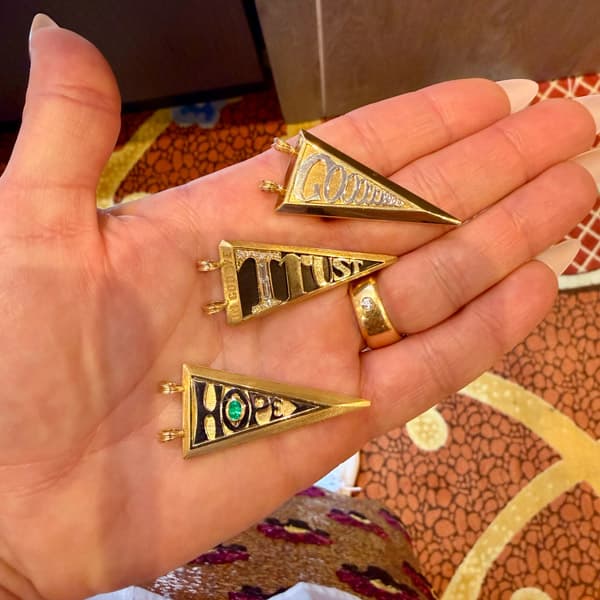
Marie Lichtenberg has taken a shape associated with team spirit and turned it into something far more intimate. Her Fanions collection, unveiled at the Couture show in Las Vegas, distills the pennant into a tiny fine-jewelry pendant that feels less like sports memorabilia than a private emblem, and that shift is exactly what makes it compelling.
The pennant, made precious
Fanion is the French word for pennant, and in Lichtenberg’s hands the form loses its shout and gains poise. The miniature flag sits at the crossroads of sports iconography and heirloom jewelry, which is why it reads as minimalist without becoming anonymous. It has a clear silhouette, a symbolic charge and just enough detail to anchor an outfit on its own.
That scale matters. A tiny pennant does not need a stack of bracelets or a crowded neckline to make sense, because its whole point is concentration: one object, one meaning, one glance. The featured Fanion pendant highlighted by JCK was rendered in 18k yellow gold with sapphire and priced on request, a combination that places it firmly in fine-jewelry territory rather than novelty dressing.
Why this feels chic rather than literal
Sports references in fashion can quickly become blunt, but Lichtenberg’s version stays elegant because she treats the motif as a sign, not a slogan. JCK specifically noted that miniature flags tap into the current popularity of sports iconography, yet the Fanion avoids the heavy-handedness that often follows that trend. The result is a pendant that feels referential and restrained, which is the sweet spot for anyone who prefers understatement with a point of view.
That restraint is what allows the piece to work as an everyday talisman. It can sit against a crisp white shirt, tuck into the open neck of a knit, or stand alone on skin without asking for a supporting cast of rings and charms. For a minimalist wardrobe, that kind of self-contained jewelry is often the most persuasive kind, because it carries personality without crowding the line of the clothes.
A designer who builds meaning into form
Lichtenberg’s approach is inseparable from her own biography. She spent 12 years as a fashion editor at French ELLE before launching her jewelry line in 2019, and several profiles trace her first jewelry inspiration to a piece she designed for her daughter. That origin story explains why her work rarely feels decorative for decoration’s sake; it is rooted in the idea that jewelry should hold memory, not just sparkle.

Her brand language reinforces that view. Born in Saint-Germain-des-Prés and shaped by French sensibility, Creole and Martinican roots, and a long fascination with symbolic objects, Lichtenberg speaks in the grammar of heirlooms, stories and protection. The brand describes its pendants collection as combining “the best craftsmanship in the world” with an irreverent sense of style, and that balance is exactly what gives the Fanions their appeal.
The India thread running through the story
The talismanic quality of these pendants is not accidental. Lichtenberg discovered Mauli on a trip to India, where she encountered the blessed, hand-woven thread said to protect the wearer, and that discovery remains central to the brand’s identity. It helps explain why her jewelry so often feels charged with meaning, whether it appears as charms, lockets, scapular necklaces or more overtly symbolic forms.
That lineage matters for the Fanions because the pendant is not simply a cute object in gold. It belongs to a larger vocabulary in which jewelry acts as a carrier of memory and intention, the same way a thread, a lock or a locket can become a private keepsake. In that context, the pennant is not a novelty at all. It is a modern heirloom in miniature, one that carries the emotional architecture of her brand into a more distilled shape.
How the Fanion fits a minimalist wardrobe
The strongest minimalist jewelry has a distinct outline and a strong reason to exist, and the Fanion has both. Its symbolism does the work that excess detail would otherwise perform, so the design can stay visually lean. That makes it especially appealing to dressers who want one notable piece rather than a full set of interchangeable basics.
In a wardrobe built on pared-back tailoring, good knitwear and careful proportions, the pendant offers a single point of punctuation. It has the ease of a small charm and the presence of a statement, which is rarer than it sounds. Because it is rendered in 18k yellow gold with sapphire, it also has enough material richness to justify its place in the category of investment jewelry, even as its size keeps it discreet.
That combination, sporty in concept and heirloom-like in execution, is what keeps the Fanions from slipping into trend-chasing territory. Lichtenberg understands that the most lasting minimalism is not empty, but precise. Here, a pennant becomes a talisman, and the result feels both contemporary and deeply personal.
This article was produced by Prism’s automated news system from verified source data, official records, and press releases, then run through automated quality and moderation checks before publishing. The system is built and supervised by the people who set the standards it runs under. Read our full AI policy.
Did this article answer your question?


