Move over rings — 2026 is all about wrist fashion: 5 rules for perfect bracelet stacking
Bracelet stacking has officially surpassed ring stacking as 2026's defining jewelry move; here are five architect-approved formulas for getting it exactly right.
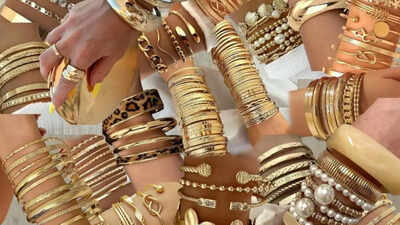
The finger had its moment. Ring stacking dominated half a decade of fine jewelry conversation, from delicate midi bands to signet towers climbing toward the knuckle. But designers and trend forecasters, citing signals from WGSN among others, are unanimously marking bracelet stacking as the dominant wrist play for 2026. Unlike its predecessor, it comes with a more forgiving learning curve. The challenge is not accumulation; it is architecture.
What separates a considered stack from a tangle is structure: one anchor piece, intentional proportion shifts, and deliberate negative space. The bracelet's advantage over the ring is modularity - the ability to build, subtract, and rotate pieces daily without committing to a single configuration. Think of it less as collecting and more as composing. Here are five formulas that work, and the rules that keep each one from unraveling.
Formula 1: One Hero Cuff + One Slim Chain
This is the most architectural of the five formulas and the most forgiving for beginners. A wide cuff, whether polished gold, hammered silver, or a flat hinged bangle with a bezel-set stone, reads as sculpture on its own. Adding a single slim chain alongside it, something in a delicate cable or trace link, creates instant contrast without competition. The contrast in width does the visual work so you do not have to.
- Do: Let the cuff sit closer to the wrist bone and the chain float above it, leaving a 3-4mm gap between pieces so each retains its outline.
- Don't: Add a second chain. Two slim chains without a structural anchor become a knot waiting to happen and produce a persistent, irritating clink against each other with every gesture.
- Office-appropriate? Entirely. A 14-karat gold cuff paired with a fine trace chain is the bracelet equivalent of a well-cut blazer: effortless authority. Keep the cuff under 20mm wide if you're wearing fitted sleeves, where width creates bunching at the cuff line.
Formula 2: Two Bangles + a Watch
The watch is already doing heavy lifting: it has volume, dimension, and a distinct finish. Two slim bangles positioned between the watch and your wrist bone create a graduated effect that feels collected rather than cluttered. Treat the watch as the largest structural element and work downward in scale from there.
- Do: Choose bangles with a satin or brushed finish if your watch has a high-polish case. The tonal variation keeps the stack from looking flat and quietly resolves the old rule against mixing metals; contrasting finishes within one metal family is always fair play.
- Don't: Stack rigid bangles that rattle against the watch crystal. This is the most common sound problem in bracelet stacking. Leave a 2-3mm gap between the top bangle and the watch case, and choose bangles in a material slightly softer than the watch bezel to prevent surface scratching.
- Office-appropriate? Yes, with one firm caveat: sound. A silent stack is a professional stack. Close-fitting bangles with a minimal interior diameter are the answer; avoid oversized loose bangles that slide into the watch case with every keystroke.
Formula 3: Three Textures, One Metal
This is the minimalist's formula and arguably the hardest to execute well because the discipline is entirely in restraint. Three bracelets, one metal color, three completely different textures: a woven mesh cuff, a faceted chain-link bracelet, and a smooth round-wire bangle, all in yellow gold. The visual interest comes entirely from surface variation, with no contrast of color to do any of the heavy lifting.
- Do: Think about how each piece handles light. A matte finish absorbs it; a high-polish piece reflects it; a diamond-cut surface scatters it. Build your three-piece stack to include at least two of these three behaviors, and the result is dimensionality without noise.
- Don't: Allow width uniformity to flatten the stack. If all three pieces sit at the same 3mm gauge, the formula loses its rhythm. Graduate from slim to slightly wider, or break the sequence deliberately with one narrow outlier to create visual punctuation.
- Office-appropriate? This is the most office-ready formula in the group. Tonal coherence reads as intention, never accident, and a gold-on-gold-on-gold stack in varied textures is genuinely sophisticated in a boardroom context.
Formula 4: Tennis Bracelet Anchor + Two Delicate Layers
A tennis bracelet, that continuous line of prong-set or bezel-set stones, functions as both the star and the stabilizer of a stack. Its weight and rigidity naturally keep looser pieces in place on either side of it. Pair it with two fine chains, one slightly longer and one shorter, so the three pieces occupy distinct planes on the wrist rather than collapsing into each other. The result is a graduated shimmer effect that works at almost any occasion level.
- Do: Make sure the tennis bracelet has enough room to lie flat. If it is bunching, twisting, or riding up onto a neighboring piece, it needs to be sized up by half a link. A twisted tennis bracelet defeats the entire visual logic of its design.
- Don't: Layer a charm bracelet directly against a tennis bracelet. Prong settings catch on chain links, and charm hardware catches on stone settings in return. This is the fastest way to damage both pieces simultaneously.
- Office-appropriate? Impeccably so, particularly in white gold or platinum. The restrained shimmer of a diamond tennis bracelet worn alongside two threadlike chains is one of the quietest and most powerful things you can wear to a client meeting.
Formula 5: Asymmetric Charm Bracelet + One Plain Chain
Charm bracelets have returned not as the charm-packed maximalist relics of an earlier era, but as deliberate personal archives. A single bracelet with two or three meaningful charms, perhaps an initial disk, a small bezel-set gemstone drop, or a symbolic motif, worn alongside one completely unadorned chain creates genuine asymmetry. One wrist tells a story; the other stays quiet. It is the stack with the clearest narrative logic of the five.
- Do: Vary the wrist. Wear the charm-heavy formula on your non-dominant wrist so the charms stay visible and undisturbed throughout the day, rather than being obscured by the constant motion of writing or typing.
- Don't: Overcrowd the charm bracelet itself. Three charms is the functional maximum that allows each one to sit flat and face forward. Beyond three, charms begin to flip, cluster, and hide behind each other - which is both the most common and the most frustrating failure point in charm stacking.
- Office-appropriate? Depends entirely on the charms. Polished gold geometric disks or single-stone drops read as fine jewelry. That said, only you can judge the culture of the room.
Troubleshooting: When the Stack Stops Working
Pinching. Two rigid bangles with no sizing differential sitting flush against each other will collapse onto skin the moment you flex your wrist. The fix is not removal but spacing: slide a slim soft-material bracelet, a fine waxed cord, a beaded piece with some give, or a narrow leather wrap between the two rigid pieces. It creates a buffer, eliminates the pinch, and adds the textural contrast the formula probably needed anyway.
Flipping charms. Charms flip when the bracelet is too loose. A charm bracelet should sit snugly enough that it does not migrate above the wrist bone; once it starts rotating freely, every charm immediately migrates to the underside of the wrist where it stays hidden and catches on sleeve fabric. Size down by one length increment or add a secondary safety chain to reduce lateral movement.
Mixed-metal chaos. Mixed metals become visually chaotic not because of color conflict but because of finish conflict. A brushed rose gold bangle next to a high-polish yellow gold chain next to a matte oxidized silver piece produces noise with no resolution point. The fix is to choose one finish as the dominant logic and let the metal colors vary around it. All brushed, different metals: collected and intentional. All different finishes, one metal: muddy and accidental.
Clasp pile-up. Three bracelets, each with a lobster clasp, tend to rotate until all three clasps cluster at the same point on the inside wrist, creating a bulky pressure ridge. Before putting the stack on, deliberately position one clasp at the inside wrist, one toward the thumb side, and one toward the pinky side. Distributing clasp weight around the circumference keeps the stack balanced and prevents that persistent pressure point that makes you want to remove everything before noon.
The bracelet stack at its best is a tightly edited composition: three to five pieces, each earning its place through texture, proportion, or personal meaning. The wrist is not a display case; it is a canvas with a character limit. Knowing when to stop is the clearest signal that someone genuinely understands jewelry, not merely accumulates it.
This article was produced by Prism’s automated news system from verified source data, official records, and press releases, then run through automated quality and moderation checks before publishing. The system is built and supervised by the people who set the standards it runs under. Read our full AI policy.
Know something we missed? Have a correction or additional information?
Submit a Tip