Personalized wedding bands and stacks define 2026 bridal jewelry trends
Bridal jewelry is becoming quieter, not simpler: hidden inscriptions, fingerprint engravings, and stackable bands are making minimalist rings feel deeply personal.
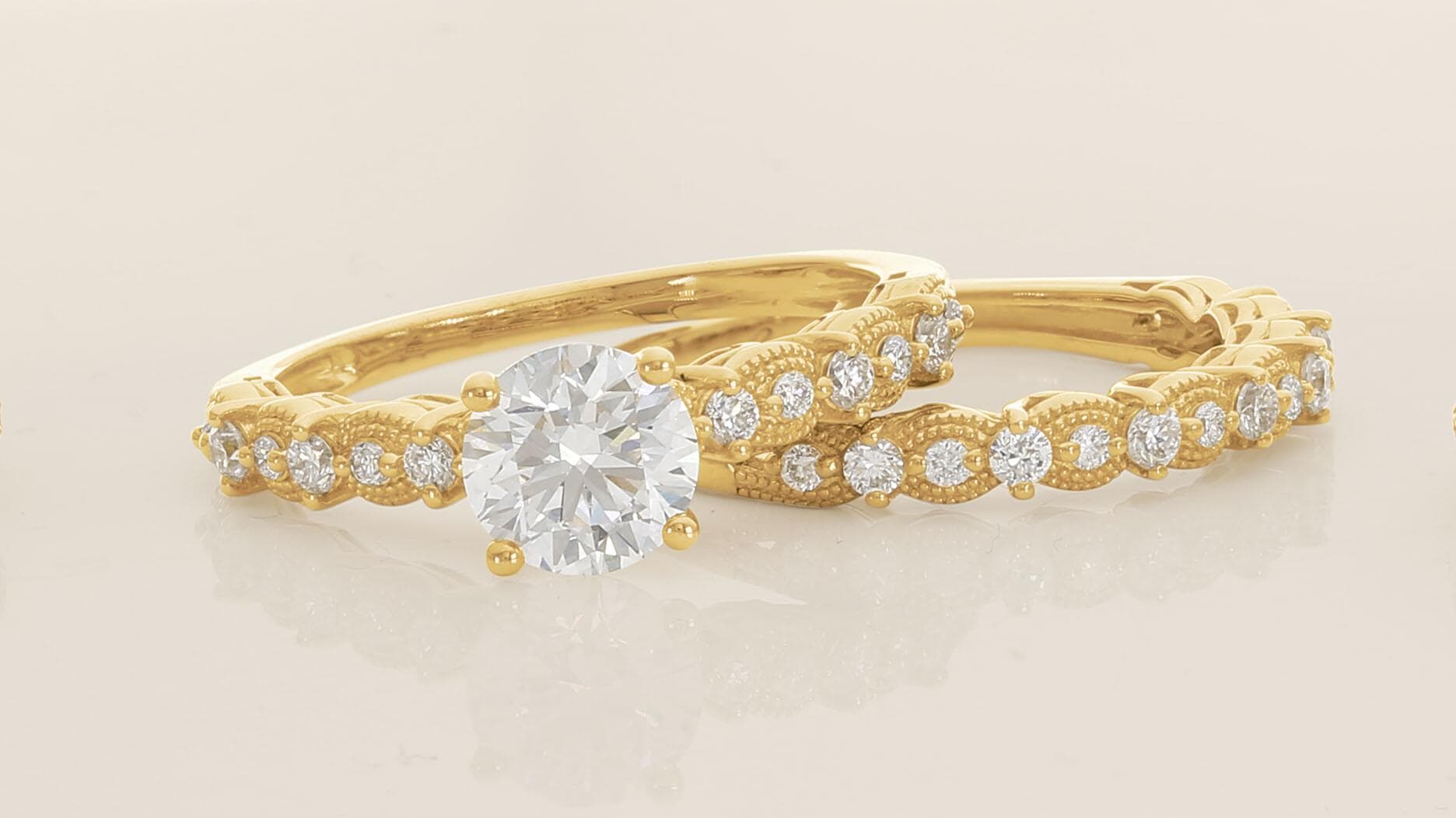
The most compelling wedding bands in 2026 are the ones that whisper. Hidden inscriptions, fine-line fingerprint engravings, and tiny symbolic motifs are giving minimalist rings a private emotional charge, while the silhouette stays clean enough to wear every day. Some brides still reach for bold gold, but the market is increasingly rewarding rings that feel handcrafted, meaningful, and built for daily life.
Quiet personalization is the new luxury
The shift is not toward ornament for ornament’s sake. It is toward restraint with intention: brushed gold that softens the light, hammered finishes that catch it in small irregular flashes, and slim profiles that let craftsmanship, not decoration, do the talking. A wedding band no longer has to announce itself across the room to feel significant. It can be pared back on the outside and rich with meaning where only the wearer knows to look.
That is what makes this moment so interesting for minimalist jewelry. The strongest rings in the category preserve a timeless outline, then layer in details that deepen the emotional read. A discreet engraved symbol can reference a shared place or date; a delicate fingerprint line can transform a plain band into something unmistakably personal. Even when the metal remains unadorned, the finish can carry the sentiment: a brushed surface feels quiet and modern, while a hammered one suggests the hand of the maker.
The inside of the ring has become the most intimate canvas
Engraving is hardly new. The Knot traces wedding-ring inscription back to medieval Europe, which gives today’s custom a surprisingly long lineage. What has changed is the technique and the intimacy of the message. Modern engraving is commonly done with a machine or a hand-held laser on the inside of the shank, or even around the perimeter of the stone, turning the hidden side of the ring into a private archive.
That is where the language of love tends to live now: nicknames, wedding dates, psalms, jokes, short lines of affection, and phrases like “I thee wed.” The appeal is not nostalgia alone. It is the elegance of a ring that stays visually clean while carrying a message that belongs to two people only. For minimalist wedding bands, that tension between simplicity and secrecy is exactly the point.
Fine-line fingerprint engraving takes the idea further. It is less about embellishment than identity, and it works especially well when the rest of the band remains uninterrupted. The result is not decorative noise. It is a subtle signature, one that keeps the ring’s geometry intact while making the piece feel impossible to duplicate.
Stacks are turning one ring into a longer story
The other defining move in bridal jewelry is accumulation. Wedding jewelry is increasingly being treated as an evolving collection rather than a one-time purchase, with anniversary bands and milestone additions building on the original ring over time. That approach is especially compatible with minimalism because each new ring can remain restrained while still contributing to the whole.
JCK has linked this appetite for personalization to Gen Z and social media, where couples gravitate toward choices that feel intentional and individual. That influence is widening the vocabulary of bridal style beyond the expected solitaire. Mixed metals, east-west settings, elongated shapes, nontraditional stacks, chunky bands, and vintage or antique-cut diamonds are all part of the same conversation: the ring should look chosen, not prescribed.
Stacking is especially powerful when the first band is quiet. A clean platinum or gold ring can serve as the anchor, then absorb later additions with ease. One band might mark a marriage, another an anniversary, another a child or milestone. The set becomes a timeline worn on the hand, with each layer preserving the original simplicity while adding another chapter.
What the market says about value and desire
De Beers’ June 2026 U.S. Diamond Acquisition Study, based on responses from 18,500 women ages 18 to 74, shows how broad this appetite has become. Gen Z is already the second-largest generation buying natural diamond jewelry, and it spends almost twice as much as Baby Boomers per purchase, at $4,080 versus $2,250. That is a striking signal for bridal jewelry, where younger buyers are not simply spending, they are spending with a specific emotional logic.
The same study found that average purchase prices for natural diamond jewelry rose 25% in 2025 compared with 2023. Natural diamond jewelry also remained the most desired luxury jewelry item among the categories tracked, ahead of synthetic lab-grown diamonds, other gemstones, and plain gold jewelry. Just as telling, personal occasions beyond traditional bridal buying, including promotions, achievements, and “just because” purchases, are becoming more important. In other words, the relationship to fine jewelry is broadening, and bridal is part of that broader self-expression.
De Beers has responded to that shift with Desert diamonds, launched in 2025 as the company’s first new beacon in more than a decade. After the bridal extension was announced on April 9, 2026, the concept expanded into bridal on April 13 with a softer, lighter-toned palette. Independent retailers involved in the campaign reported increased foot traffic and more bridal-led inquiries, which suggests that even in a highly traditional category, color nuance and storytelling still matter.
How to choose a personalized band without losing the line
The most successful minimalist wedding bands balance sentiment with structure. A ring can be deeply personal without becoming visually crowded, and that restraint is what keeps it elegant for decades.
- Choose one meaningful detail and let it lead, whether that is an inside inscription, a fingerprint engraving, or a tiny symbol.
- Keep the outer profile disciplined so the band remains easy to wear alone or in a stack.
- Consider finishes, not just form. Brushed and hammered gold create texture without adding bulk.
- If you want a future stack, start with a band that can accept companions in the same metal family or a compatible shape.
- Let the personalization stay proportionate to the ring. The best details are felt before they are noticed.
That is the real direction of bridal jewelry now: less decoration, more authorship. The ring is becoming not just a symbol of marriage, but a finely made record of who the couple is, and the quietest versions are often the most revealing.
This article was produced by Prism’s automated news system from verified source data, official records, and press releases, then run through automated quality and moderation checks before publishing. The system is built and supervised by the people who set the standards it runs under. Read our full AI policy.
Did this article answer your question?


