Rare 17th-century diamond cluster ring heads to Noonans auction
A 17th-century diamond cluster ring with eight hogback stones and a rose-cut center will go to Noonans, its missing diamond recovered from sifted soil.
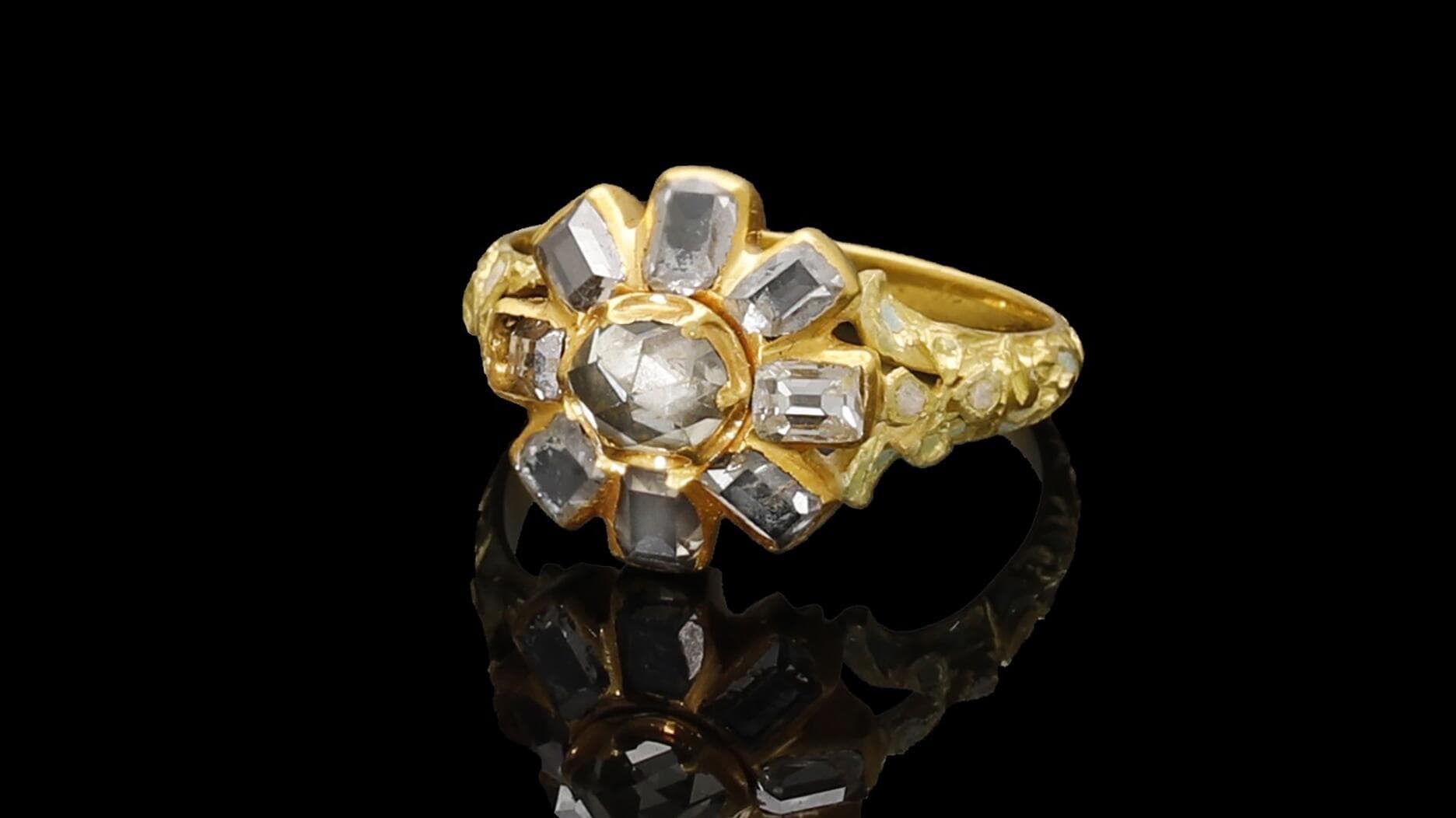
A late 16th- or early 17th-century ring with a flowerhead bezel and eight hogback diamonds circling a rose-cut center has the kind of quiet asymmetry modern minimalist collectors increasingly prize. Noonans has named the piece The Evesham Diamond Ring, and its appeal lies as much in its restrained silhouette as in its age: a clustered form that reads intimate rather than ostentatious, with the hand-made irregularity of an object that has survived centuries intact enough to still feel wearable.
The ring was discovered in Wormington, Gloucestershire, in November 2024 by 42-year-old Stuart Jones of Solihull, a welder fabricator at Jaguar Land Rover who had been metal-detecting for several years. Jones searched the site from about 9:00 a.m. to 4:00 p.m. and found the ring in the final hour and a half. When he lifted it, one diamond came loose, and a second setting was vacant. After a club administrator suggested he try again, Jones took soil home and sieved it, recovering the missing stone. He described the discovery as “absolutely overwhelmed with joy” and called it his “once in a lifetime find.”
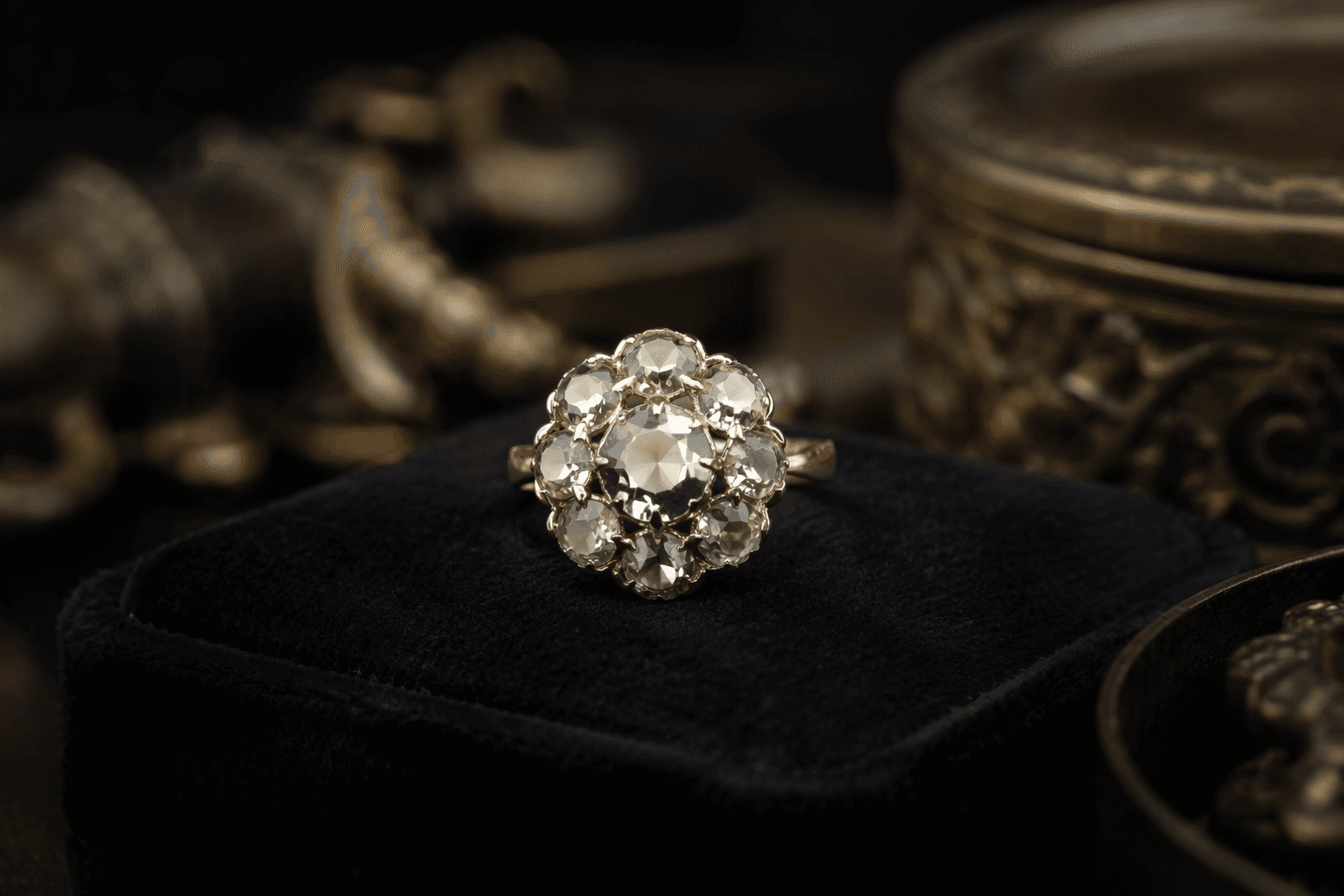
The ring has since been examined and authenticated by the British Museum, and its construction helps explain why it reads as such a compelling precursor to today’s understated antique jewels. Laura Smith, Noonans’ jewellery specialist, has described the flowerhead cluster as an exceptionally rare arrangement for the period. The hogback diamonds are an early form of diamond cut, made when faceting was still in its infancy, and their slightly gray-white appearance reflects a time when cutters emphasized external shape and light on the surface rather than the bright internal reflection modern cuts deliver. In the early 17th century, baroque taste favored larger clustered compositions over solitaire settings, with floral and heraldic motifs carrying the day.
XRF testing identified the gold as 19.2-carat fineness, a standard with roots in legislation introduced during the reign of Edward I in 1300. That old-world purity, combined with the ring’s compact scale, gives the piece a remarkably current feel: not flashy, but finely judged, with enough history in the silhouette alone to satisfy buyers who want their jewelry to signal discernment rather than volume.
The ring will head to Noonans’ Jewellery auction in London on Tuesday, June 23, where it is lot 106 in the broader Jewellery, Silver, & Objects of Vertu sale running June 23-24. It carries an estimate of £15,000 to £20,000, and the proceeds will be split equally between Jones and the landowner. The sale includes 14 metal-detected jewels in all, but The Evesham Diamond Ring is the one most likely to resonate beyond the auction room: a rare Tudor-era cluster whose modest scale feels newly exact for the minimalist moment.
This article was produced by Prism’s automated news system from verified source data, official records, and press releases, then run through automated quality and moderation checks before publishing. The system is built and supervised by the people who set the standards it runs under. Read our full AI policy.
Did this article answer your question?


