Suzanne Kalan on wearable fine jewelry, Hollywood fans and LA roots
Suzanne Kalan made baguette diamonds feel effortless, turning Fireworks, family design and LA ease into a blueprint for minimalist fine jewelry with red-carpet reach.

A scattered sparkle that reads quiet, not severe
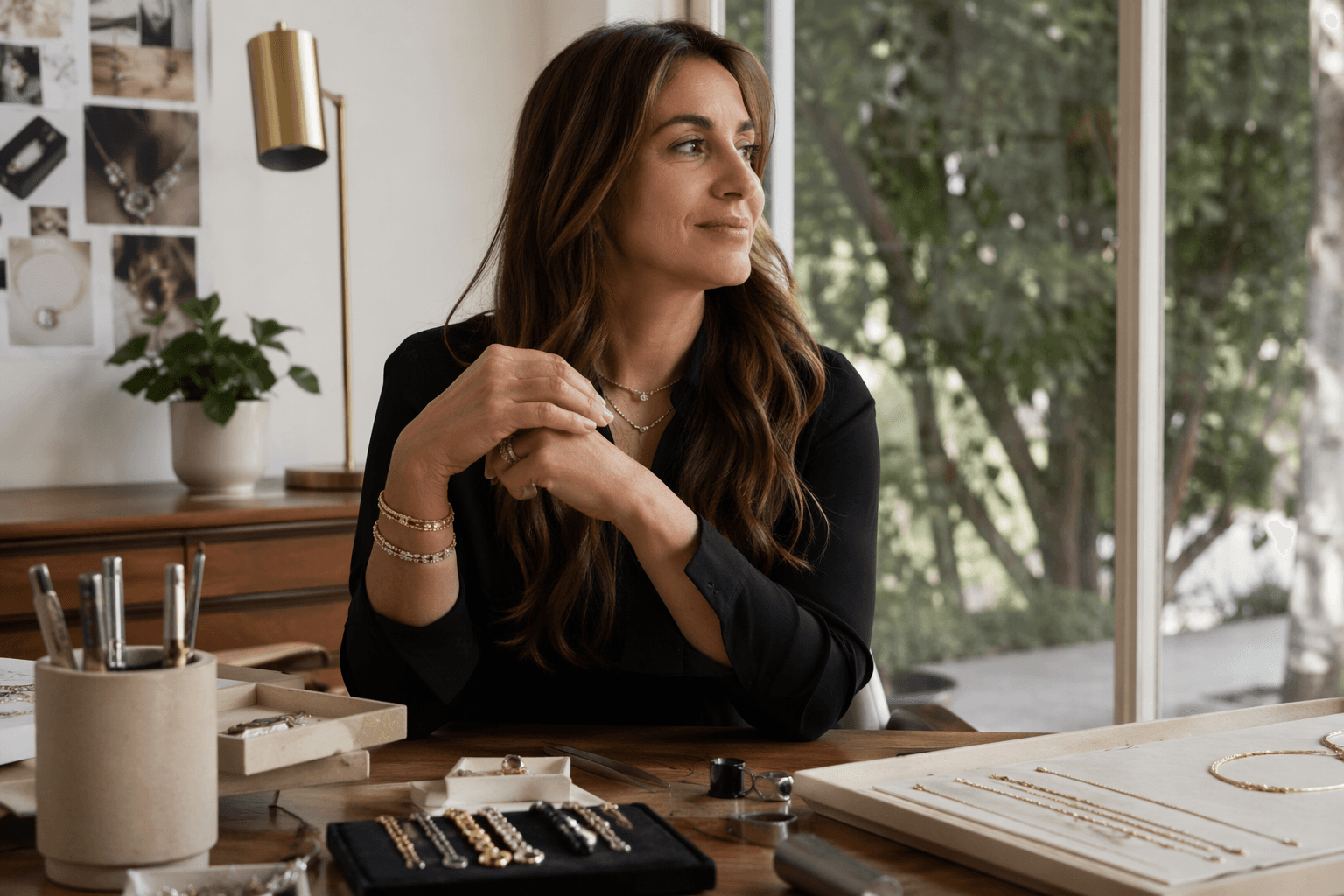
Suzanne Kalan’s best-known idea is also her clearest argument for minimalist fine jewelry: diamonds do not need to shout to register. Her award-winning Fireworks collection reimagined baguette-cut diamonds in a scattered, explosive pattern, giving the clean geometry of the cut a looser, more modern rhythm. It is the kind of design that feels polished in daylight, then suddenly more luminous at night, which is exactly why her work has become shorthand for jewelry that slips easily between daily life and dressier moments.
That balance is the real lesson in Kalan’s approach. The pieces are meant to be wearable, comfortable, versatile, and stackable, but they still carry enough visual intelligence to feel considered. In a market crowded with tiny diamond everything, Kalan’s work stands out because the minimalism has structure. The stones are not there simply to sparkle; they are arranged to create movement, texture, and a sense of ease.
From a dining room table to a global name
Kalan founded her namesake brand in 1988, shortly after becoming a new mother, and she began by making jewelry from her dining room table. That origin matters because it explains the practical core of the brand: this is jewelry born from real life, not from a distance from it. A first commercial order led to a much larger department-store order, and that early leap helped turn a small homegrown operation into a global fine-jewelry brand.
Her path also explains why the work feels so direct. Kalan has spent roughly 35 years in the industry, and that long view shows in pieces that are not built around trends so much as around repeat wear. The brand’s own story says she helped redefine the use of baguette-cut diamonds, and the nickname that followed, “Queen of Baguettes,” captures how thoroughly she made that cut her signature.
Why the diamonds look modern
The genius of Kalan’s Fireworks pieces lies in their refusal to behave like conventional diamond jewelry. A traditional baguette setting can feel architectural and linear, but her scattered arrangement breaks up that rigidity and gives the eye a place to travel. The result is fine jewelry that reads less like a single formal gesture and more like a constellation, which is part of why it works so well for readers drawn to minimalist pieces with a point of view.
That design logic is useful when you are buying your own elevated everyday jewelry. Look for pieces that sit close to the body, layer cleanly, and keep their sparkle under control rather than overwhelming the whole look. In Kalan’s hands, restraint is not about making jewelry smaller. It is about making the details sharper so the piece can hold its own without dominating the person wearing it.
LA is not a backdrop, it is part of the aesthetic
Kalan is based in Los Angeles, and she has been clear that the city is a creative inspiration. She has said, “The city that comes to mind when I need creative inspiration is LA,” and that feels right for a designer whose work is relaxed without being casual. Los Angeles style often thrives on contrast, ease mixed with polish, glamour worn in daylight, and Kalan’s jewelry reflects that tension beautifully.
The city’s weather and landscape also feed the brand’s sensibility, which helps explain why the pieces feel so easy to live with. Jewelry inspired by LA tends to avoid heaviness, and Kalan’s work favors that lightness through scale, spacing, and movement. For anyone buying minimalist jewelry, that is a useful standard: the piece should feel like it belongs to a life that moves between errands, meetings, dinners, and events without needing to be changed.
Celebrity visibility, but not celebrity dependence
The brand’s celebrity press pages name Florence Pugh, Lewis Hamilton, Dua Lipa, Suki Waterhouse, Karen Gillan, Jessica Chastain, Naomi Osaka, Kris Jenner, Ashley Graham, and others as wearers. That roster helps explain why Kalan has become visible far beyond the fine-jewelry niche, but the celebrity appeal works because the design language already makes sense in real wardrobes. The jewelry photographs well on red carpets because it has clarity and line; it also looks right in less formal settings because it is not overbuilt.
That distinction matters. Plenty of jewelry becomes famous because it is dramatic once and difficult thereafter. Kalan’s pieces seem to travel in the opposite direction, gaining relevance precisely because they can be worn repeatedly. The broad celebrity reach is therefore less a gimmick than a proof point: the pieces are tuned for visibility without excess.
Family keeps the brand moving forward
One of the most interesting parts of the Kalan story is how deeply family is embedded in the business. Suzanne’s daughter, Patile Kalan, joined the family company in 2012 and designs the 14K line, KALAN. Suzanne, her husband, her son, her daughter, and other family members are all involved in design, business, and production, which gives the brand a continuity many luxury houses struggle to maintain across generations.
That family structure matters stylistically too. It allows the brand to balance older signatures with newer interpretations, rather than freezing the label in one recognizable look. The 14K line extends the same thinking into a more accessible daily-wear lane, while the larger fine-jewelry universe keeps the brand’s core language intact. For buyers, that means the Kalan world is not a single mood but a system of ideas that can move from one generation to the next.
What to look for when buying minimalist fine jewelry
Minimalist jewelry is worth buying when the craftsmanship supports the wearability. A good piece should sit comfortably against the skin, avoid snagging, and layer naturally with other jewelry you already own. If you are looking at diamond pieces, pay attention to how the stones are set: a low profile will often wear more easily day to day, while a more open setting can give a stone greater light and lift.
Kalan’s work offers a particularly smart template for this kind of purchase:
- Choose designs with visual movement, not just size, so the piece feels alive when worn repeatedly.
- Look for stackability in the silhouette, especially in rings and bracelets, so the jewelry can evolve with your wardrobe.
- Favor settings and proportions that allow day-to-night wear without feeling precious or fragile.
- Consider how the piece behaves next to older favorites, because the strongest minimalist jewelry can bridge new and inherited pieces without competing with them.
- Look for a designer with a recognizable point of view, because minimalism is most interesting when it has discipline rather than anonymity.
Kalan’s success shows that the most compelling everyday fine jewelry does not dilute luxury. It refines it. Her baguette diamonds, LA ease, family continuity, and celebrity visibility all point to the same conclusion: the future of minimalist jewelry belongs to pieces that are quiet in scale but confident in design.
This article was produced by Prism’s automated news system from verified source data, official records, and press releases, then run through automated quality and moderation checks before publishing. The system is built and supervised by the people who set the standards it runs under. Read our full AI policy.
Did this article answer your question?


