Tiffany’s Blue Book 2026, Hidden Garden blooms with 122 high-jewelry pieces
Tiffany’s Hidden Garden turns Jean Schlumberger’s flora into 122 jewel moments, and its most useful ideas for minimalist jewelry are one stone, one line, one bloom.
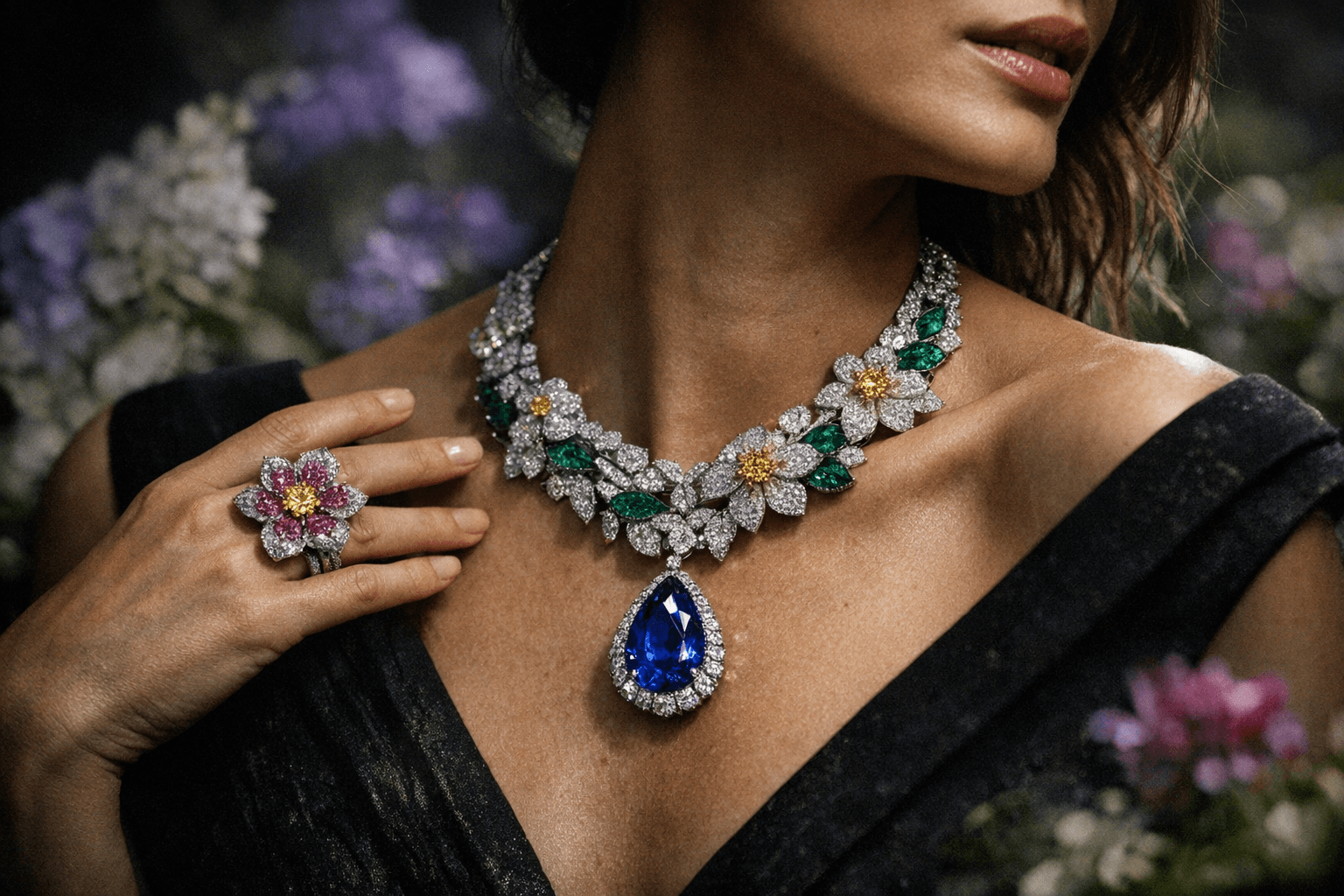
Nathalie Verdeille’s garden, built on Tiffany history
Tiffany’s Blue Book 2026, Hidden Garden, arrives as a lesson in how maximalism can still teach restraint. Under Nathalie Verdeille, Tiffany’s Senior Vice President and Chief Artistic Officer of Jewelry and High Jewelry, the house has turned its oldest high-jewelry platform into a modern design language, one that reads as lavish in scale but highly legible in detail. Hidden Garden is the fourth Blue Book collection under her leadership, and its 122 pieces are being unveiled in three waves, beginning with an exclusive New York City gala on April 16, 2026.
That rollout matters because Blue Book is not just a catalog title at Tiffany. The house dates its origin to 1845, when Blue Book first appeared as the first direct-mail catalog in the United States, before evolving into Tiffany’s annual high-jewelry showcase. In other words, Hidden Garden is not a seasonal capsule. It is Tiffany using one of its most historic formats to make a case for what contemporary high jewelry should look like now: gem-rich, conceptually coherent, and unmistakably tied to the brand’s own archive.
Why Hidden Garden feels so Tiffany
The collection leans into a long-running Tiffany obsession: the flora-and-fauna world associated with Jean Schlumberger. Under Verdeille, that legacy is not treated as costume history. It is translated into organic gold vines, platinum leaves, and diamond creatures that keep the pieces light enough to feel alive rather than overworked. Bird on a Rock, Paradise Bird, Parrot, Butterfly, Monarch, Marguerite, and Bee all appear in the collection’s conceptual orbit, which gives Hidden Garden a recognizable visual grammar even when the pieces themselves are wildly ambitious.
That connection to Schlumberger has real house history behind it. Walter Hoving brought Jean Schlumberger to Tiffany in 1956, and Bird on a Rock followed in 1965, becoming one of the most durable motifs in American jewelry. In Hidden Garden, Tiffany is not simply repeating those signatures. It is mining them for fresh proportion, fresh color, and fresh movement, which is exactly why the collection matters beyond the auction-level fantasy of high jewelry.
Anthony Ledru, Tiffany’s chief executive, frames the collection as a statement of creativity, craft, and the highest standards of gemology. That emphasis is apt. The strongest high jewelry collections do not merely display stones. They organize them into a point of view, and Hidden Garden is built around that idea of transformation and renewal in nature.
What minimalist shoppers can actually borrow from a 122-piece high-jewelry collection
The easiest mistake is to assume a collection like Hidden Garden is only for a fantasy wardrobe. In fact, its most persuasive ideas are scale, color discipline, and motif clarity. Those are the same qualities that make a small piece feel expensive instead of merely delicate.
Look for one dominant gemstone, then let the setting disappear
Hidden Garden is a precious-stone story, but the better takeaway for a minimalist shopper is not quantity. It is concentration. A single saturated stone, whether a sapphire, emerald, ruby, or even a richly colored tourmaline, can echo the way Tiffany builds a high-jewelry composition around one visual center and keeps the surrounding metal work in service of it.
The most wearable everyday version is a ring or pendant where the stone carries the mood and the setting stays quiet. A bezel setting can make that idea feel smoother and more modern, while a fine prong setting reads a little more open and light. Either way, the key is not excess sparkle. It is a clear focal point.
Choose botanical references that read as line, not theme
Hidden Garden’s vines, leaves, and petals matter because they are abstracted into structure. That is the translation trick minimalist jewelry can use best. A single curved band that suggests a stem, a slim leaf-shaped earring, or a pendant traced in a soft floral outline can carry the same garden idea without becoming decorative noise.
This is where metal choice becomes meaningful. Platinum and white gold sharpen the silhouette, while yellow gold gives the line a warmer, more sensual edge. In a minimalist context, the goal is not to literalize the flower. It is to capture its movement.
Favor one recognizable motif, not a whole menagerie
Tiffany’s Bird on a Rock, Butterfly, Bee, and Marguerite references work because each motif has a strong shape that can stand alone. That same principle applies to simpler jewelry. One butterfly stud, one bee charm, or one petal-like drop earring can feel more sophisticated than a crowded cluster of symbols, precisely because the eye knows where to rest.
For daily wear, the most compelling pieces are often the ones that hint at a larger story. A narrow ring with a single marquise stone can quietly suggest a leaf. A pendant with one suspended diamond can read like a dewdrop. That restraint is what makes the jewelry look intentional rather than themed.
A showcase with commercial gravity, not just decorative charm
Tiffany’s decision to launch Hidden Garden in three waves, rather than all at once, signals how seriously the brand treats Blue Book as a merchandising and storytelling engine. The strategy also echoes the 2025 Blue Book, Sea of Wonder, which introduced nearly 40 never-before-seen designs under Verdeille and used chapters to build momentum over time. Hidden Garden is following that same model, only with a more explicitly floral and gemstone-driven vocabulary.
There is also an external validation layer here. Tiffany says it received the Jury’s Special Prize and Heritage Prize at the inaugural Grand Prix de la Haute Joaillerie in Monaco, a useful reminder that the house is not only trading on nostalgia. It is being recognized for the very blend Hidden Garden tries to project: heritage, savoir faire, and high-level design ambition.
Why this collection resonates beyond the salon
What makes Hidden Garden compelling is not simply that it is large, rare, or expensive. It is that Tiffany has turned its own archive into a modern design system, then used that system to make luxury feel legible again. For minimalist jewelry buyers, the lesson is practical: the most elegant pieces often borrow from high jewelry’s strongest habits, a single gemstone, a disciplined line, and one unmistakable motif.
That is why the best everyday jewelry inspired by Hidden Garden will not try to imitate the whole collection. It will distill it. A flower becomes a curve. A bird becomes a silhouette. A garden becomes one exquisite point of color, held in enough space to breathe.
This article was produced by Prism’s automated news system from verified source data, official records, and press releases, then run through automated quality and moderation checks before publishing. The system is built and supervised by the people who set the standards it runs under. Read our full AI policy.
Did this article answer your question?


