TikTok Trends (March 23, 2026): What’s Driving Jewelry Demand Right Now
Dainty layered necklaces and micro-pendants are owning TikTok's For You page — and brands that master three filming techniques are converting views into sales.
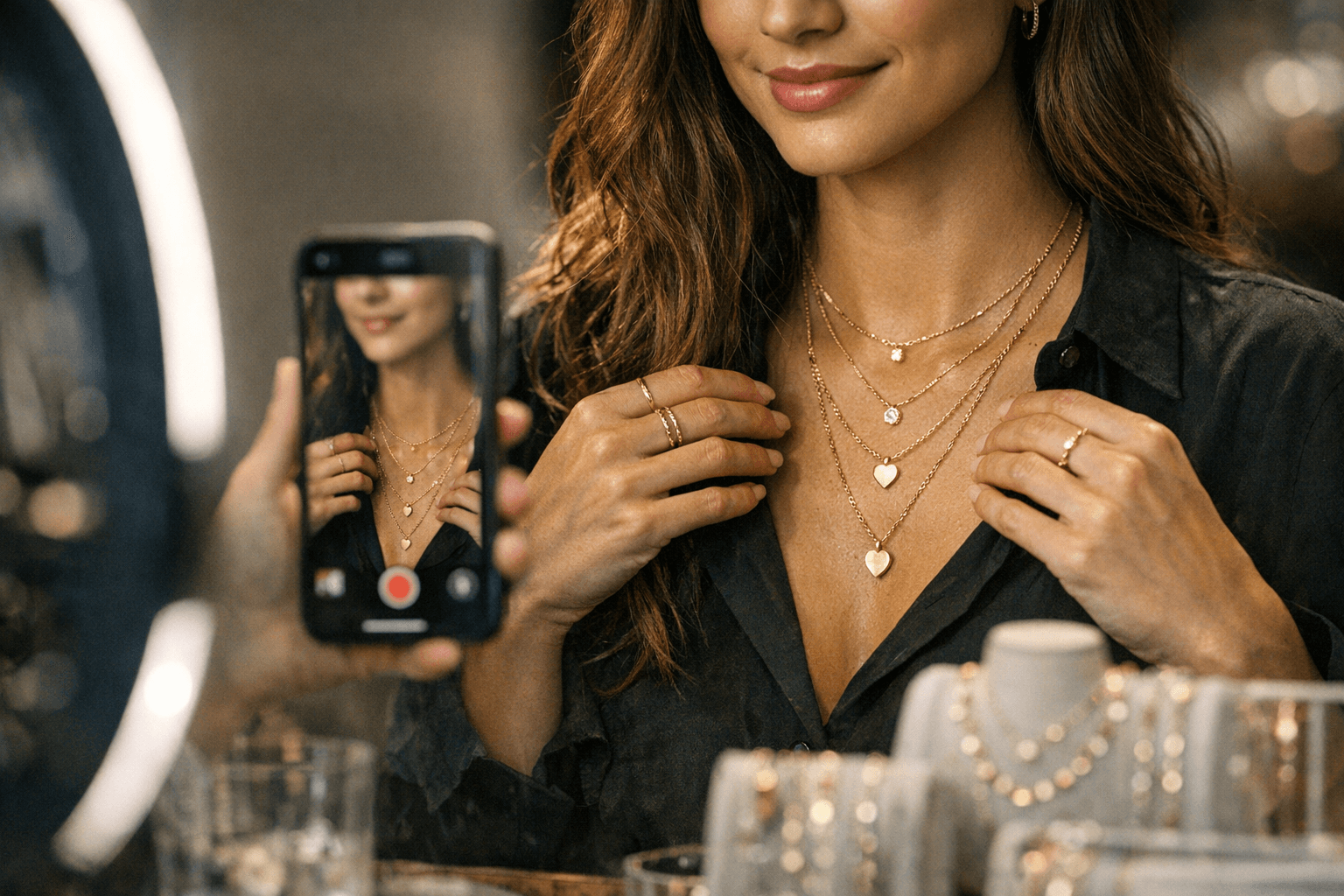
Short-form video has rewritten the rules of jewelry discovery. What once required a well-lit boutique display or a glossy magazine spread now happens in seconds, on a phone screen, in the scroll of a thumb. The March 23 TikTok trends briefing makes the case clearly: four jewelry formats are driving consumer interest harder than anything else on the platform right now, and understanding how they perform visually is as important as understanding why people want them.
The Four Formats Winning the For You Page
Dainty layered necklaces are the undisputed anchor of this moment. The appeal is architectural: two or three fine chains worn at slightly different lengths, each carrying something small, whether a tiny diamond solitaire, a bezel-set stone, or nothing at all. On video, the layered stack catches light at different depths, creating motion even when the wearer is still. That shimmer is catnip for the algorithm.
Micro-pendants are the natural companion format. A pendant that might register as almost invisible in person becomes a focal point under close-up video, where its scale reads as intentional rather than understated. The intimacy of the format suits TikTok's visual grammar perfectly: something small, examined closely, feels like a secret being shared. Women across a wide age range, from their twenties into their fifties, have embraced micro-scale jewelry precisely because it communicates personality without announcing itself.
Thin rings, worn singly or in a considered stack, are generating consistent engagement through a specific content format: the ring stack transition. A hand enters frame bare, and in a cut or a slow reveal, it reappears with three or four stacked bands across multiple fingers. The visual reward is immediate. Stacking has become, as one observer put it, the visual language of modern jewelry styling, and thin rings are the grammar of that language.
Anklet flashes round out the four. The ankle shot, a quick tilt of the camera down toward a bare foot or sandal, has become a recognizable shorthand for summer ease and quiet luxury. A fine gold anklet caught in natural light, against tanned skin or a linen hem, communicates an entire lifestyle in two seconds. It is among the most efficient pieces of jewelry storytelling on the platform.
What the Hashtag Clusters Reveal
The viral hashtag landscape around minimalist jewelry consolidates around a handful of clusters that work in tandem. Tags like #daintyjewelry, #minimalistjewelry, and #jewelrytok function as community markers, pulling content toward audiences already predisposed to delicate, fine-finish pieces. #Tiktokmademebuyit remains one of the platform's most conversion-linked tags, and minimalist jewelry consistently surfaces within it, which is a signal that this category is not just aspirational browsing but active purchasing.
#Ringsoftiktok draws a specific community of ring enthusiasts, and content using the tag tends toward the demonstrative: hands in motion, stacking sequences, close-ups of knuckle-grazing bands. Meanwhile, broader discovery tags like #fyp and #aesthetic ensure that content reaches beyond the already-converted. The most effective posts layer both community-specific and broad-reach tags, using the former to establish credibility and the latter to widen the funnel.
The Visual Cuts That Convert
Three specific types of footage are driving the strongest engagement in this category, and each one rewards a distinct quality of attention.
The close-up of delicate chain movement is the most reliable. A fine cable chain or a box chain in 14-karat gold, filmed at a few inches' distance as it shifts against a collarbone or drapes across a wrist, shows texture and quality in a way that a flat product image cannot. The micro-detail of individual links, the way the metal bends rather than stiffens, the slight swing with movement: these are the signals that tell a viewer this is a real piece, worth their money.
Ring stack transitions work because they have narrative shape. There is a before and after. The viewer's eye tracks the change, and the brain registers the outcome as desirable. The transition format also compresses time effectively, making a complex styling decision look effortless, which is precisely the fantasy the viewer wants sold to them.
Ankle shots earn their place because of their lifestyle encoding. The camera angle places the viewer in a specific scene, whether it is a terrace, a beach, a sun-filled morning, and the anklet becomes inseparable from that scene. It is one of the few jewelry shots that sells an experience rather than an object.
How Brands Can Film for Discoverability
The briefing offers three specific production principles for brands and retailers presenting delicate jewelry in short-form video, and each one addresses a specific failure mode common to underperforming jewelry content.
Lighting that catches subtle metal is the first and most foundational principle. Thin gold and silver pieces disappear under flat, overhead light. The metal needs a directional source, whether a window, a ring light placed at an angle, or even a simple reflector, to create the specular highlights that make a fine chain readable on a small screen. Without that catch of light, a dainty necklace becomes invisible at standard playback size.
A slower pan to show movement is the second. The instinct for brands new to short-form video is to cut fast, matching the pace of trending audio. But delicate jewelry needs more time on screen to register. A slow, deliberate pan across a layered necklace stack, or a gradual reveal of a ring on a moving hand, allows the viewer's eye to settle on the details. Speed works for statement pieces; restraint works for dainty ones.
Pairing jewelry with everyday outfits is the third principle, and arguably the most strategically important. When a micro-pendant is shown against a plain white tee, or a thin ring stack is photographed on a hand reaching for a coffee cup, the viewer can immediately place the piece in their own life. Context answers the unspoken question every potential buyer is asking: where would I wear this? Showing a delicate anklet on a woman in jeans rather than on a white velvet display platform does not cheapen the piece. It closes the distance between wanting and buying.
TikTok's algorithm favors engagement over follower count, which means a precisely filmed, well-tagged piece of content from a small independent jewelry brand can reach as many viewers as a post from a major retailer. That is a structural advantage for the makers of fine, dainty pieces, whose work rewards exactly the kind of intimate, close-up visual storytelling the platform was built for. The brands learning to use light, pace, and context to their advantage right now are not just following a trend; they are building a durable fluency in the medium where the next generation of jewelry buyers is spending its attention.
This article was produced by Prism’s automated news system from verified source data, official records, and press releases, then run through automated quality and moderation checks before publishing. The system is built and supervised by the people who set the standards it runs under. Read our full AI policy.
Did this article answer your question?


