Basra pearls trace Gulf history, from royal suites to auctions
Basra pearls have moved from Gulf trade goods to museum-grade references, and their scarcity now shapes how jewellers price, authenticate and narrate pearls.

From Gulf beds to royal courts
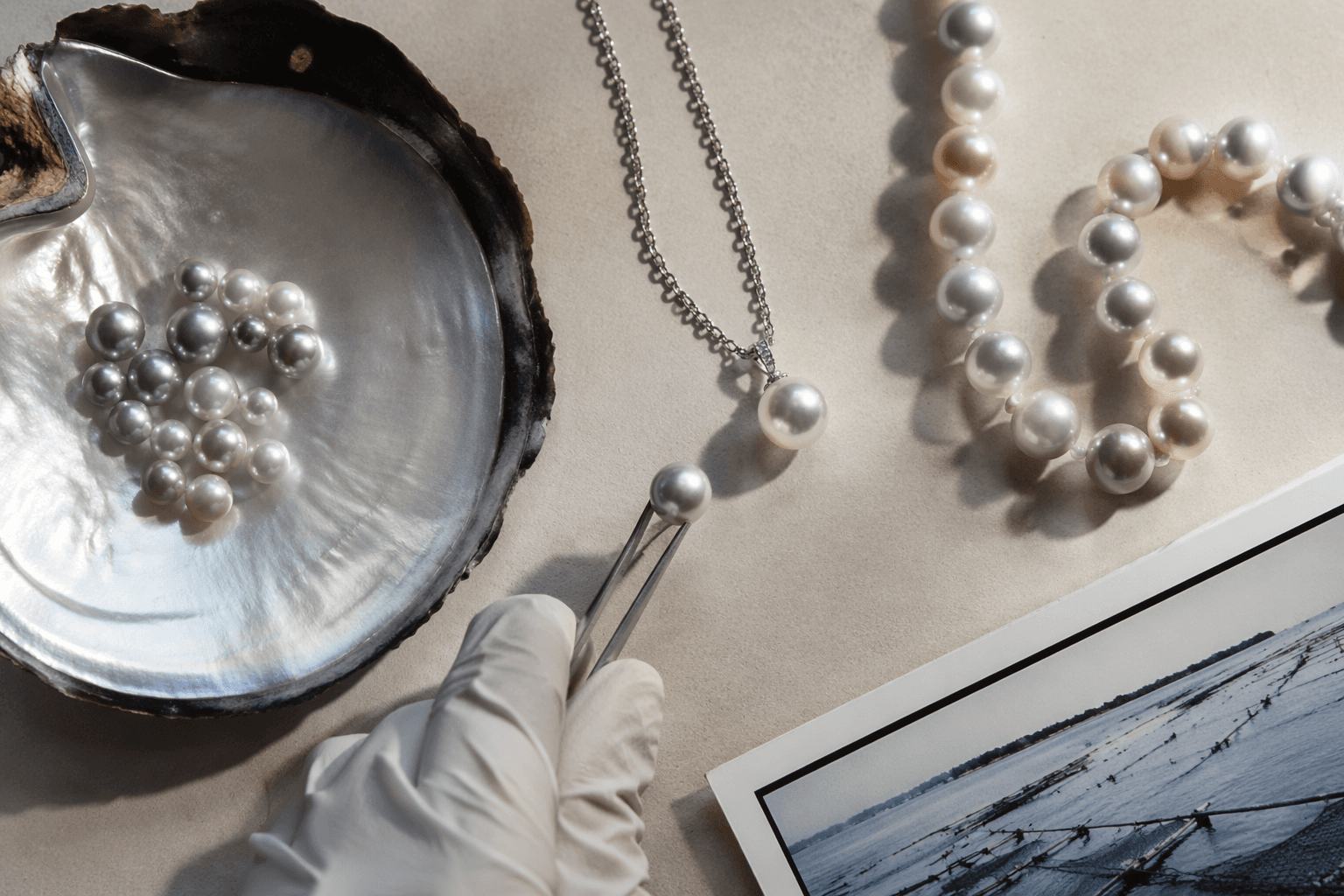
Basra pearls still carry the romance of a working pearl economy, but in practice they now live mostly in heirloom boxes, auction catalogues and private collections. Once drawn through Gulf trading routes and stitched into royal regalia, they have become less a material jewellers can easily source than an archive of prestige, a reference point for designers chasing softness, irregularity and old-world sheen.
That shift begins in the waters of the Arabian and Persian Gulf, where the pearl beds rank among the oldest and most prolific known. The British Pearl Association says individual pearls from the region date back at least 7,000 years, and that Julfar in today’s Ras Al Khaimah was already a major pearling centre by 1154. The geography matters because Basra pearls were never just ornaments; they were the product of a sea economy that linked Bahrain, Qatar, Kuwait, Iraq and the wider Gulf to princely households across South Asia.
Why Basra pearls read differently now
What makes Basra pearls so compelling to collectors and designers is not only age, but absence. Vogue India has noted that these pearls were once stitched into royal canopies, while today jewellers struggle to find even a single strand. That scarcity has changed the market’s language: where pearl jewellery once meant abundance, Basra now signals refinement, survival and proof of origin.
The term also works as a shorthand for a certain visual code. Basra pearls are remembered for their soft, often slightly uneven character, the kind of antique luminosity that modern cultured pearls can imitate but not fully replace. Designers increasingly borrow that look, or build a provenance story around it, because actual strands are hard to secure and even harder to document. In high jewellery, the Basra reference has become almost as powerful as the material itself.
Natural pearls versus cultured pearls
The distinction between natural and cultured pearls sits at the centre of that scarcity. GIA says natural pearls form without human intervention, while cultured pearls are created through deliberate human insertion of a bead or tissue. In today’s market, the vast majority of pearls are cultured, which is why genuine natural pearls usually surface as antique material rather than newly available inventory.
That rarity has practical consequences for pricing and trust. A seller can describe a pearl as old, but age alone does not prove it is natural, and a natural pearl does not automatically command a premium unless its provenance is credible. Collectors, dealers and auction houses all treat documentation as part of the jewel’s value, because once the pearl leaves the realm of family history and enters the market, the burden of proof becomes part of the design story.
How authentication works in practice
Authentication is where the romance ends and the laboratory begins. GIA says digital X-radiography and microradiography are key methods for determining whether a pearl is natural or cultured, and that microradiography is the most reliable non-destructive approach. SSEF uses testing to distinguish natural from cultured pearls, separate freshwater from saltwater pearls, identify treatments and determine whether a pearl has been worked.
That lab work matters because Basra pearls often circulate with stories that are difficult to verify on sight alone. SSEF also offers radiocarbon age dating of pearls, a service it has provided since 2017, which can help place a pearl in historical context when a collector needs more than family lore. For anyone buying at the top end, the most valuable words in the file are often not poetic ones like “moonlit” or “opalescent,” but technical ones: natural, untreated, documented, dated.
- Look for a laboratory report from a recognized gemological service.
- Ask whether the pearl has been tested by X-radiography or microradiography.
- Request any record of prior ownership, restoration or mounting.
- Treat vague heritage claims with caution unless they are backed by documentation.
Royal suites, auction rooms and the price of provenance
The market’s fascination with Basra pearls is easiest to see in objects that carry both size and history. Christie’s says the Baroda Pearl Canopy contains approximately 950,000 Basra pearls and is one of only two surviving pieces from a five-part royal suite commissioned by Maharaja Khande Rao Gaekwad of Baroda in the 1860s. When it sold at Christie’s New York in June 2019, it brought $2,235,000 as part of the Maharajas & Mughal Magnificence sale, which totaled $109,271,875 and drew bidders from 45 countries.
Sotheby’s has pointed to another telling example, a royal coat embroidered with thousands of Basra seed pearls, as evidence of both late-19th-century Maharaja court splendour and the ancient sea-trade that fed natural pearls from the Arabian Gulf into South Asian princely life. These are not merely decorative objects; they are records of how power, craft and maritime commerce once met in fabric and stone. When such pieces appear in auction rooms, they reset the market’s ceiling for what documented provenance can command.
Why the Basra name still moves the market
Among natural pearls, famous provenance can matter as much as size. Christie’s says La Peregrina, the celebrated natural pearl once owned by Spanish monarchs and later Elizabeth Taylor, sold for $11,842,500 in 2011. That result explains why rare natural pearls with a verified chain of ownership continue to behave like trophy assets: they are not bought only for beauty, but for certainty, scarcity and story.
That is where Basra pearls sit now, at the intersection of design and disappearance. In contemporary jewellery, the true strand is rarer than the reference to it, and the reference itself has become a luxury language. The next chapter of the pearl market may be less about finding more Basra pearls than about proving them, honouring them and, in many cases, evoking them without ever touching the real thing.
This article was produced by Prism’s automated news system from verified source data, official records, and press releases, then run through automated quality and moderation checks before publishing. The system is built and supervised by the people who set the standards it runs under. Read our full AI policy.
Did this article answer your question?