How pearl whitening treatments make gems look brighter and whiter
That cool blue glow under UV can expose pearl whitening and brightening treatments, and it changes how buyers should read beauty, value, and disclosure.
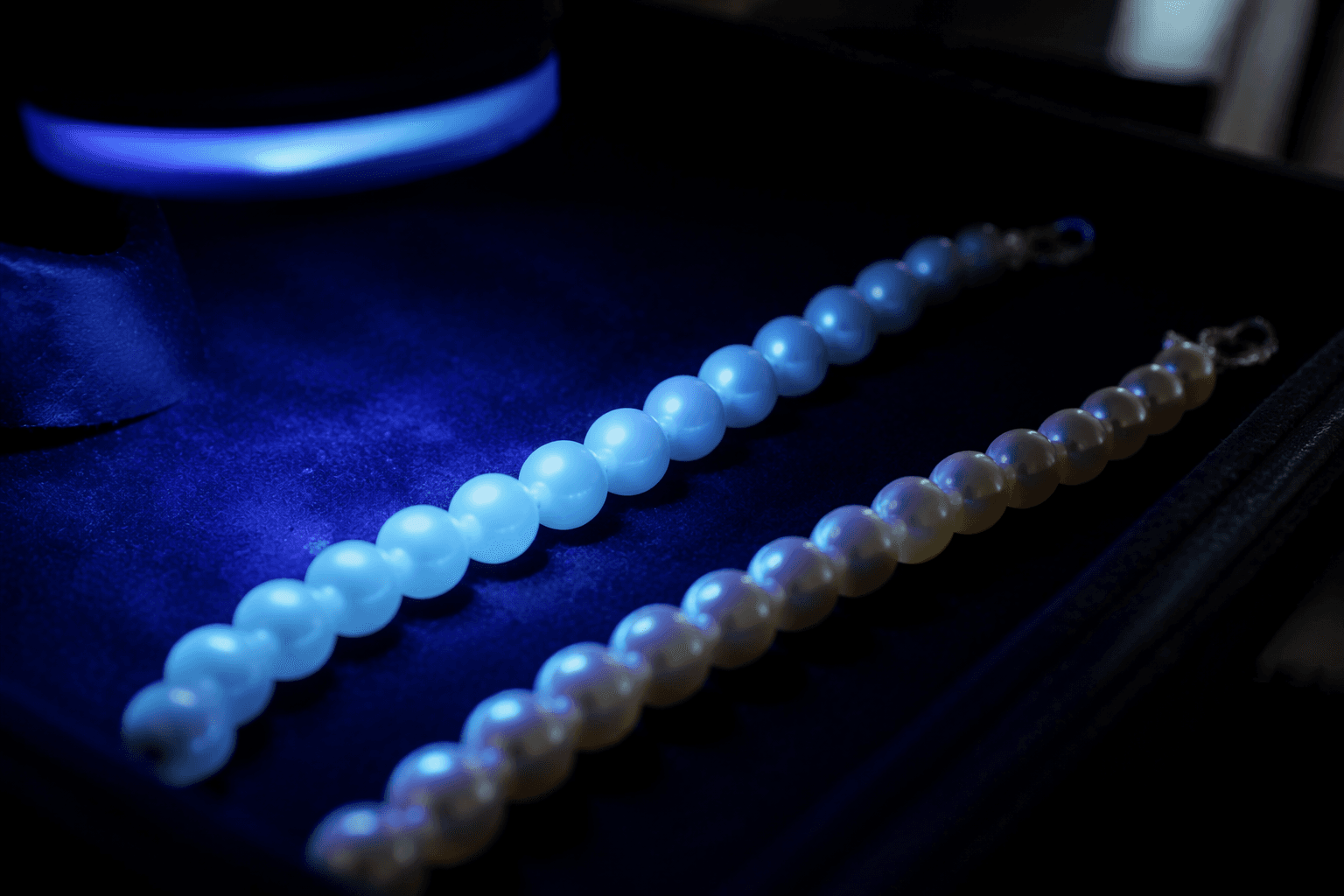
White and very light-hued pearls, especially akoya and freshwater cultured pearls, are routinely bleached, and the trade also uses a cluster of luster-enhancement steps known as maeshori. Ultra-bright, highly uniform pearls have a sleek, immediate appeal, but some of that polish can come from post-harvest treatment rather than from the pearl itself. Those finishes can sharpen the look of a strand in showcase lighting, yet they also raise the question that matters most in a buying decision: is the color coming from the pearl’s own body color, or from an added process after harvest?
What whitening actually changes
Bleaching does not simply make a pearl “look nicer.” It can pull down yellow or uneven overtones, push the surface toward a cooler white, and help a set of pearls read as more consistent from bead to bead. Pearls are judged on a layered set of qualities, including size, shape, color, luster, surface, nacre, and matching. When a necklace looks beautifully even, that may reflect both nature and treatment, and the difference affects how the piece is described, priced, and compared with an untreated pearl of similar size or luster.
Routine enhancement for white to near-white akoya and freshwater pearls includes bleaching, polishing, and heat treatment. The Cultured Pearl Association of America uses the trade term maeshori for that routine enhancement. Bleaching is the most prevalent treatment, and maeshori is an umbrella term for different luster-enhancement steps.
Why the blue glow matters
The most revealing clue is often invisible in ordinary light. In GIA’s optical-whitening study, known samples of optically brightened akoya cultured pearls, along with other cultured pearls and an in-house treated South Sea pearl, showed strong bluish fluorescence under long-wave ultraviolet excitation. The same work found a fluorescence maximum around 430 to 440 nm, a signature that helps separate brightened pearls from non-brightened ones.
A pearl can look immaculate in a boutique display case, then reveal a different story under lab analysis. Fluorescence spectroscopy, paired with visual fluorescence observation, provides a quick and easy way to detect optical brighteners in nacreous pearls.
Color treatment and brightening are not the same thing
Pearl treatments are often discussed as if they were one category, but the science draws sharper lines. The most common color treatments are dyeing and irradiation. Optical brightening is a separate issue: it is tied to fluorescence behavior and the way a pearl responds under UV light, not to the obvious visible color shift that comes with dye.
A buyer can encounter several different kinds of enhancement in the same market. A pearl might be dyed for color, irradiated to alter its tone, or optically brightened to increase whiteness and apparent glow. If a seller treats all of those as the same thing, the conversation about value becomes fuzzy fast. A pearl that is naturally white, a pearl that has been bleached, and a pearl that has been dyed are not the same purchase, even if they sit side by side under soft lighting.
How labs separate natural body color from post-harvest enhancement
GIA’s 2021 study of Chinese freshwater Edison pearls analyzed 23 freshwater Edison pearls. Nineteen were confirmed as bead cultured pearls and four were non-bead cultured pearls. Seven samples were identified as color-treated, and five of the remaining 16 were identified as optically brightened.
Researchers used microscopic observation, long-wave UV fluorescence observation, long-wave and short-wave fluorescence spectroscopy, Raman spectroscopy, and trace-element analysis. Edison pearls are near-round to round freshwater bead cultured pearls invented and produced by Zhejiang Grace Pearl Jewellery Co Ltd in China.
What sellers should disclose, and what buyers should ask
Under Federal Trade Commission rules, sellers must disclose pearl treatments when a treatment is not permanent or creates special care requirements. CIBJO’s Pearl Commission went further in 2024, recommending that bleaching be disclosed in all transactions and described throughout the supply chain, noting that it is commonplace in Japanese akoya pearls.
For a buyer, the practical questions are straightforward:
- Was the pearl bleached, dyed, irradiated, or optically brightened?
- Was maeshori used, and if so, what steps did it include?
- Is the pearl’s color its natural body color, or the result of post-harvest enhancement?
- Does the seller have documentation or a lab report that identifies treatment?
- Does the treatment create any special care requirements?
This article was produced by Prism’s automated news system from verified source data, official records, and press releases, then run through automated quality and moderation checks before publishing. The system is built and supervised by the people who set the standards it runs under. Read our full AI policy.
Did this article answer your question?