Princess Kate and Queen Mary’s Pearl Tiaras Trace Royal Lineage
Kate’s Lover’s Knot and Queen Mary’s Danish Pearl Poiré show how pearl tiaras carry family memory, not just sparkle.
A shared pearl language
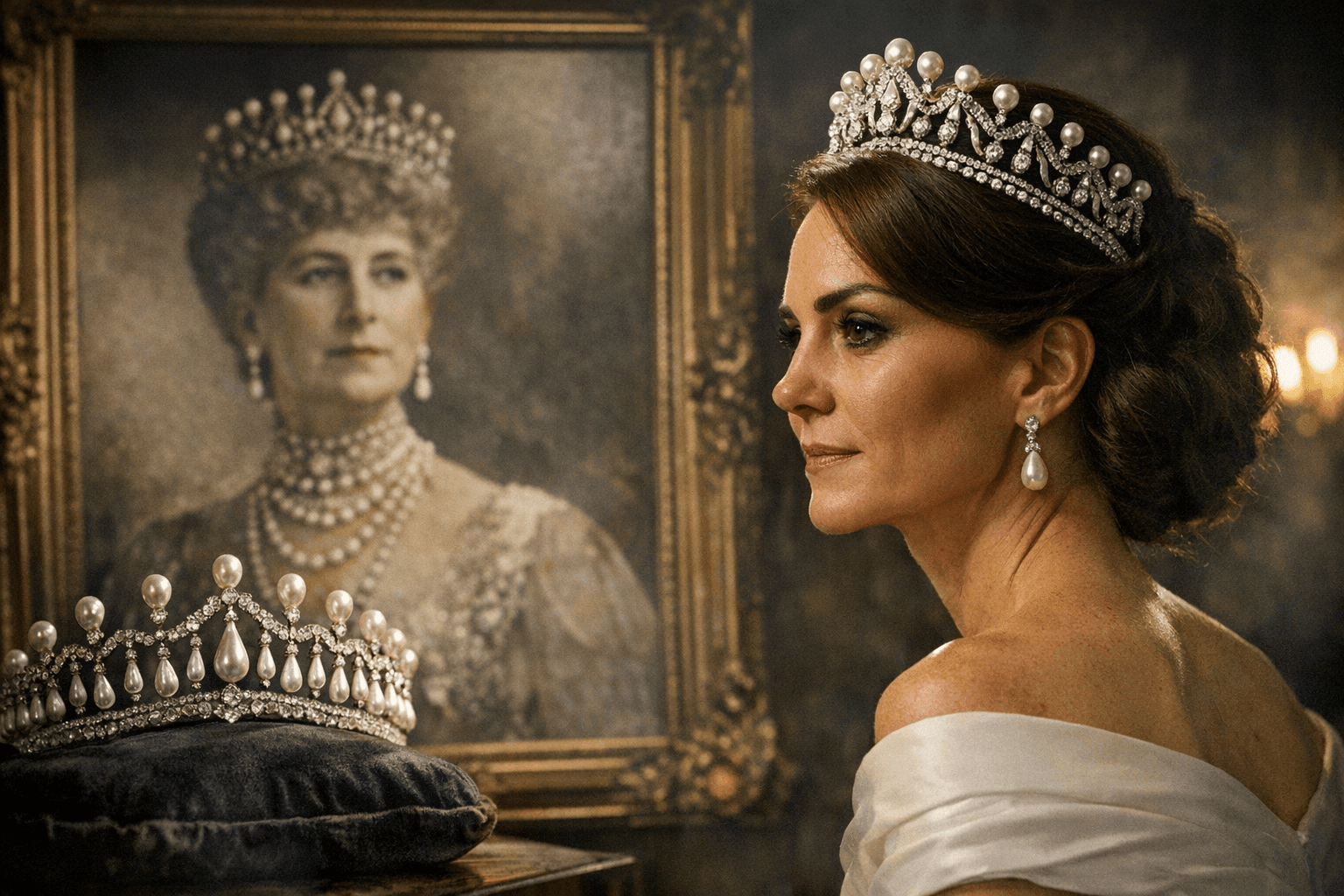
Kate and Queen Mary of Denmark wear tiaras that look almost like twins, but the resemblance is doing more than pleasing the eye. In pearl jewelry, repetition is a language of inheritance, and these two women are speaking it fluently. Kate has worn Queen Mary of the United Kingdom’s Lover’s Knot Tiara 14 times in public between 2015 and 2026, making the jewel feel less like an occasional ornament than a working emblem of continuity.
The power of that effect is easy to miss if you look only at the shimmer. A pearl tiara earns its authority from symmetry, restraint, and the disciplined way pearls sit against diamonds, usually in a structure that feels architectural before it feels decorative. That is why royal pearl tiaras tend to read as heirlooms first and jewelry second.
From Queen Mary of the United Kingdom to Kate
The Lover’s Knot Tiara that Kate wears was commissioned by Queen Mary of the United Kingdom in 1913 and 1914 from Garrard, and she used diamonds and pearls she already owned. That detail matters: this was not a one-off fashion commission, but a remaking of family memory in hard stones and nacre. Queen Mary looked back to the Cambridge Lover’s Knot Tiara worn by her grandmother, Princess Augusta of Hesse-Kassel, and the design’s lineage stretches even further through Princess Augusta, Duchess of Cambridge.
That older family line helps explain why the motif keeps resurfacing across royal women. The tiara’s knots and dangling pearls create a rhythm that feels ceremonial and intimate at once, the kind of balance that survives changes in silhouette, hairstyle, and era. Its emotional weight also deepened when it was offered to Princess Diana for her 1981 wedding, before she chose the Spencer tiara instead.
For anyone reading pearl jewelry as more than sparkle, this is the key lesson: the most memorable pieces are rarely the most complicated. They are the ones that preserve a shape, a spacing, and a sense of order so well that a new wearer can step into the design without erasing its past.
Denmark’s near-match and the meaning of access
Queen Mary of Denmark’s near-identical jewel is the Danish Pearl Poiré Tiara, part of the Pearl Poire set. That suite also includes a necklace, earrings, and two brooches, and the Danish royal house describes it as one of the Danish Royal Property Trust’s best-known garnitures. It is especially interesting because the set was not originally created as a single ensemble, but now functions as one, which is exactly how royal jewelry often works: a collection of pieces becomes a visual family when the shapes, stones, and proportions are right.
The Pearl Poire set is generally dated to 1820 to 1869, with royal-history sources placing the tiara lineage at about 200 years old. Its path through the royal houses of Prussia, the Netherlands, Sweden, and into Denmark in 1870 gives it the kind of provenance that collectors prize, because provenance turns beauty into record. The Danish Royal Property Trust itself was established by Frederik VIII and Queen Lovisa in 1910, and the house’s crown jewels and trust jewels are organized into four large garnitures: emerald, brilliant-cut diamond, pearl-ruby, and rose-cut diamond.
Queen Mary first wore the Pearl Poiré tiara at a state banquet in Oslo on May 14, 2024, during a state visit to Norway with Frederik X. The date was also the 20th anniversary of her marriage to Frederik X, which gave the debut a public and personal charge at once. As queen, she now has access to crown jewels and other historic pieces, giving her more freedom than she had as crown princess, and that flexibility is part of why royal pearl jewelry remains so compelling: the same silhouette can shift from state formality to a more individualized expression of rank.
How to read an heirloom pearl tiara
An heirloom pearl tiara announces itself through proportion before opulence. Look for mirrored sides, a centered motif, and a setting that lets pearls appear suspended rather than crowded, because that is what creates the floating effect so common in royal pieces. Diamonds often serve as the scaffolding, while pearls supply the softness, and when the balance is right, the tiara looks precise rather than busy.
Provenance is the final cue. A piece traced from one royal house to another, or from a queen’s private commission to a later wearer, carries a narrative that changes the way its design is read. That is why the Lover’s Knot and the Pearl Poiré feel so similar even though their histories differ: both are built on the idea that a pearl jewel can preserve a family line in visible form.
What the royal look means for modern pearl jewelry
The same design codes show up in modern bridal and formal pearl pieces, especially in tiaras, necklaces, and earrings that favor symmetry over excess. A centered pearl drop, a diamond framework, and a balanced profile still read as aristocratic because the eye recognizes order before sparkle. In bridal jewelry, that can mean a tiara or comb that echoes the royal silhouette without copying it outright; in evening jewelry, it may be a necklace or earrings that pair luminous pearls with crisp diamond edges.
The practical lesson is just as important as the aesthetic one. Pearls that look flat or chalky lose the depth that makes these heirloom-style pieces so persuasive, while well-proportioned settings help the stones read as part of a coherent whole. The royal examples make the case clearly: when pearl jewelry is designed with symmetry, provenance, and restraint, it stops feeling seasonal and starts feeling like a family story worth wearing again.
This article was produced by Prism’s automated news system from verified source data, official records, and press releases, then run through automated quality and moderation checks before publishing. The system is built and supervised by the people who set the standards it runs under. Read our full AI policy.
Did this article answer your question?