A citrine brooch links one family to a ship’s maiden voyage
A modest citrine brooch carries a maiden voyage, a family name, and a shipping dynasty in its reverse inscription.
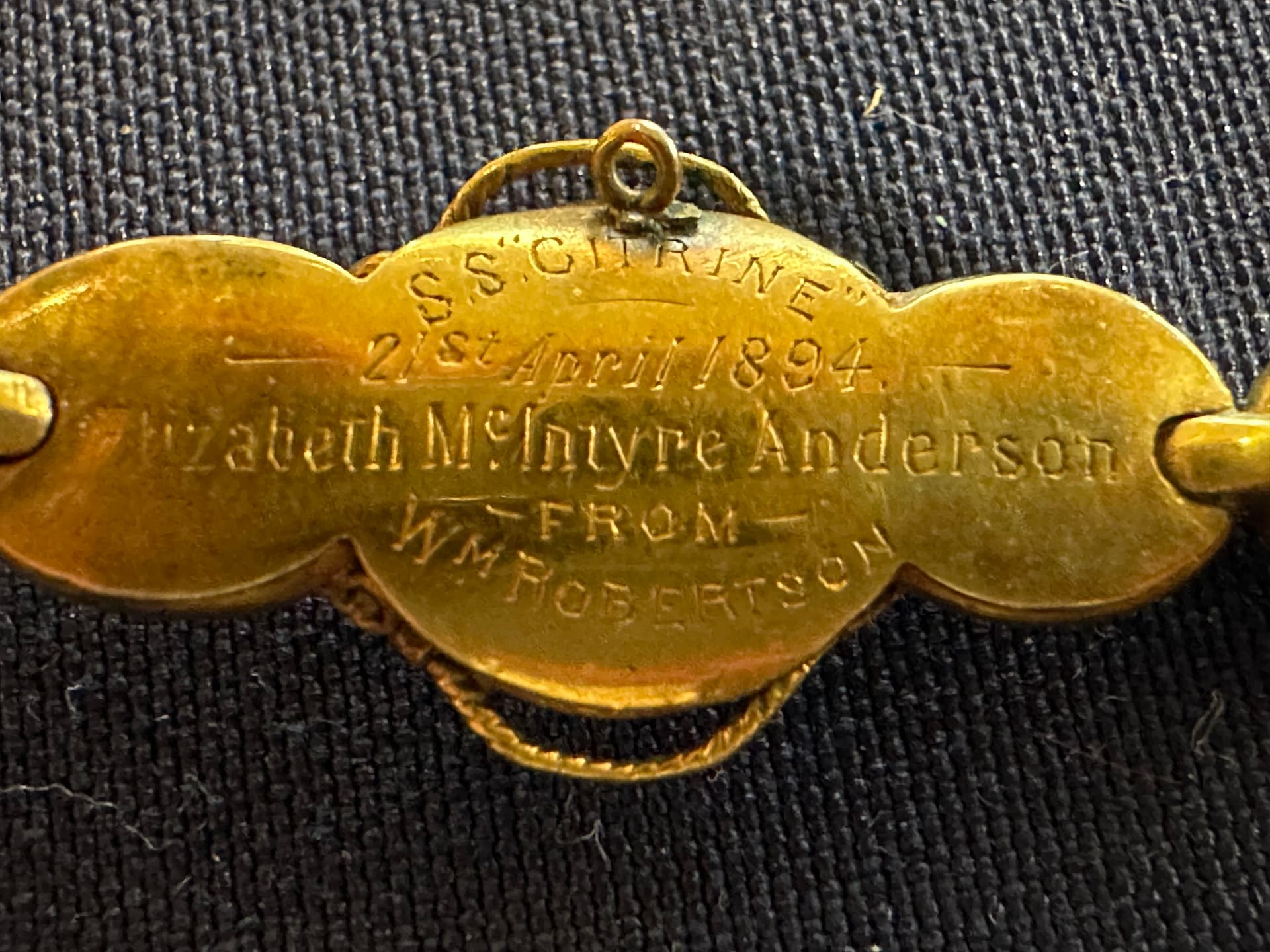
A citrine brooch can act like an archive. Presented on April 21, 1894 to Elizabeth McIntyre Anderson, it carries the date of the SS Citrine’s maiden voyage, the name of the ship, and the hand of William Robertson on its back. The stone is only part of the appeal. What gives the jewel its force is the way it turns a personal gift into a record of a specific place, a specific day, and a family enterprise that stretched across decades.
A jewel that records a voyage
The reverse inscription makes the brooch read less like ornament and more like evidence: “SS Citrine, 21st April 1894, Elizabeth McIntyre Anderson, from William Robertson.” That kind of inscription is exactly what gives personalized jewelry its emotional gravity. A name, a date, and a giver can do more than a gemstone ever could on its own, because they locate the jewel in lived history rather than in the abstract language of carat weight or style.
Elizabeth McIntyre Anderson is believed to have been the first person to board the SS Citrine for its maiden voyage, which gives the brooch an intimate origin story from the start. This was not a generic presentation piece, but a commemorative jewel tied to a first passage. For collectors of personalized jewelry, that distinction matters: the piece is not simply decorated with a citrine stone, it is anchored to a moment that can be read, named, and traced.
The design reinforces that sense of specificity. Its sides are shaped like ship’s rope, and its center forms a life ring set with a citrine stone, a maritime vocabulary translated into gold and gem. The choice of citrine is especially apt because the name of the stone echoes the name of the ship, allowing the jewel to work on two levels at once, as a visual emblem and as a verbal pun.
The ship behind the setting
The SS Citrine was completed in 1894 by W.B. Thompson & Co. in Dundee for William Robertson of Glasgow. It was a screw steamer, a workmanlike vessel rather than a glamour ship, which makes the brooch all the more interesting. The jewel does not celebrate a famous liner or an imperial showcase; it remembers a specific ship in a working fleet, and that grounded provenance is part of its charm.
The ship’s later fate only deepens the story. On March 17, 1931, the Citrine struck rocks at Bradda Head near Port Erin on the Isle of Man and sank. Reports say nine of the ship’s 11 crew members died in the wreck, a tragic end that landed 37 years after the maiden voyage memorialized by the brooch. Seen in that light, the jewel becomes one of the few surviving objects linked to the vessel’s earliest chapter.
That temporal gap matters. A commemorative brooch can feel charming when the subject is still intact and triumphant; it becomes far more poignant when the ship itself has long since vanished. The Citrine brooch preserves the optimism of the launch, not the disaster of the sinking, which is precisely why it holds such narrative weight. It keeps alive the human firsts, the names, and the ritual of departure.

William Robertson and the rise of the Gem Line
The brooch also points to a larger industrial story. William Robertson founded his shipping business in 1852, beginning with the purchase of the barge Ellen, which worked the Forth and Clyde Canal and the Clyde Estuary. From that modest start, the Gem Line grew into one of Britain’s largest coastal bulk shipping fleets. By 1900, Royal Museums Greenwich records place the fleet at almost forty vessels, and a later book summary puts it at up to fifty ships at its peak.
That expansion gives the brooch a second layer of meaning. It is not merely a token from one ship to one passenger, but a small artifact from a maritime dynasty large enough to leave a paper trail in institutional archives. The business was still in Robertson hands in 1931, with William Francis Robertson and James Robertson running it after William Robertson’s death, which underscores the family continuity behind the gift. The line later became Gem Line Ltd in 1958 and was acquired by Powell Duffryn Ltd in 1970, but the brooch belongs to the era when the Robertson name still defined the company’s identity.
For jewelry readers, this is where provenance becomes more than a collecting term. The best estate pieces often gain their appeal not from rarity in the usual gemological sense, but from the chain of ownership and the precision of their story. Here, that chain runs from a Dundee-built screw steamer to a maiden voyage, from a family shipping firm to a surviving inscription, and from the back of a brooch to a far wider maritime history.
Why personalized jewelry collectors notice pieces like this
Pieces like this explain why personalized jewelry continues to fascinate beyond monograms and initials. A commemorative brooch with a dated inscription does something more durable: it stores a relationship. The name of the recipient, the name of the giver, the date of presentation, and the vessel all survive together, and the object becomes a compact biography.
The craftsmanship helps tell that story without words. Rope-like sides signal seafaring immediately, while the life-ring motif around the citrine stone turns a practical rescue image into ornament. That kind of symbolic design is especially compelling because it makes the jewel legible even before the engraving is read. You see the maritime reference first, then discover that the back confirms it with names and a precise date.
In the estate market, that combination is often more compelling than intrinsic gem value alone. A modestly priced brooch with a citrine stone can become the most desirable object in a case if it carries a true inscription and a verifiable link to a ship, a family, and a date. The Citrine brooch does exactly that, preserving not just a stone, but a boarding, a gift, and the memory of a vessel that once moved through the Clyde under the Robertson name.
This article was produced by Prism’s automated news system from verified source data, official records, and press releases, then run through automated quality and moderation checks before publishing. The system is built and supervised by the people who set the standards it runs under. Read our full AI policy.
Did this article answer your question?