Bridal jewelry in 2026 turns personal, custom designs and boutique showrooms lead the way
Bridal jewelry is becoming a relationship archive, with custom rings, private showrooms, and engravings replacing generic wedding-day sparkle.
Bridal jewelry is becoming a relationship artifact
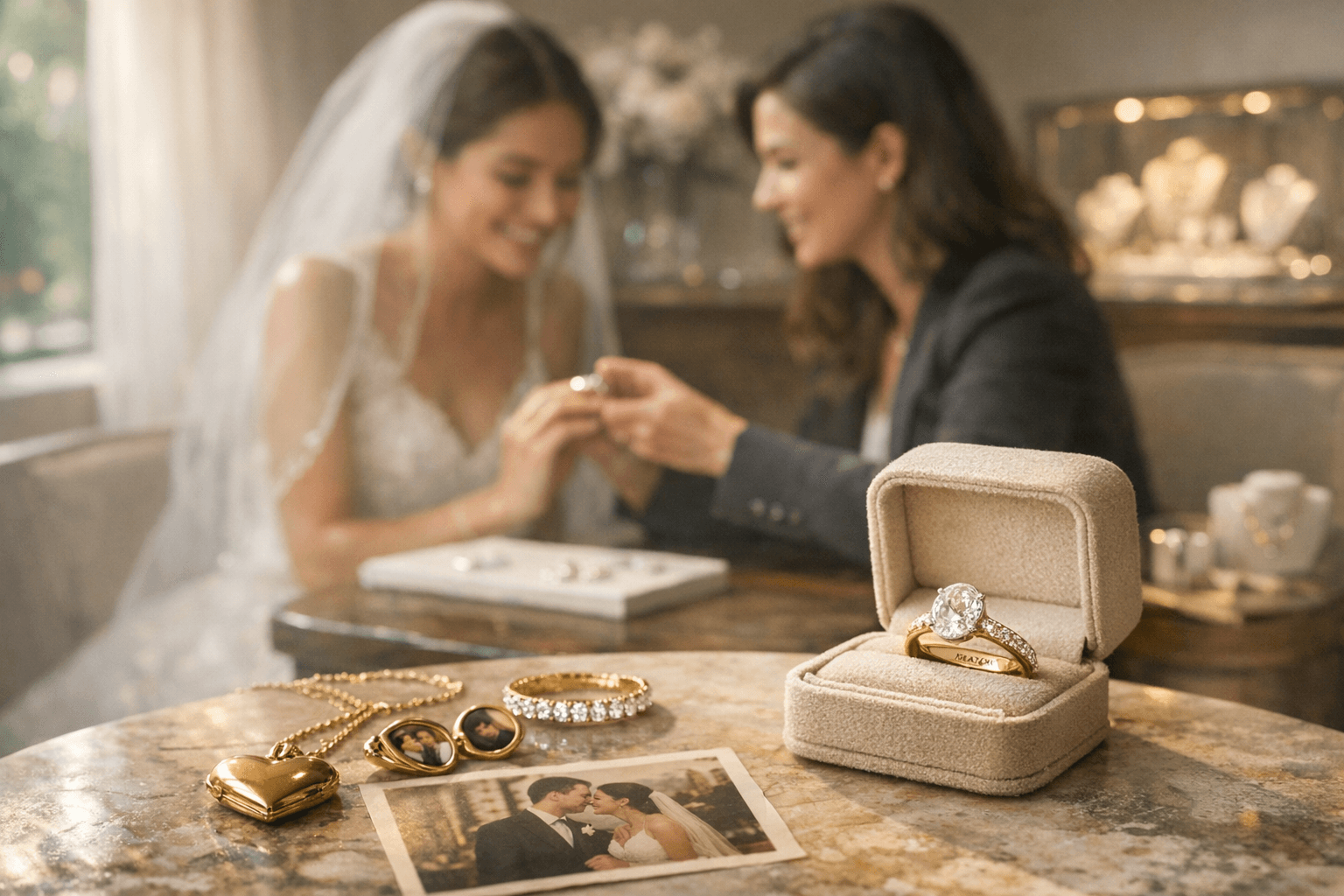
The most compelling bridal pieces now do more than signal a wedding day. They are being designed to carry a couple’s story before the ceremony, through the ceremony, and long after the last toast, which is why custom work, engravings, and intimate consultations are moving to the center of the category.
That shift is visible in the way brides and grooms are shopping. The Knot’s engagement-ring data shows that couples still love classic silhouettes, but they are choosing them with more intention than ever. In other words, the emotional weight is no longer coming from a generic “bridal” look. It is coming from details that feel personal, legible, and specific to one relationship.
The showroom is now part of the design
Hitched has built its business around that appetite for intimacy. The company’s showrooms in Philadelphia, Chicago, and Washington, D.C.’s Georgetown neighborhood are meant to feel more like bistros than traditional jewelry stores, with no formal cases and couples seated at bistro-style tables to see and try on rings. For millennial and Gen Z buyers, that softer setting matters because ring shopping has become a conversation, not a transaction.
Hitched says every engagement ring is made to order after an in-store consultation, and couples can view the design in computer-aided design during the process. That kind of visualization changes the experience of buying bridal jewelry: you are not simply selecting from inventory, you are watching a ring become real piece by piece. The brand opened its Georgetown shop in summer 2023 and has said it hopes to reach 10 retail locations by 2030, a telling sign that bespoke service is no longer niche.
What personalization is worth paying for
The details that resonate most are the ones that actually deepen the meaning of the piece. A date engraved inside a band, initials tucked discreetly into the metal, a private line from vows hidden where only the wearer knows to look, or an heirloom ring redesigned so it can be worn every day all give a bridal jewel emotional permanence. Those choices matter because they transform a ring from a style choice into a keepsake with a memory attached.
That is also why customization should feel considered, not decorative for its own sake. A well-placed engraving or an heirloom reset can do more than a louder, trend-driven design ever could. A stone from a grandmother’s ring, for instance, can be recast in a cleaner modern mount so it still carries family history without feeling precious in the untouchable sense. The most successful personalized bridal jewelry is usually the kind that becomes easier to live with, not harder.
- Engravings work best when the message is short and specific, such as a date, initials, or a line that marks the proposal or ceremony.
- Heirloom redesigns matter most when the original stone or setting has emotional weight, but the proportions no longer fit modern wear.
- Custom CAD renderings are useful when you want to see how a setting, shank, or side stones change the ring’s profile before it is made.
- Boutique consultations are worth the time because they let you compare subtle differences in height, width, and finish that do not translate on a screen.
Why the retail experience is getting more luxurious, and more human
Brilliant Earth’s new Beverly Hills showroom makes the same argument in a different register. The nearly 3,500-square-foot space opened on Jan. 28, 2026, and the company describes it as a “showroom of the future,” a phrase that captures how bridal jewelry retail is being recast around artistry, personalization, and human connection. It is Brilliant Earth’s 42nd showroom, and that scale matters: the brand began as a bridal-only company two decades ago, so the new flagship reads less like a departure than an amplification of its original mission.
The Beverly Hills store also reflects how much bridal shopping has migrated toward guided, appointment-driven retail. Couples want to touch the materials, compare settings, and hear the logic behind each decision. In a category where the purchase often carries both emotional and financial weight, the showroom is now part of the value proposition.
Classic shapes still anchor the category
Personalization has not erased classic taste. The Knot’s Jewelry and Engagement Study found that round center stones still lead at 28 percent of engagement rings in the United States, while oval center stones account for 25 percent. That balance says a lot about the current market: couples want rings that feel individual, but they still trust shapes that have already proved themselves on the hand.
The deeper story is how quickly taste has shifted within that classic frame. Round center-stone popularity has fallen 21 percent since 2015, while oval rings rose from 2 percent in 2015 to 25 percent in 2024. That is a dramatic swing, and it explains why so many buyers are choosing familiar stones and then making the ring personal through setting, engraving, and design details rather than chasing novelty in the silhouette itself.
The Knot’s 2026 wedding-trend coverage points to the same mood, describing a moment when couples are making decisions with “utmost thoughtfulness and care.” That care is amplified by Gen Z’s social-media-driven eye for aesthetics, which makes a piece feel shareable only if it already feels meaningful in real life. As The Knot put it, “Because Gen Z has grown up in the age of social media, aesthetics plays an even bigger role.”
How to choose a personalized bridal piece that lasts
The smartest bridal jewelry choices in 2026 are usually the ones that can survive everyday wear without losing their intimacy. A bezel setting, which wraps the stone in metal, can feel especially modern and secure for a ring meant to be worn constantly, while prongs keep a center stone more open to light and preserve the classic look many buyers still prefer. The right choice depends on whether you want the ring to read as delicate, architectural, or visibly traditional.
What matters most is that the piece can hold more than one moment. The proposal, the ceremony, the anniversary, the ordinary Tuesday years later, all can live in the same object when the design is specific enough. That is why bridal jewelry is moving away from generic accessories and toward pieces that look, and feel, like a private archive made of gold and stone.
This article was produced by Prism’s automated news system from verified source data, official records, and press releases, then run through automated quality and moderation checks before publishing. The system is built and supervised by the people who set the standards it runs under. Read our full AI policy.
Did this article answer your question?