How AI, AR, and ERP Tools Are Transforming Personalized Jewelry Businesses
AI configurators, AR try-on, and ERP systems are no longer optional upgrades for jewelry brands; they're the operational backbone of profitable personalization at scale.
Jewelry ecommerce converts at just 1%. That single statistic explains why the industry's most competitive brands are no longer treating digital tools as optional enhancements. They are rebuilding the entire personalization value chain, from the moment a customer imagines a piece to the moment it ships, around three interlocking technologies: artificial intelligence, augmented reality, and enterprise resource planning software. The results are measurable and, in some cases, remarkable.
The AI Layer: From Configurators to Recommender Engines
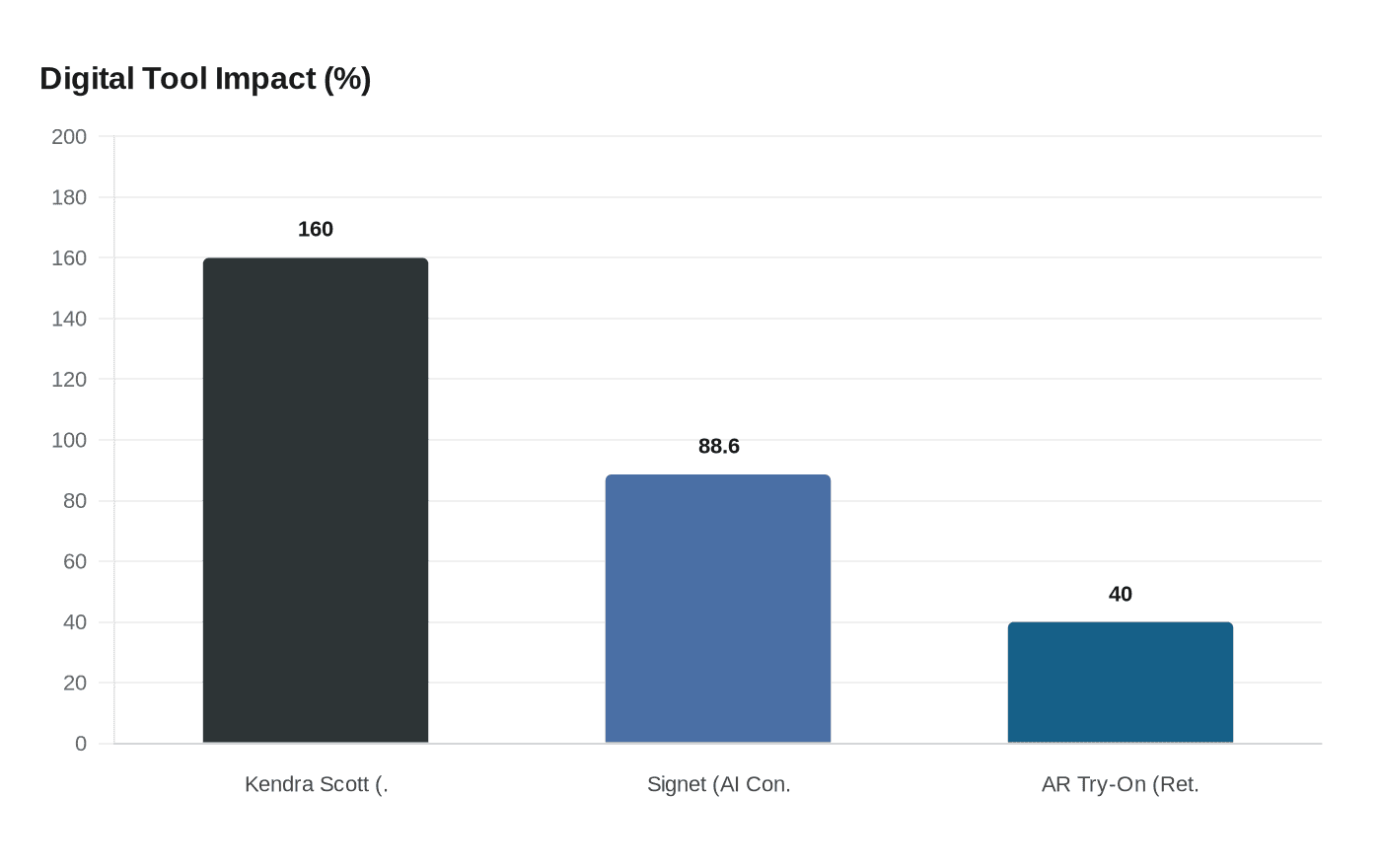
Kendra Scott saw 160% more revenue from AI-powered tools, while Signet achieved an 88.6% conversion uplift — figures that illustrate how decisively this technology has moved from pilot project to core revenue driver.
The mechanism behind these numbers is relatively straightforward. Rather than relying on past purchase data, which is limited when jewelry purchases are infrequent, conversational AI builds a style profile through questions: "Does she prefer minimalist or statement pieces?" "Is this for everyday wear or a special occasion?" "Gold, silver, or rose gold?" This guided-selling approach is particularly powerful for bespoke and personalized pieces, where a customer may arrive with a feeling rather than a specific product in mind.
On the design side, generative CAD tools are compressing the concept-to-prototype timeline. Generative CAD engines such as Autodesk Dreamcatcher and Pencil create multiple weight-optimized variations from a single sketch, while diffusion models like Midjourney accelerate concept art, allowing designers to test stone placements, metal combinations, and structural forms long before any wax is carved. For a custom jeweler, that speed translates directly into faster client approvals and lower revision costs.
AR Try-On: Beyond the Novelty Phase
Augmented reality virtual try-on is no longer a conversion gimmick. For jewelry ecommerce specifically, it has become a foundational tool in the purchase funnel, reducing the uncertainty that makes a customer hesitate before committing to a piece they cannot physically examine. Retailers using virtual try-on solutions have seen a 40% decrease in return rates, especially for expensive items like engagement rings.
The technology's effectiveness depends almost entirely on asset quality. Creating photorealistic 3D models of jewelry pieces demands significant attention to detail, capturing intricate designs, gemstone reflections, and metal finishes accurately. This level of precision directly impacts the customer's virtual try-on experience and their purchasing confidence. A poorly rendered rendering of a diamond solitaire in a prong setting, one where the stone lacks brilliance or the shank looks flat, does more harm than no try-on at all. The investment in high-fidelity 3D modeling is inseparable from the investment in the try-on platform itself.
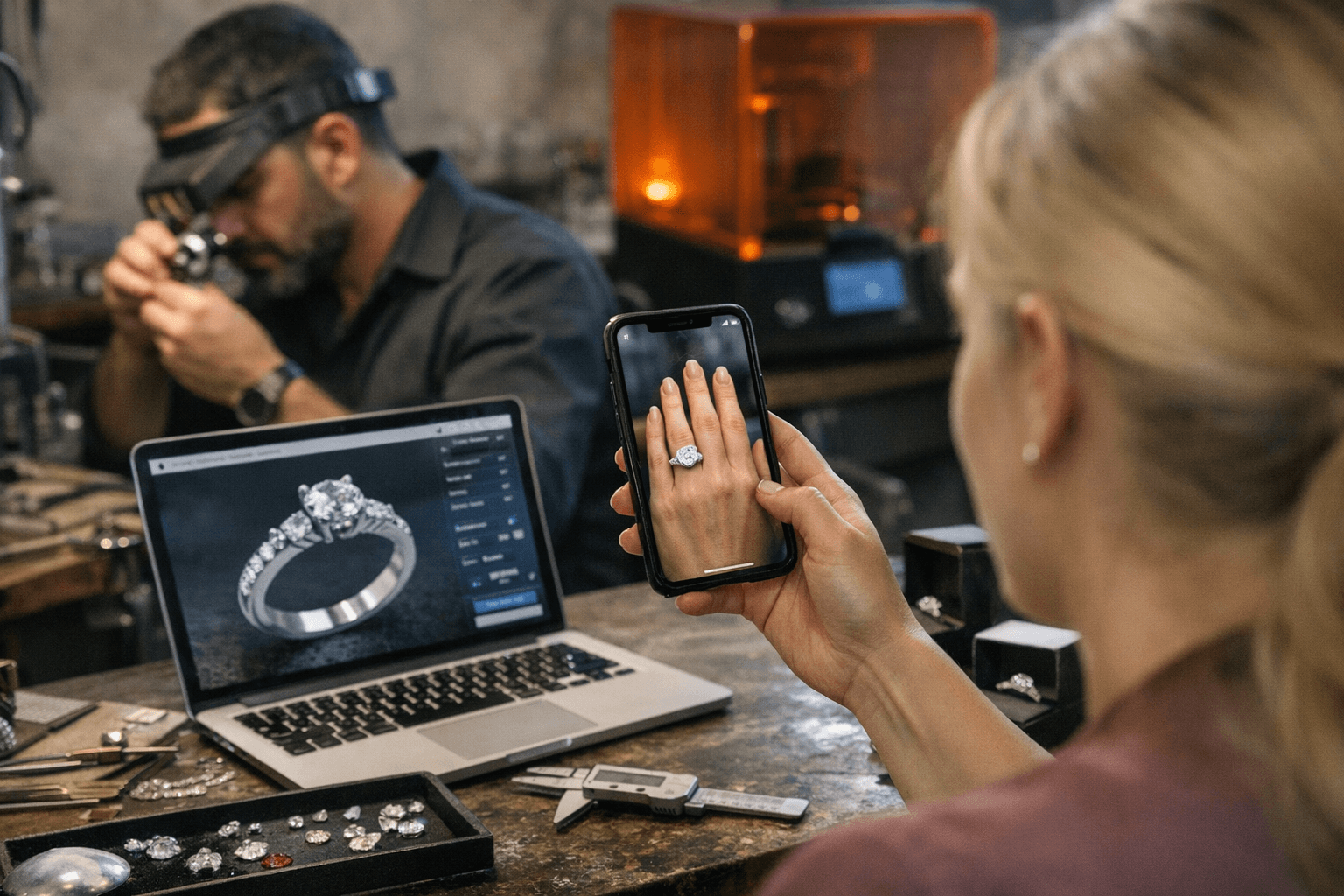
AR technology allows the jewelry to move naturally with the user, maintaining its position as the user changes angles or distances from the camera, providing a much more accurate representation of how the jewelry will look in real life. For rings and earrings, where fit and proportion are everything, that dynamic accuracy is the difference between a tool that converts and one that frustrates.
ERP and PLM: The Infrastructure Behind Custom Scale
The front-end elegance of AI recommendation and AR try-on collapses without operational infrastructure to fulfill what customers choose. This is where ERP and PLM systems do their less visible but indispensable work: tracking raw material inventory, managing job queues across the production floor, and maintaining realistic lead times for custom orders.
Many jewelry transactions aren't simple one-time sales; they involve personalization, engraving, resizing, or repair follow-ups. This is where jewelry ERP systems come into play, integrating not just point-of-sale operations but back-office inventory, customer relationship management, vendor management, and reporting.
The market has recognized this need decisively. The POS software market for jewelry is growing from $1.5 billion in 2023 to a projected $4 billion by 2030. Platforms such as PIRO and Luxare have been built specifically for jewelry's operational complexity: multi-metal inventory tracked by weight and alloy, jobs that move through wax carving, casting, setting, polishing, and quality control before reaching the shipping bench. In 2025, jewelry ERP software has become a must-have for manufacturers, wholesalers, and retailers, integrating everything from supply chain management to customer engagement into one system.
PLM integration takes this further by governing the product lifecycle from initial design through sampling and pre-production. Development schedules can be created to streamline manufacturing processes across different stages, including prototype, sampling, and pre-production, and size charts developed to eliminate guesswork that can lead to costly production errors. For a brand scaling a personalized line, this structure is what separates a sustainable operation from a custom order bottleneck.
Building the In-House Personalization Stack
The practical architecture for a jewelry business entering serious personalization involves four components working in sequence.
The first is the virtual try-on layer. Evaluating vendors on the realism of their 3D rendering engine, compatibility with existing ecommerce platforms, and the quality of their onboarding support for asset creation should come before any other investment. The technology only earns its cost when the digital models are convincing enough to substitute for the in-person experience.
The second is production technology. Fiber-laser engraving has become the standard for high-precision personalization on hard metals, capable of rendering fine text, intricate monograms, and decorative motifs on gold, platinum, and silver without the surface damage associated with mechanical engraving. Fiber laser marking machines are widely used to create high-precision markings on hard metals, and from these materials jewelry laser engravers can create intricate designs on earrings, necklaces, bracelets, rings, and watches. Paired with 3D printing and rapid casting partners, a jeweler can prototype a bespoke piece, present a physical sample for client approval, and move to production without maintaining a full in-house casting operation.
The third component is the AI recommendation and configurator layer, integrated into the product detail pages and checkout flow. The fourth is the ERP backbone that connects customer orders to inventory positions, production schedules, and delivery commitments in real time.
Where to Start: Sequencing the Investment
The sequencing of these investments matters as much as the investments themselves. The practical guidance here is direct: deploy AR try-on before scaling marketing spend on personalized pieces. Driving traffic to a custom jewelry configurator that lacks convincing visualization tools wastes acquisition budget and trains potential customers to distrust the experience.
Equally important is auditing production lead times before promoting custom orders widely. An ERP system's value in this context is its ability to surface honest capacity constraints before a customer commits. A handcrafted bespoke piece set in a cathedral prong setting or a hand-engraved signet ring carries an implicit promise of care and time. The worst outcome in custom jewelry is not a delayed order; it is a delayed order that was never flagged as a risk.
The jewelry e-commerce landscape is undergoing a significant change, and the brands positioned to benefit are those treating digital infrastructure as craft, worthy of the same precision and intention they apply to the pieces themselves. The tools exist. The conversion data is compelling. What separates the businesses that grow from those that stall is the discipline to build the back end before they sell the front.
This article was produced by Prism’s automated news system from verified source data, official records, and press releases, then run through automated quality and moderation checks before publishing. The system is built and supervised by the people who set the standards it runs under. Read our full AI policy.
Know something we missed? Have a correction or additional information?
Submit a Tip