Prince Philip’s custom jewels for Queen Elizabeth become heirlooms
Initials, flowers, and family stones can turn a jewel into a private archive. Prince Philip’s gifts to Queen Elizabeth II show how symbolism makes an heirloom.
The personalization cues that last
The most memorable custom jewels begin with a clue, not a carat weight. An initial tucked into a clasp, a flower drawn from a title or family name, a stone lifted from one jewel and reborn in another, these are the details that make a piece feel inseparable from the person who wears it.
If you are commissioning something for an anniversary, a milestone birthday, or a redesign of a family jewel, start there:
- Use initials as a design device, not a monogram alone. Interlocking letters can feel more intimate than a name spelled out in full.
- Choose a flower with a private meaning. A rose, lily, or blossom tied to a title, place, or memory gives a jewel a second layer of language.
- Borrow from family history. A stone from an older piece, or a motif linked to a parent or spouse, can give a new jewel emotional depth without sacrificing freshness.
- Add one symbol that only the two of you would recognize. A badge, a heraldic reference, or a shared national emblem can make a jewel read like a coded message.
Prince Philip understood that formula instinctively. His gifts to Queen Elizabeth II were never generic tokens of affection. They were designed as small biographies, each one carrying a reference to their marriage, their families, or the titles that shaped her public life. That is why these pieces still read less like royal trophies than as some of the most persuasive examples of personalized jewelry ever made.
A bracelet that speaks in symbols
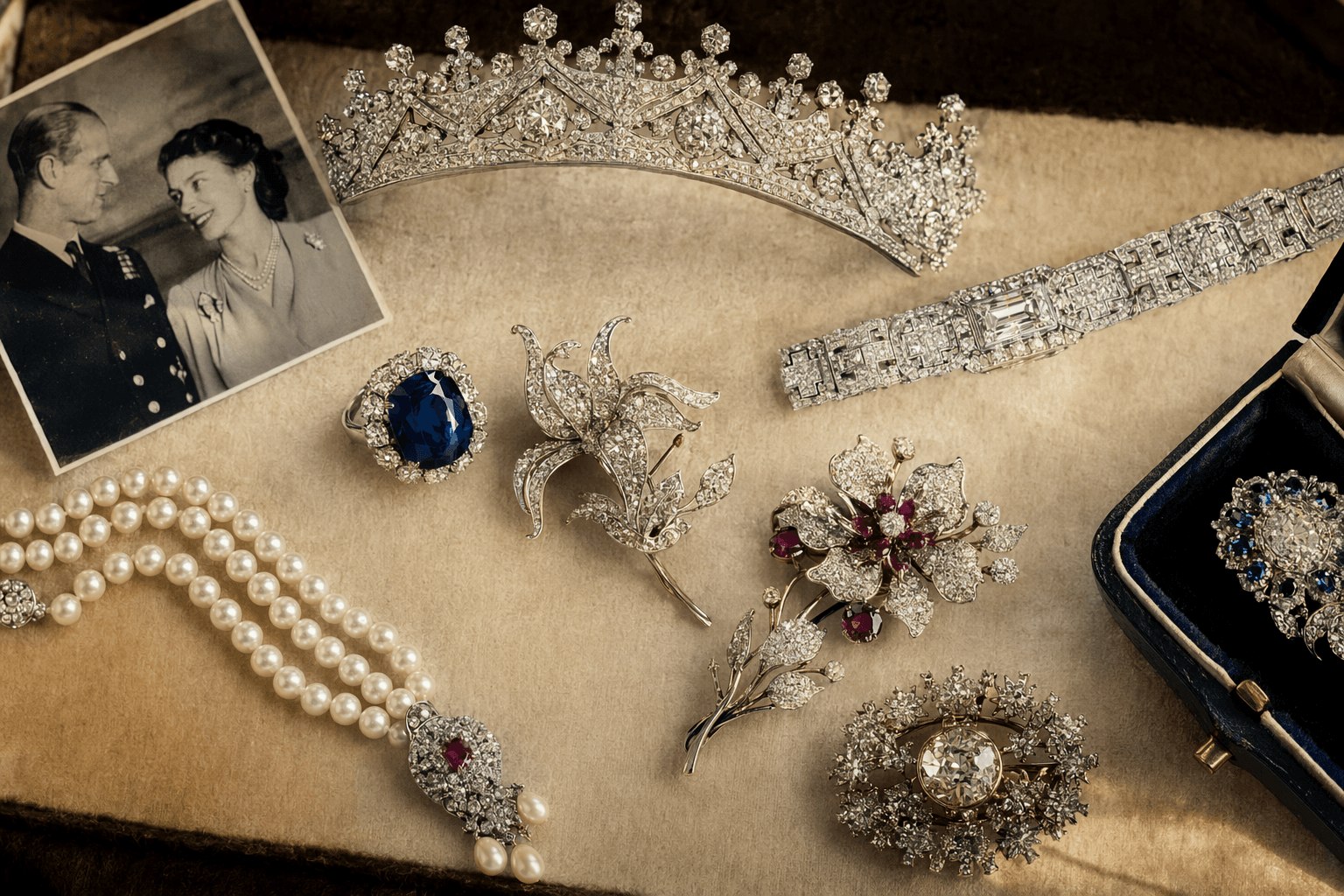
The strongest example is the Fifth Wedding Anniversary Bracelet, designed by Prince Philip and executed by Boucheron in gold, diamonds, sapphires, and rubies for November 1952, shortly after Elizabeth became queen. The bracelet was not simply pretty. It was densely coded, built around interlocking “E” and “P” initials, Greek crosses in the colors of Greece and England, Philip’s naval badge, and York roses that referred to Elizabeth’s title as Princess Elizabeth of York.
That layering is what makes the design feel so modern. A commissioned jewel becomes far more compelling when it carries several truths at once: romance, history, identity, and place. Here, the initials anchor the intimacy, while the heraldic and national symbols widen the story into family and country. The York roses are especially elegant as a choice, because they turn a formal title into a floral motif, the sort of transformation that gives bespoke jewelry its poetry.
The bracelet was worn publicly only rarely, which only deepened its mystique. Elizabeth wore it at Royal Ascot in June 1954, when her horses won two races, and again at a black-tie dinner at Clarence House on November 18, 2007, ahead of the couple’s 60th wedding anniversary. A jewel like this does not need constant visibility to matter. In fact, restraint often makes a personal piece feel even more treasured, as though it is reserved for moments that already carry weight.
When one motif becomes unforgettable
Philip’s Scarab brooch, given in 1966 after he admired Andrew Grima’s work, shows how a single motif can carry a remarkable amount of meaning. The brooch featured a carved ruby center meant to resemble an Egyptian scarab, a form associated with renewal and protection, and it gave Elizabeth a different kind of signature: less heraldic, more sculptural.
This is the lesson for modern commissions. A personal jewel does not need to be literal to feel specific. Sometimes the strongest design is a symbolic shape rendered with precision, because it leaves room for interpretation while still feeling unmistakably chosen. The carved ruby center gives the Scarab brooch its pulse, while the form itself reads as both ancient and contemporary, a rare balance that helps explain why it remained so visible in Elizabeth’s wardrobe.
She wore it at some of the most watched moments of her later life, including her Golden Jubilee tour in Falmouth in 2002, her Christmas message in December 2007, a state visit to Slovenia in 2008, her platinum anniversary portrait in 2017, and Philip’s memorial in 2022. Those appearances matter because they show how a personal jewel can become a visual shorthand for continuity. The same piece can carry memory across decades and still look purposeful in photographs, which is exactly what heirloom jewelry should do.
A broader family language of jewels
Philip’s custom gifts did not begin with the bracelet or the scarab. In 1947, he gave Elizabeth her diamond engagement ring, and her wedding bracelet was made by Philip Antrobus using stones from a tiara belonging to Princess Alice of Battenberg. Those gifts reveal a pattern that is especially instructive for anyone planning a redesign today: meaningful jewelry often works best when it connects several generations at once.
Using stones from Princess Alice of Battenberg’s tiara transformed inherited material into something newly intimate. That is the quiet genius of heirloom redesign. The old stones are not merely preserved; they are reinterpreted so that family history remains visible, but no longer feels locked in time. For a modern client, this could mean resetting diamonds from a grandmother’s brooch into a pendant, or using rubies from a bracelet in a ring that marks a wedding anniversary.
There is also something deeply useful in the way Philip’s gifts tied into Elizabeth’s titles and public role. The bracelets and brooches did not float free of biography. They acknowledged Princess Elizabeth of York, Philip’s Greek and naval identity, and the couple’s shared history. That is what makes personalized jewelry feel expensive in the best sense of the word: not merely costly, but considered.
How to translate the idea into a modern commission
The most successful custom jewelry commissions today tend to work the same way. They begin with one private fact, then build outward with disciplined restraint. If you are planning a piece for an anniversary or milestone gift, think in layers rather than in a single motif.
- One initial or monogram that signals the relationship
- One flower or emblem tied to a name, place, or title
- One colored stone that reflects a birth month, anniversary, or shared memory
- One inherited element, even if it is only a single diamond or a fragment of an older setting
A strong commission might combine:
That approach creates jewelry with narrative depth and wearability. The piece should still sit comfortably against the body, light enough for daily use if desired, but rich enough to feel ceremonial when it is worn for special occasions. Boucheron’s bracelet does this through its balanced composition, while the Scarab brooch does it through a stronger sculptural silhouette. Different forms, same principle: a jewel becomes unforgettable when it holds a relationship in plain sight.
Philip’s gifts endure because they never tried to be universal. They were specific, intimate, and exacting, and those qualities are what allow a jewel to travel from romance into inheritance. The best personalized jewelry does not merely commemorate a moment. It preserves the language of a relationship long after the occasion has passed.
Know something we missed? Have a correction or additional information?
Submit a Tip