Print on Demand Jewelry — How to Sell Custom Jewelry Online Without Inventory
A custom engraved necklace costs $10-15 to produce and retails for $40-65 — here's the full POD jewelry playbook to launch your first five listings this weekend.
A custom engraved necklace costs $10 to $15 to produce and routinely sells for $40 to $65. That $25 to $50 margin per sale is territory most print-on-demand apparel sellers will never see. The jewelry category is still comparatively uncrowded, and the buyers are uncommonly motivated: someone ordering a personalized piece is making an emotional purchase, an anniversary gift, a memorial necklace, a "just because" gesture that demands to be right. That emotional stakes, combined with the no-inventory economics of print-on-demand production, makes custom jewelry one of the most compelling categories for first-time online sellers. What follows is the full operational playbook, from choosing your first SKUs to writing your Etsy title tags.
Why POD beats handmade for your first jewelry business
Handmade jewelry carries real romance, but it also carries real risk: upfront materials costs, production bottlenecks during peak seasons, and a hard ceiling on how many SKUs you can realistically manage. Print-on-demand inverts that equation. You design the product once, list it, and a fulfillment partner handles engraving, packaging, and shipping every time an order comes in. Cash flow stays positive from the first sale because there is no inventory to fund. SKU breadth, which a handmade seller might cap at a dozen items, can expand to hundreds of variations without any additional warehouse cost. Speed matters especially at gifting peaks: Mother's Day, Valentine's Day, and the winter holiday window can double or triple order volumes overnight, and a POD partner absorbs that surge without requiring you to hire temporary labor or pre-order stock. The trade-off is less control over physical quality, which is why supplier selection and mandatory sample-ordering are non-negotiable steps before your first listing goes live.
Picking products that feel premium when personalized
Not every jewelry category translates well to POD. The strongest performers share a common trait: the personalization is the product. The customer is not buying a generic necklace with text added; they are buying a message made physical.
Three product types consistently convert at the highest rates:
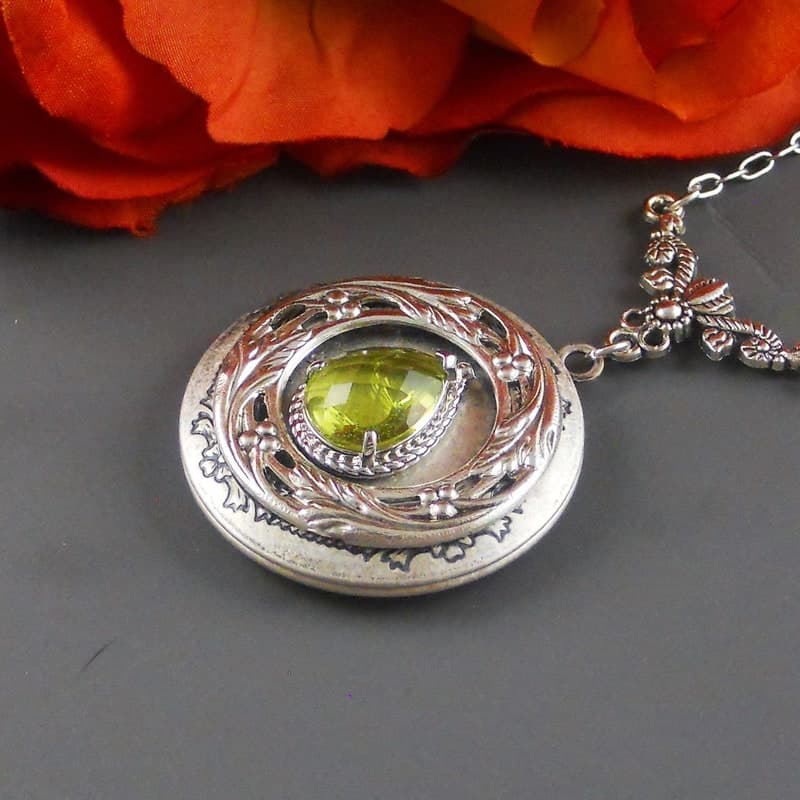
- Engraved bar necklaces: A clean horizontal or vertical bar with a name, date, or coordinate set stamped into it. Simple geometry means the engraving reads clearly. Base blanks in stainless steel (often gold-plated or rose-gold-plated over a steel core) hold engraving lines sharply and resist tarnishing better than brass-base alternatives.
- Photo lockets and photo pendants: A customer uploads an image, and the supplier prints or laser-etches it onto a pendant face. These require strict photo-quality guidelines on your intake form: minimum 300 DPI, square crop, high contrast. Blurry submissions produce blurry pendants, and the result lands at your door as a refund request.
- Name rings and initial stackers: Thin band rings with engraved names or initials, often sold as stackable sets. The personalization input is simple (a name, a font choice), and the gifting context is obvious, making them strong performers for couples and bridesmaid markets.
Avoid POD categories where the personalization is secondary to complex setting work (pavé halos, prong-set stones) because the base blank quality and stone calibration required exceed what most POD partners offer at accessible price points.
Choosing your supplier: ShineOn, Printify, and Printful compared
ShineOn is the category specialist and the starting point for most serious POD jewelry sellers. Its catalog is built specifically around jewelry and message-led gifts, including engraved necklaces, engraved watches, and photo-printed pendants, all shipped from U.S. facilities. Its Shopify app integrates directly with your storefront, and the platform's mockup generator produces the lifestyle previews you need for product pages. Sellers report silver pendant necklaces moving at up to $59.99 with net profit exceeding $50 before advertising costs, with engraving add-ons generating an additional $7.50 per sale on average.
Printify connects you to a global network of print providers, and while its jewelry selection is narrower than its apparel catalog, it does offer customizable jewelry boxes and engraving options through select partners. The limitation is consistency: because Printify routes orders to whichever partner has capacity, quality control requires vetting your specific chosen print provider carefully before committing to a supplier relationship.
Printful is the dominant name in general POD but operates with meaningful constraints in jewelry specifically. Its core strength is apparel and wall art; jewelry options are limited in scope, and engraving capabilities are not a core offering. For sellers building primarily around personalized jewelry, Printful is better understood as a secondary partner for non-jewelry SKUs than as a jewelry fulfillment backbone.
The sample-order QA checklist before you list anything
Going live without holding the physical product is the most common mistake first-time POD jewelry sellers make. Before publishing any listing, order at least two samples of every SKU: one with a simple text personalization and one with the most complex input your form will allow (a long name, a mix of uppercase and lowercase, a special character if your form permits it).
Evaluate each sample against these benchmarks:
- Engraving depth and line clarity: text should be legible at arm's length without magnification
- Plating consistency: no bare patches, consistent color saturation across the surface
- Clasp and chain integrity: pull-test the clasp; check that chain links are fully closed
- Packaging: does the box or pouch arrive presentable, or does it look like a fulfillment afterthought?
- Turnaround accuracy: compare the actual ship date against the supplier's stated production window
If a sample fails any of these, resolve it at the supplier level before a paying customer sees the result.
Building a personalization input form that reduces errors
Every engraved or photo-based listing needs a structured input form, not an open text field. Ambiguous instructions produce costly reprints. A well-built form specifies exactly what you need:
- Character limit per line (e.g., "up to 20 characters per line, two lines maximum")
- Case formatting instructions ("enter text exactly as you want it engraved, including capitalization")
- Date format preference ("MM/DD/YYYY or written out, e.g., June 14, 2024")
- Photo specifications for photo pendants ("minimum 300 DPI, face centered, high contrast; avoid heavy filters")
On Etsy, this information lives in the "personalization" field of your listing. On Shopify, use a custom product option app (Infinite Options and Bold Product Options are both widely used) to build conditional fields that only appear for relevant variants. The cleaner your intake, the fewer customer service messages you will field about whether their submission was received correctly.
Pricing math, reprints, and the returns problem
The standard pricing model for a custom engraved necklace positions production cost ($10 to $15) against a retail price of $40 to $65. That spread covers platform fees (Etsy charges a 6.5% transaction fee plus a $0.20 listing fee; Shopify's transaction fee depends on your payment plan), return shipping on defective orders, and occasional reprints for input errors.
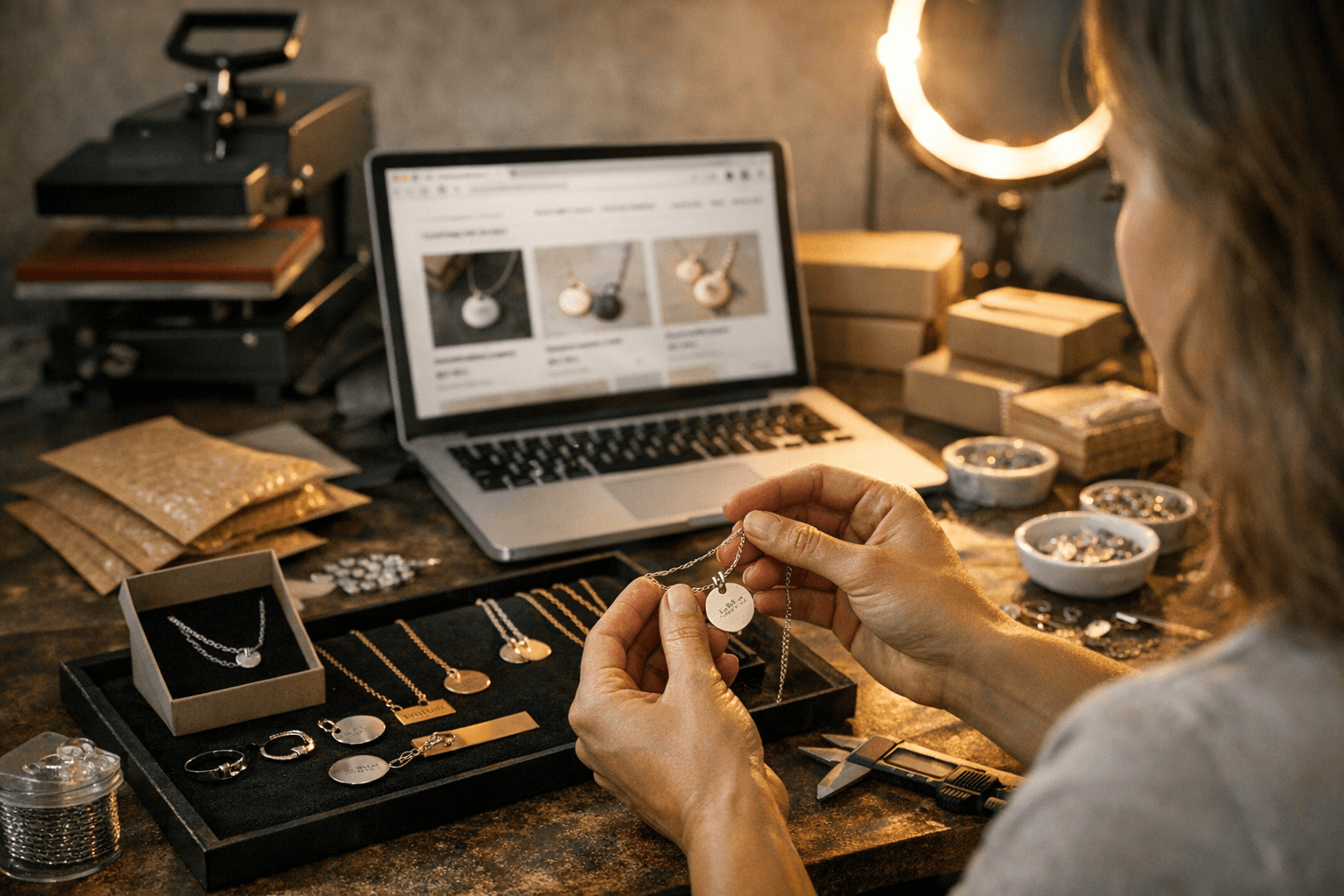
Reprints are the line item most first-time sellers underestimate. If a customer submits garbled text and the piece is produced correctly but unusably, who absorbs the reprint cost? Build a clear policy: reprints caused by customer input errors are charged at cost; reprints caused by production defects ship free. State this plainly in your shop policies.
Returns for engraved and personalized pieces are legally permissible to refuse under most consumer protection frameworks because the item cannot be restocked. Communicate this before purchase, not after. A clearly worded pre-purchase notice ("Because this piece is made specifically for you, we cannot accept returns unless the item arrives defective") dramatically reduces disputes.
Budget approximately 3 to 5 percent of revenue for reprints, defective replacements, and goodwill resolutions. This is not a flaw in the model; it is a normal operational cost, and the margins in personalized jewelry absorb it without threatening profitability.
Turnaround-time promises: what to tell customers
Most specialized POD jewelry partners operate on a production window of 2 to 7 business days before the item ships. ShineOn's U.S.-based fulfillment typically lands at the faster end of that range. Domestic shipping adds 2 to 5 days; international shipping adds considerably more.
Your listed turnaround promise should reflect the realistic total, not the optimistic minimum. If your supplier's production window is 3 to 5 business days and domestic shipping averages 3 days, promise 7 to 10 business days from order to delivery. Then communicate proactively: an automated order confirmation that sets the expectation clearly, and a shipping confirmation with a tracking link, will cut "where is my order?" messages by a significant margin.
For holiday seasons, add buffer. Mother's Day and Valentine's Day compress order windows dramatically. Publish seasonal order-by dates prominently on your product pages at least three weeks before the holiday.
Writing a product page that converts
Personalized jewelry sells on emotion, not specification. A product page that leads with "316L stainless steel, 18-inch chain, lobster clasp" will underperform against one that leads with the feeling the piece creates. Write your headline and opening paragraph from the recipient's perspective: what does it mean to receive this necklace?
The practical specifications (metal type, chain length, pendant dimensions, plating) belong in a dedicated details section below the fold, not in the opening copy. Occasion tagging, "perfect for Mother's Day," "a meaningful gift for a new grandmother," "celebrate her graduation," functions both as emotional framing and as keyword anchor text for Etsy search.
Every product page needs a visualization: a mockup or lifestyle photo showing the piece worn or held, not floating on a white background. ShineOn's mockup generator produces lifestyle images suitable for product pages and social ads. For photo pendants, include an example showing the finished product with a sample image so customers understand what the output actually looks like.
Where to sell: Shopify vs. Etsy
Both platforms work for POD jewelry, but they work differently.
Etsy delivers organic traffic through its internal search engine, where "personalized necklace," "engraved name necklace," "custom photo pendant," and "initial ring" are among the highest-volume jewelry search terms. A well-optimized Etsy listing with all 13 tags filled, keyword-rich titles, and complete attribute fields can generate sales without paid advertising. The trade-off is Etsy's fee structure and its control over your customer relationship.
Shopify gives you full ownership of the customer, the email list, and the brand experience, but traffic is your responsibility. A Shopify store paired with Meta or Pinterest advertising, particularly gift-occasion campaigns running four to six weeks ahead of major holidays, gives you the highest ceiling for revenue but requires meaningful upfront ad spend to generate momentum.
The practical first-mover strategy: launch on Etsy to validate the product and gather initial reviews, then build a Shopify storefront as your brand gains traction. Etsy reviews are social proof; your Shopify store is the brand home where repeat buyers return.
Etsy and Shopify SEO title templates
For Etsy, your title should front-load your primary keyword and include the occasion and material: "Personalized Bar Necklace, Custom Name Necklace in Gold, Mother's Day Gift for Her, Engraved Jewelry." Use all 13 available tags, mixing high-volume terms ("personalized necklace," "custom jewelry," "name necklace") with long-tail specifics ("gift for new mom," "engraved bar pendant," "custom coordinate necklace").
For Shopify, your product page title for SEO purposes should follow a similar structure and your meta description should include a direct consumer benefit: "Custom-engraved with any name, date, or message, shipped in 7 to 10 business days."
Marketing that works: occasion cadence and gift positioning
Personalized jewelry is a gift category first. Position every product around the giver, not the wearer. Your ad copy, your email subject lines, and your product page headlines should speak to the person making the purchase decision: "Give her something no one else has." "The gift she'll wear every day." Gift-message copy framing outperforms lifestyle framing consistently in this category because it addresses the buyer's actual motivation.
Run occasion-specific campaigns on a calendar: Valentine's Day (campaigns start in mid-January), Mother's Day (campaigns start in early April), and the winter holiday window (campaigns start in late October for guaranteed delivery positioning). Between peak seasons, lean on evergreen gifting occasions: birthdays, anniversaries, graduations. A catalog built around five to seven core SKUs with clear occasion tags can generate consistent daily revenue from organic Etsy traffic alone, with paid campaigns layered on for seasonal amplification.
The sellers who build durable businesses in this category are not the ones who chase trends in shapes and stones. They are the ones who understand that a name, a date, and a message etched into metal carries a weight that no apparel print-on-demand product can match, and who build every touchpoint, from the input form to the packaging to the post-purchase email, around honoring that weight.
This article was produced by Prism’s automated news system from verified source data, official records, and press releases, then run through automated quality and moderation checks before publishing. The system is built and supervised by the people who set the standards it runs under. Read our full AI policy.
Did this article answer your question?