Cartier’s gold moon-landing tribute, a hidden microfilm history
Cartier turned Apollo 11 into a gold archive: tiny LEM replicas, a subscriber microfilm, and a plaque for Le Figaro’s readers hidden inside the tribute.

Hold one of Cartier’s Lunar Excursion Module replicas and it feels less like a souvenir than a sealed archive in precious metal. About 15 centimeters tall, with a yellow-gold body, white-gold landing gear, and a microfilm hidden inside, the piece turns the moon landing into a collectible object with an unusually intimate paper trail.
A moon landing translated into luxury
Cartier’s tribute was commissioned by Le Figaro and presented to Neil Armstrong, Edwin “Buzz” Aldrin, and Michael Collins during the astronauts’ Paris stop in October 1969. That visit fell on October 8, the eighth stop on the trio’s 38-day, 24-country “Giantstep” goodwill tour, which ran from late September to early November 1969. The setting matters: this was not a retail release or a commemorative trinket, but a diplomatic gift made at the moment Apollo 11 had become a global event.
The symbolism is unusually sharp. Apollo 11 fulfilled President John F. Kennedy’s May 25, 1961 goal of a crewed lunar landing and safe return, so the mission already carried the weight of national ambition. Cartier and Le Figaro recast that achievement through French craftsmanship and French civic pride, turning a feat of engineering into an object of display, memory, and authorship.
Why the materials matter
The replicas were not made as simple desk ornaments. Their yellow-gold bodies were fashioned by artisans who specialized in boxes and cases, including makeup and cigarette cases, which places the project squarely in the tradition of Cartier’s object-making as much as its jewelry. That craft lineage matters because the models behave more like miniature objets d’art than conventional jewels: rigid, luminous, and built to be seen from every angle.
The landing gear was formed in white gold by Cartier’s jewelry atelier, a practical choice as much as an aesthetic one. White gold gave the legs added sturdiness, which makes the structure feel engineered rather than merely decorative. The contrast between yellow and white gold also sharpens the silhouette, reinforcing the Lunar Excursion Module’s spindly, futuristic profile while keeping the entire piece unmistakably Cartier.
For collectors, that material split is part of the fascination. The object sits at the intersection of two disciplines: the box-maker’s precision in the body and the jeweler’s technical control in the supports. It is a reminder that late-1960s luxury was not only about sparkle, but about turning modern forms into durable, precious artifacts.
The hidden archive inside the gold
The most remarkable detail is invisible at first glance. Inside each model sat a microfilm listing the subscribers who helped underwrite the project after the astronauts safely returned to Earth. On the outside, a plaque carried a dedication from “the readers of Le Figaro.” That combination of hidden names and public tribute gives the piece a social life that most luxury objects do not have.
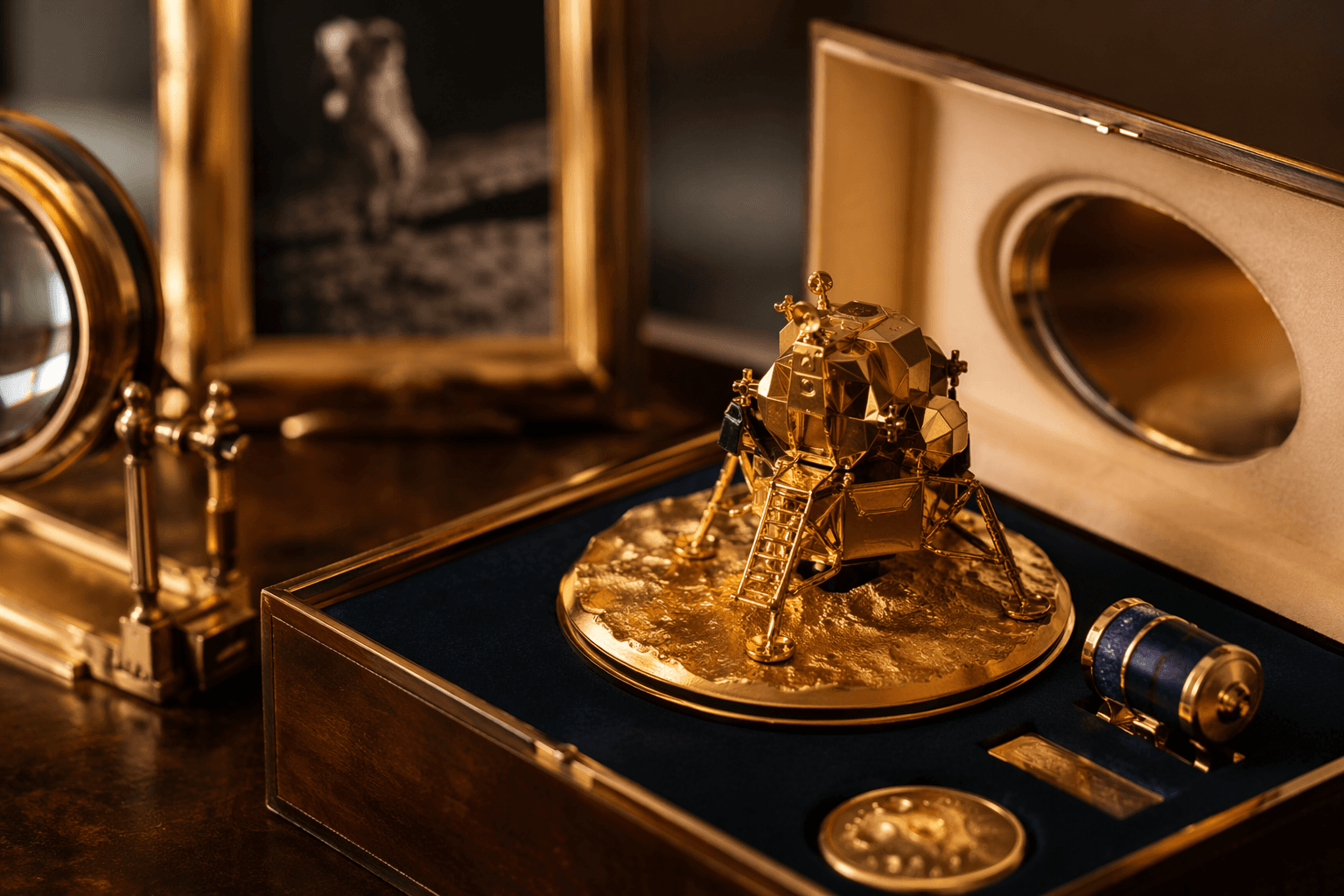
This is where the tribute becomes more than commemoration. The microfilm turns the model into a record of collective participation, not just elite patronage. It is a jewel-box version of public memory, where the donors are preserved inside the object itself and the dedication is carried on its surface. For a vintage collector, that kind of embedded provenance is far more compelling than a simple presentation case.
What collectors should look for
Unusual Cartier one-offs from the space-race era reward close inspection. The most important questions are not only who made the piece, but who commissioned it, who received it, and what survives with it today.
- A clear link to Le Figaro’s commission and the Apollo 11 presentation in Paris
- The original plaque with its dedication from the readers of Le Figaro
- The microfilm, or at minimum evidence that it was originally present inside the model
- Integrity of the two-tone construction, especially the yellow-gold body and white-gold landing gear
- Documentary history connecting the object to one of the three astronauts
- Auction and exhibition history, which can strengthen the provenance chain
Look for:
That last point matters because one of the three models, the version given to Michael Collins, was acquired by Cartier at auction in 2003. It later appeared in a Comité Colbert exhibition at The Shed in New York, a trajectory that moved it from diplomatic gift to collectible and then to museum-style exhibit. When a Cartier one-off travels that far through institutional and market history, it becomes easier to evaluate as a serious object, not just a curiosity.
What the tribute reveals about late-1960s commemorative luxury
This Cartier model captures a moment when luxury houses were willing to think like publishers, patrons, and chroniclers. Instead of producing a standard commemorative medal, the brand and newspaper created a miniature spacecraft in precious metal, complete with a hidden roster of supporters. The result feels deeply of its era: confident in modernity, fascinated by technology, and still committed to hand-finished craft.
That is why the piece reads so well today. It is not just about Apollo 11, and it is not simply a moon-landing memento. It is a rare example of Cartier translating the Space Age into an object with material nuance, symbolic density, and documented rarity, which is exactly what makes unusual Cartier one-offs so collectible now. The tiny LEMs show that the best commemorative luxury does more than celebrate history, it stores it.
This article was produced by Prism’s automated news system from verified source data, official records, and press releases, then run through automated quality and moderation checks before publishing. The system is built and supervised by the people who set the standards it runs under. Read our full AI policy.
Know something we missed? Have a correction or additional information?
Submit a Tip